Players learning action-heavy support roles
If you repeatedly use abilities, items, targeting actions or modifiers, a thumb-button grid offers a way to group those bindings. Plan only as many as you can reach and distinguish with your usual grip.


Choose a dense MMO thumb grid if your support-role practice calls for many actions under one thumb and you can press its buttons distinctly. An adjustable layout is worth considering if reach or game genre changes; a lighter mouse with fewer controls makes more sense when you need only a smaller set of extra bindings. Check grip fit and software compatibility before treating any button count as usable capacity.
If you repeatedly use abilities, items, targeting actions or modifiers, a thumb-button grid offers a way to group those bindings. Plan only as many as you can reach and distinguish with your usual grip.
If your games call for different numbers of bindings, consider a changeable side layout or a mouse with fewer, more spaced controls. Decide which commands genuinely need to leave the keyboard.
If cable-free desk placement matters to you, compare connection modes and how each mouse is powered. Wireless convenience also means planning for charging or battery replacement.
Start with the actions you want to bind, then choose a layout your thumb can use reliably. Treat connection type and weight as separate decisions: either can matter without determining how many side controls you need.
Consider it when: You want a concentrated set of thumb-accessible support actions.
Trade-off: A full grid takes practice to distinguish, and its reach depends on your hand and grip.
Consider it when: You need to reposition side controls or change layouts between games.
Trade-off: Check what the adjustment actually changes; it does not remove the need to set up and learn your bindings.
Consider it when: You need a smaller set of remaps and give weight more priority than a full thumb grid.
Trade-off: More support actions may have to remain on the keyboard.
| Concern | What to check | Who it matters to |
|---|---|---|
| Action access | Count the thumb-side controls you could use distinctly, not just all programmable controls. Check remapping support for the exact model. | If I regularly need abilities, targeting commands and items while keeping my keyboard hand on movement keys, I want those actions within reliable reach. Around 33% of consumers put dense action access first. |
| Thumb reach and grip | Compare the side-button position with your grip and hand reach; look for an adjustable layout if a fixed grid feels awkward. | During longer practice, I would rather reach each intended control accurately than add buttons I might mis-press. Approximately 27% of consumers make reach and grip their primary concern. |
| Wireless use | Check the exact connection modes, power source and any conditions attached to quoted battery life. | For a cable-free desk, I am willing to manage charging or batteries if the connection suits my setup. Roughly 20% of consumers place wireless convenience first. |
| Weight and mixed-game use | Compare stated weights for the exact variants, then make sure the available controls still cover your intended bindings. | When I switch between support practice and other games, I may prefer a lower stated weight to a full thumb grid. Around 20% of consumers prioritise that balance. |
Programmable controls can include buttons beyond the thumb panel. A high total will not help if you cannot reach or identify the controls you intend to use; Razer describes its Naga line as aimed at medium-to-large hands and palm or claw grips.
Write down your planned actions and check the positions you would use most. If a fixed grid is hard to reach, consider adjustable placement or another layout.
Wireless battery figures from Razer and SteelSeries refer to particular models and stated conditions. Your connection mode and settings may differ.
Check the power source, connection mode and conditions for the exact variant. Compare a wired mouse if avoiding battery interruptions matters more than cable freedom.
Depending on the model, ownership also involves charging time or replacement batteries.
A suffix or variant can change connectivity, the side-button layout or what comes in the box. Those differences matter when you have a specific binding plan.
Before ordering, confirm the complete model name, wired or wireless configuration, supplied accessories and control layout on the product page.
These brand lines illustrate different control layouts; assess the individual model rather than assuming every mouse from a brand works the same way.
Razer’s Naga line focuses on MMO thumb grids. The Naga V3 Pro has swappable side plates for changing the control layout between games.
Corsair’s wired Scimitar RGB Elite pairs a 12-button side panel with a Key Slider system for repositioning the side controls.
The wired G502 X uses a dispersed multi-control layout rather than a full MMO thumb grid. Logitech G lists the model at 89 g.
SteelSeries offers the MMO/MOBA-oriented Aerox 9 Wireless and the lower-button Aerox 5 Wireless for different binding plans.
These mice offer different starting points for support-role bindings: a wireless model with a larger stated command set, a lighter multi-button option and a mouse for a smaller set of actions. Check each control layout and the remapping software against your own setup.
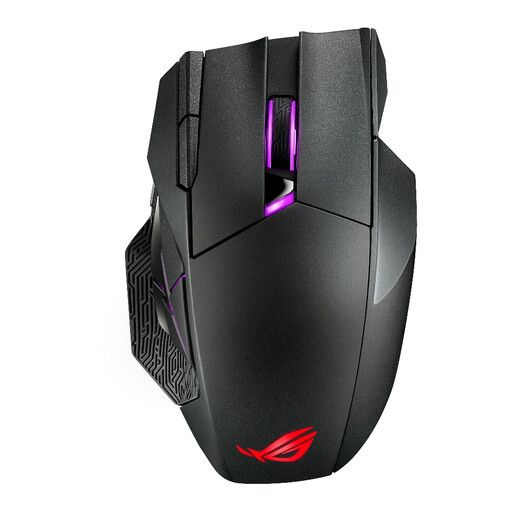 No image available
Consider this mouse if your support-role plan calls for several mapped actions and you want wireless use. Check the side-control positions against your thumb reach and confirm that its remapping software works with your operating system and game setup.
 No image available
Consider this option if you want several remappable support actions without choosing a full MMO grid. Its product name states 10 programmable buttons and a weight of 53 g; check how many controls are within thumb reach. The quoted battery figure has conditions, including a driver update for low-power mode.
 No image available
Consider this mouse if you need a smaller group of support-role actions and want a choice of connection modes. Its product name specifies Bluetooth, 2.4G and USB-C. Confirm which controls can be remapped and where they sit; check the exact variant’s weight if it will affect your decision.
No: choose a 12-button grid when your binding plan needs that many thumb-accessible actions and you can press them distinctly. Razer and Corsair describe MMO/MOBA mice with 12-button side layouts; if you need only a few extra commands, check a less crowded multi-button layout instead.
Start with a small, stable group of actions you need while keeping your keyboard hand on core keys. Confirm that the exact mouse and its software support the remaps and game profiles you intend to use; Logitech G’s G HUB guidance describes these functions for supported devices.
No: wireless changes desk setup and power management, not whether a side-button layout suits your bindings. Compare the connection modes you need with the charging or battery work you are willing to take on; a wired mouse remains an option if you want to avoid that work.
Check that the listing identifies the exact model and provides appropriate compliance information. The Office for Product Safety & Standards describes the Radio Equipment Regulations 2017 as covering the safety and electromagnetic compatibility of radio equipment in Great Britain. Northern Ireland has a distinct framework, so check the guidance applicable there rather than extending the Great Britain position to it.