What matters when choosing
Decide whether image presentation or switching between game types drives your display choice. Treat console compatibility and headphone routing as separate checks: either display route still needs to work with your intended connections.
31.5- or 32-inch 4K OLED
Choose it when: Cinematic 4K play and dark-scene presentation matter most, and you have room for a larger screen.
Allow for: Model-specific panel-care and warranty terms; a stated 240 Hz refresh rate does not mean every connected system or game will produce 4K at 240 Hz.
27-inch dual-resolution IPS
Choose it when: You regularly switch from cinematic 4K games to faster games and prefer a smaller screen.
Allow for: A different HDR and black-level proposition from an OLED model with DisplayHDR True Black certification; compare the exact certifications rather than refresh rates alone.
| Concern |
What to check |
Who this matters to |
| HDR and dark scenes |
Check the exact VESA DisplayHDR or DisplayHDR True Black tier and whether the screen is 4K at your preferred size. |
If shadow detail and bright highlights shape the adventures I play, I want more than a generic HDR label; around 36% of consumers put this image-presentation need first. |
| Console output |
Confirm 4K at 120 Hz and VRR support on the HDMI port you will use, alongside a suitable cable. |
I do not want my PS5 or Xbox Series X setup to lose the output mode I chose the monitor for; roughly 29% of consumers primarily care about console-signal compatibility. |
| Headphone routing |
Decide whether headphones will connect to the source, a monitor output or separate eARC-compatible equipment. |
When I play with headphones, I need to know where they will plug in before choosing a monitor; about 14% of consumers place that connection need first. |
| Mixed games and desk fit |
Compare screen size and the resolution and refresh rate available in each operating mode. |
If I move between story-led games and faster matches, one screen needs to suit both my games and my desk; around 21% of consumers prioritise that flexibility. |
Joybuy monitors for these setups
These monitors offer larger-screen OLED choices alongside a smaller dual-mode IPS option for players who also switch game types. Compare their exact HDR certification, console input modes and headphone connections against your own setup before choosing.
 No image available
Samsung Odyssey OLED LS32FG810SUXXU, 32-inch
Consider this larger OLED monitor if screen size is central to your cinematic setup.
Before choosing it for HDR, console play or headphones plugged into the monitor, confirm the exact certification, HDMI output modes and audio connection you need.
View on Joybuy
 No image available
Dahua 32-inch curved 4K 165 Hz OLED monitor
This curved 4K OLED format may appeal if you want a larger screen for story-led games; the product title specifies 3840 × 2160 resolution and 165 Hz.
Check the exact VESA HDR certification rather than treating its HDR400 wording as proof of a tier. Confirm console HDMI modes and whether its audio-out connection suits your headphones.
View on Joybuy
 No image available
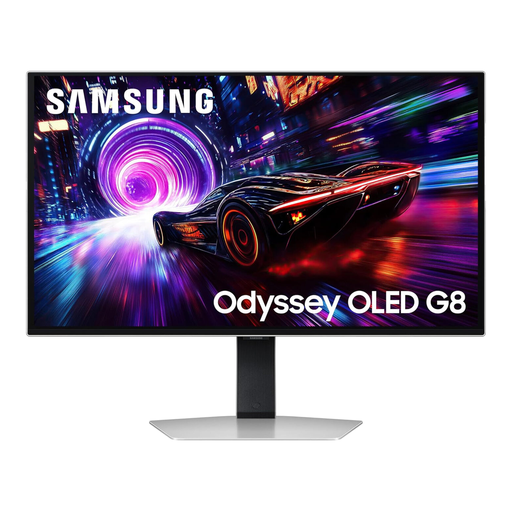
Samsung Odyssey OLED G8 LS32DG802SUXXU, 32-inch Ultra HD
This 32-inch Ultra HD OLED model is another larger-screen option for cinematic games.
If certified HDR, console VRR or a direct headphone connection is essential, check those exact-model features and the relevant HDMI port before deciding.
View on Joybuy
 No image available
LG UltraGear G8 27G850A, 27-inch 4K Nano IPS dual-mode
Consider the smaller Nano IPS format if you switch between cinematic adventures and faster games; its product title lists 240 Hz and 480 Hz dual modes.
Check which resolution applies to each mode. Also confirm the exact HDR certification and the console modes available through its HDMI 2.1 connection.
View on Joybuy
Common questions
Do I need monitor speakers if I always use headphones?
No, not if your headphones connect to the PC, console or controller. If you want to plug them into the monitor instead, check its exact audio output and whether that connection suits your headset; MSI, for example, specifies a headphone output on the MAG 321UP QD-OLED X24.
How do I check whether a PS5 can use the monitor’s intended video modes?
Check the monitor’s stated HDMI capabilities, then inspect the connected device information under Screen and Video in the PS5 settings. PlayStation’s guidance lets you review the video output; 120 Hz and VRR also depend on support from the connected display and the game or mode in use.
What does Xbox Series X need for 4K at 120 Hz?
Xbox Support specifies an Xbox Series X, an Ultra High Speed HDMI cable supporting HDMI 2.1 and an HDMI 2.1-capable display for 4K gaming at 120 Hz. Check that the monitor’s intended HDMI input supports the mode, then review the console’s resolution and refresh-rate settings after connection.
Is an HDR label enough to choose a monitor for cinematic games?
No. VESA distinguishes certified DisplayHDR and DisplayHDR True Black performance tiers from unqualified HDR wording. Look up the exact model and tier if certified HDR performance is an important part of your decision.


