What matters when choosing?
Start with the room and your most demanding use: dark-scene gaming, quiet play beside someone else, the modes your gaming device can deliver, or the space and tasks the screen must share.
32-inch 4K OLED
Consider it when: cinematic games are mainly played in a dim room and dark-scene presentation matters most.
Trade-off: recurring static desktop or game elements bring a permanent burn-in risk, even when a model has panel-care features.
32-inch 4K Mini LED
Consider it when: the screen will see bright daytime conditions or prolonged static use.
Trade-off: zone-based dimming can show haloing around bright objects in dark scenes; RTINGS distinguishes this from OLED's per-pixel control.
27-inch QHD Mini LED
Consider it when: a 32-inch screen would crowd the desk or QHD better suits your PC plans.
Trade-off: 2560 × 1440 provides less image detail than 4K, and console input modes still need a model-specific check.
| Concern | What to check | Who this matters to |
|---|
| Dark-scene picture |
Compare panel type, recognised HDR certification and the exact model's HDR modes against your usual room lighting. |
If I mostly play after dark, I want night scenes to retain their impact without distracting halos. Around 33% of consumers put dark-scene picture quality first. |
| Private audio |
Check for the headphone output or other audio route you intend to use, and whether your console or PC can send sound through it. |
Playing beside someone who needs quiet makes a dependable headset route more important to me than monitor speakers; private audio comes first for around 27% of consumers. |
| Device compatibility |
Check the monitor's supported resolution, refresh rate and variable refresh rate (VRR) modes on the intended port, alongside the device and game. |
If I'm connecting a console or PC, I need the display mode I plan to use to work across the whole connection. That is the primary concern for around 20% of consumers. |
| Desk fit and static use |
Measure the screen and stand footprint; consider recurring static content and the model's panel-care instructions. |
My gaming screen also has to leave room for everyday desk use without ignoring long periods of static content. Around 20% of consumers put that practical fit first. |
Brands to consider
These brands have relevant monitor lines; the features below refer to named models, not every monitor each brand makes.
ASUS ROG
The ROG Swift OLED PG32UCDM is a 4K QD-OLED option for buyers considering a roughly 32-inch screen.
- ASUS ROG lists a 240 Hz refresh rate and OLED-care functions for this model.
- Consider how often static desktop elements will remain on screen; the care functions do not remove burn-in risk.
Alienware
Dell's Alienware AW3225QF offers a curved 4K QD-OLED route.
- Dell lists a 1700R curve and height, swivel and tilt adjustment for this model.
- Check whether the curve, stand footprint and OLED static-use considerations suit your desk.
MSI
The MPG 322URX QD-OLED is relevant when console modes are a key part of the shortlist.
- MSI lists HDMI 2.1 with 4K 120 Hz, VRR and auto low-latency mode (ALLM) support for this model.
- Confirm the intended device and game modes, and follow the model's OLED-care guidance for static use.
LG UltraGear
LG's 32GX850A-B combines a 4K OLED mode with a separate Full HD high-refresh mode.
- LG lists 4K at 165 Hz and Full HD at 330 Hz for this model.
- The second mode matters only if you will use it; the OLED panel still calls for care with static content.
Samsung Odyssey
The Odyssey Neo G8 provides a 32-inch 4K Mini LED route distinct from Samsung's OLED models.
- Samsung lists HDMI 2.1, a headphone output and 1,196 local-dimming zones for the Neo G8.
- Its zone-based dimming is not OLED's per-pixel control; assess the exact model for dark-scene use.
Joybuy product choices
These OLED models cover several screen sizes for cinematic play, from a 27-inch QHD option to 32-inch 4K screens and a much wider 49-inch display. None should be chosen for a shared bedroom without checking desk space, private audio and the intended gaming-device modes.
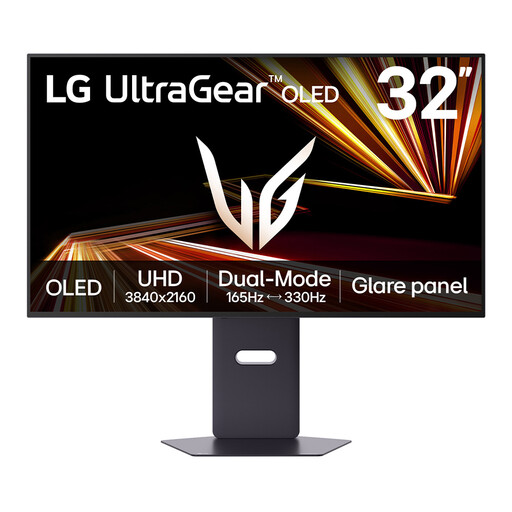 Image unavailable
LG UltraGear 32GX850A-B 32-inch 4K OLED Dual Mode
Consider this model for dim-room cinematic play if a separate high-refresh Full HD mode would also be useful.
LG lists 4K at 165 Hz and Full HD at 330 Hz for the 32GX850A-B. Check your audio route and allow for OLED care during prolonged static use.
View on Joybuy
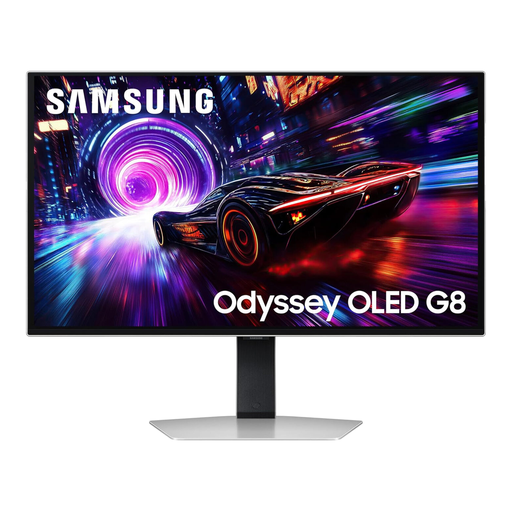 Image unavailable
Samsung Odyssey OLED LS32FG810SUXXU 32-inch
Consider this 32-inch OLED if a large screen for dim-room games fits your desk.
Check the model's supported console modes and your private-audio route before buying. OLED static-image care remains relevant if the screen also serves as a desktop monitor.
View on Joybuy
 Image unavailable
Samsung Odyssey OLED G8 LS32DG802SUXXU 32-inch Ultra HD
This 32-inch OLED is another screen-size match for cinematic gaming at a shared-bedroom desk.
Confirm its assembled footprint, headset connection and intended console modes. Plan for OLED care if static windows or game interfaces will remain visible for long periods.
View on Joybuy
 Image unavailable
Samsung Odyssey G6 S27DG612 27-inch QHD OLED, 240 Hz
Consider this smaller OLED when a 32-inch 4K screen does not suit the desk or your preferred resolution.
The product name specifies QHD, 240 Hz and 0.03 ms. Check the exact console modes and private-audio route, and account for OLED burn-in risk during recurring static use.
View on Joybuy
 Image unavailable
Acer X Predator X49X 49-inch 32:9 curved QD-OLED
Consider this ultrawide only if a substantially wider display suits the room and the games you intend to play.
Its name specifies Dual QHD, an 1800R curve and 240 Hz. Measure the desk and check your source's display modes and private-audio route; recurring static content still presents an OLED burn-in risk.
View on Joybuy
Frequently asked questions
Do I need a 240 Hz monitor for PS5 cinematic games?
No: a 240 Hz monitor is not required simply because you use a PS5. If 4K at 120 Hz matters to you, check the exact display connection and whether the game supports that output; PlayStation says VRR also depends on support from the display and game.
Can I plug my headset into any gaming monitor?
No; check the exact monitor's audio connections and how your console or PC sends sound. A direct console or controller headset route may be more suitable than relying on a monitor output, depending on your setup.
Is OLED a poor choice if I also study or work at this desk?
Not necessarily, but prolonged recurring static content makes OLED care and burn-in risk part of the decision. If documents, taskbars or other fixed elements will occupy much of your screen time, consider whether a Mini LED monitor better fits that use.
Does a monitor warranty replace my rights if it develops a fault?
No; a manufacturer's warranty does not replace statutory rights concerning faulty goods. Citizens Advice says legal rights for a fault can extend up to six years, or five years in Scotland. Check the guidance for your UK nation and the circumstances of the fault, and keep your proof of purchase.
What should I do with an old monitor?
Check your retailer's electrical take-back arrangements or your local authority's collection options rather than putting the monitor into ordinary household waste. GOV.UK's waste electrical and electronic equipment guidance describes measures intended to reduce electrical waste sent to landfill or incineration.


