For long city-building sessions, choose a screen that lets you see maps and menus clearly and position the display comfortably; a 27-inch QHD or 4K model is a useful starting point. Favour 4K if fine detail matters and your PC can drive it, or QHD if you want a less demanding resolution. Treat high refresh rates and larger curved screens as choices for your wider gaming habits and desk setup, not substitutes for suitable positioning.
Who these monitors suit
Detail-first map planners
If you regularly read build menus, survey large maps and manage several overlays at once, compare how QHD and 4K displays present fine detail at the screen size you want. Check the game’s interface-scaling options as well as your PC’s ability to run the chosen resolution.
Comfort-focused long-session players
If your desk or seating position makes screen placement difficult, prioritise a suitable stand or compatible mount. The Health and Safety Executive advises positioning the top of a workstation screen level with your eyes and the screen about an arm’s length away.
Immersion-and-smoothness seekers
If you also play faster games, compare refresh modes and adaptive-sync support alongside resolution. A larger curved format is another option if its dimensions and viewing position suit your desk.
What matters when choosing
Choose resolution and screen size for the maps and menus you use most, then check whether the monitor fits your desk and whether your PC supports the display mode you want.
27-inch QHD IPS
Consider it: When you want more pixels than Full HD without the rendering demand of 4K.
Trade-off: At the same screen size, fine detail is less sharp than on a 4K display.
27-inch 4K IPS
Consider it: When fine map and interface detail is a priority and your PC can run games at 4K.
Trade-off: Rendering at 4K demands more graphics performance than QHD; a high refresh specification does not guarantee a matching game frame rate.
32-inch curved QHD
Consider it: When you prefer a larger curved view and have room to position it at a suitable distance.
Trade-off: A 32-inch screen needs more physical space and has lower pixel density at QHD than a 27-inch QHD screen.
27-inch QHD OLED
Consider it: When OLED contrast and fast pixel-response specifications matter to you across the games you play.
Trade-off: For long periods with persistent game menus, read the exact model’s care guidance and warranty terms before choosing it over IPS.
| Concern | What to check | Who this matters to |
|---|
| Map and menu detail |
Compare native resolution and screen size; check game interface scaling and your PC’s 4K capability. |
If I spend hours reading small map labels and crowded management panels, fine detail comes before extra refresh headroom. Around 42% of consumers would put map and interface detail first. |
| Screen positioning |
Check stand adjustment or VESA mounting, plus the space available for a suitable viewing distance. |
On a desk that limits where the screen can sit, I need to adjust its height and distance without compromising the layout. Screen positioning would be the primary concern for around 33% of consumers. |
| Smoothness and immersion |
Check refresh rate at native resolution, adaptive-sync compatibility, connections and performance in your games. |
Because I play faster games as well as city-builders, I want a display mode my PC can use and may prefer a larger view. Around 25% of consumers would prioritise smoothness or immersion. |
Buying pitfalls
-
Buying by refresh rate alone
A 240Hz monitor does not make a simulation-heavy game render at 240 frames per second. The available mode also depends on your graphics output and connection.
Choose resolution and desk fit first, then check which refresh mode your PC, cable and games can use.
-
Treating eye-care features as a complete setup
Low-blue-light and flicker-free features are model-specific manufacturer specifications, not a substitute for placing the screen appropriately or changing activity during a long session.
Check the stand’s adjustment range and viewing distance. For workplace display-screen use, follow your employer’s assessment and break arrangements.
-
Choosing a large curved screen before measuring
A larger monitor can be difficult to position centrally and at a suitable distance on a shallow desk.
Measure usable desk width and depth, check the stand footprint and mounting compatibility, and read the seller’s return conditions.
If the stand cannot provide the placement you need, a compatible monitor arm or a different desk arrangement may be necessary.
-
Treating OLED and IPS as interchangeable
City-building games can leave interface elements visible for long periods, making the exact OLED model’s care guidance and warranty relevant to the choice.
Read those terms for the model you are considering and compare its other features with a QHD or 4K IPS alternative.
Relevant brands to consider
BenQ MOBIUZ
The EX2710Q is a reference point for a 27-inch QHD gaming display with stand adjustment.
- BenQ UK specifies 2560 × 1440, 165Hz, FreeSync Premium and 100 mm of height adjustment for the EX2710Q.
- Its listed flicker-free technology and low-blue-light mode are features of this model, not evidence that the display prevents eye strain.
Dell
Dell offers useful model-specific points of comparison across QHD gaming and 4K mixed-use displays.
- Dell UK lists the 27-inch G2725D as QHD Fast IPS with AMD FreeSync, while the 27-inch S2725QS is a 4K IPS model with up to 120Hz, height adjustment and pivot.
- Stand and refresh specifications differ between these models; check the particular display you intend to buy.
Samsung Odyssey
The 32-inch Odyssey G65B provides a larger curved QHD option to assess against your desk space.
- Samsung UK specifies QHD, 240Hz and FreeSync Premium Pro for this 32-inch model.
- Its larger format needs a suitable placement, and curvature remains a viewing preference rather than a universal comfort advantage.
ASUS ROG
The ROG Strix XG27UCSR is relevant if you want 4K detail and a separate higher-refresh Full HD mode.
- ASUS ROG UK lists this 27-inch Fast IPS model with 4K at 160Hz and FHD at 324Hz.
- Check your graphics output and connection requirements for the mode you plan to use.
LG UltraGear
The 27GS95QE-B offers a QHD OLED specification to compare with IPS displays.
- LG UK lists the 27GS95QE-B as a 27-inch QHD OLED monitor with 240Hz and a 0.03ms GtG response specification.
- For extended play with persistent interface elements, assess the exact model’s care guidance and warranty terms.
Joybuy monitor choices
These Joybuy choices cover 27-inch 4K and QHD gaming monitors, plus a larger OLED option. Compare their stated features with your desk space, PC connections and the games you play.
 No image available
LG UltraGear G8 27G850A 27-inch 4K UHD Nano IPS
Consider this 27-inch 4K model if detailed maps are your priority and you want to assess its fit on your desk.
The product name lists Nano IPS, FreeSync Premium Pro, DisplayPort 2.1 and HDMI 2.1. Confirm the refresh mode you intend to use against your PC, graphics output and cable.
View on Joybuy
 No image available
Samsung Odyssey G6 S27DG612 27-inch QHD OLED
This OLED option suits consumers comparing QHD detail with high-refresh gaming across more than city-builders.
The product name specifies 240Hz and 0.03ms. If you expect long periods with persistent game menus, check this model’s care guidance and warranty terms before buying.
View on Joybuy
 No image available
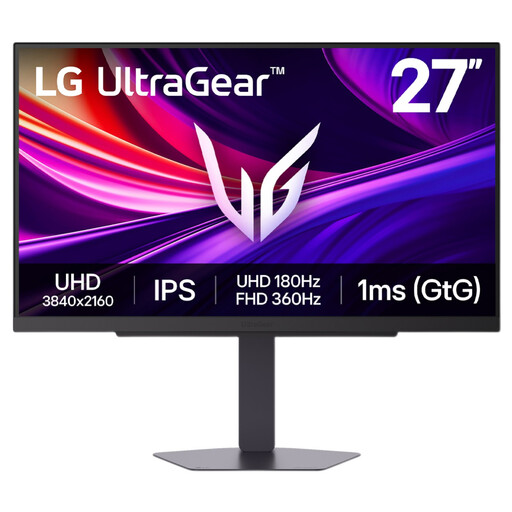
LG UltraGear 27G810A-B 27-inch 4K UHD IPS
Consider this 27-inch 4K IPS model if fine map detail matters and you also want to compare gaming refresh modes.
The product name describes a dual-mode monitor with a maximum of 360Hz; check which resolution that maximum applies to and whether your PC, graphics output and cable support your preferred mode.
View on Joybuy
 No image available
Samsung Odyssey OLED G8 LS32DG802SUXXU 32-inch Ultra HD
This larger OLED display is an option if you want to assess fine map detail on a 32-inch screen and have room to position it comfortably.
Check its care and warranty terms for persistent game interfaces, and confirm the connections and display mode you need against your graphics output and cable.
View on Joybuy
 No image available
HKC G27H2DPro 27-inch QHD Fast IPS
Consider this QHD model if you want a lower-demand resolution than 4K while also comparing high-refresh options for other games.
The product name specifies 2560 × 1440 and 220Hz. If screen height is important for your desk setup, confirm the stand’s adjustment range before buying.
View on Joybuy
Common questions
Should I choose QHD or 4K for city-building games?
Choose 4K if fine map and interface detail is your priority and your PC can run games at that resolution; choose QHD if you prefer a less demanding option. At the same screen size, 4K has more pixels, but also check the game’s interface scaling so menus remain practical to read.
Will a high-refresh monitor make a city-builder run faster?
No: the monitor’s refresh specification does not remove limits imposed by the game or your PC. Check the refresh mode available at your chosen resolution, the required connection and the performance you can expect in the games you play.
How should I position a monitor for a long session?
The Health and Safety Executive advises placing the top of a workstation screen level with your eyes and the display about an arm’s length away. Choose a stand or compatible mount that helps you achieve a suitable position on your desk, and change activity or take breaks rather than relying solely on display settings.


