Dark-scene clue hunters
If much of your play involves shadowy rooms and night scenes, compare the panel type and documented HDR implementation before treating a high refresh rate as the deciding feature.


For detective games, choose a monitor by how well its specifications address dark scenes, readable clues and the output modes your PC or console can use—not by refresh rate alone. A 4K OLED model is worth considering when black levels matter most; a 4K Mini LED model offers a different, local-dimming approach to HDR, while a 4K IPS model may suit you if clear detail matters more than prioritising contrast. Check the exact model and input mode before deciding.
If much of your play involves shadowy rooms and night scenes, compare the panel type and documented HDR implementation before treating a high refresh rate as the deciding feature.
If you regularly inspect documents, maps and environmental details, look for a 4K mode your PC or console can actually output. The available refresh rate may differ between a monitor’s resolution modes.
If the same screen will serve a gaming PC and a PS5, check the monitor’s supported modes on each input. PlayStation UK says PS5 supports 4K 120 Hz output and requires an HDMI 2.1 VRR-compatible display for variable refresh rate.
Choose the display approach that fits your games and room, then check clue readability and the connection modes your hardware can use.
Consider it when: Black-level presentation in dark interiors is your main priority.
Bear in mind: Check the exact model’s 4K input modes and whether its size and shape fit your desk.
Consider it when: You want to assess a local-dimming HDR approach alongside 4K detail; BenQ specifies 1,152 dimming zones and DisplayHDR1000 for the EX321UX.
Bear in mind: Its local-dimming specifications do not establish how every dark scene will look compared with an OLED monitor.
Consider it when: 4K text and environmental detail matter, but an OLED or Mini LED contrast approach is not your overriding requirement.
Bear in mind: Compare the exact model’s HDR and contrast-related specifications rather than assuming its refresh rate describes dark-scene performance.
| Concern | What to check | Who this matters to |
|---|---|---|
| Shadow detail and HDR | Compare panel type and the exact HDR standard; for Mini LED, check the stated local-dimming approach. | If I spend time searching dark rooms for clues, I want to judge the monitor’s black-level and HDR specifications rather than rely on a generic HDR label. Around 36% of consumers put this dark-scene need first. |
| 4K clue readability | Check native resolution and the refresh rate supported at 4K by your device and chosen input. | Documents and maps are central to how I play, so I want enough resolution for their fine detail. For around 29% of consumers, 4K readability is the primary concern. |
| PC and console compatibility | Confirm the required resolution, refresh rate and VRR mode for each HDMI or DisplayPort connection. | When I switch between a PC and PS5, I need both devices to deliver the modes I intend to use. Connection compatibility comes first for around 21% of consumers. |
| Desk fit and long sessions | Measure desk space and check stand adjustment or mounting options, plus the exact seller’s warranty terms. | I may spend long sessions reading and exploring, so the screen must fit where I sit and adjust to a workable position. Around 14% of consumers make setup practicality their main concern. |
A 240 Hz specification does not tell you the monitor’s resolution, HDR implementation or available connections.
Start with the scenes and clues you need to see clearly, then compare the exact model’s panel, HDR standard, resolution-at-refresh modes and inputs.
PlayStation UK says PS5 supports 4K 120 Hz output, while VRR requires an HDMI 2.1 VRR-compatible display. The game, settings and connection also matter.
Check the monitor’s supported HDMI modes before ordering, then review the PS5 video-output settings after connecting it.
LG UK marks the 32GS95UE-B as discontinued; the similarly named 32GS95UV-B is a different model identifier. A family name alone cannot establish which specifications or bundle you are buying.
Match the complete code across the retailer listing, manufacturer page and specification sheet.
Warranty cover, optional protection and return arrangements can affect a purchase after the monitor arrives.
Read the exact seller’s current terms and check the supplied power-lead details before paying.
The AW3225QF is a 31.6-inch curved 4K QD-OLED option for comparing dark-scene presentation and PC or console connections.
LG UK lists OLED gaming monitors with 4K and dual-resolution modes, including the 32GX850A-B.
The EX321UX provides a 32-inch 4K Mini LED option to compare with OLED monitors.
These choices span 4K OLED and non-OLED monitors, plus QHD and ultrawide OLED alternatives. If reading small clues at 4K is essential, distinguish the latter two from the 4K models before comparing other features.
 No image available
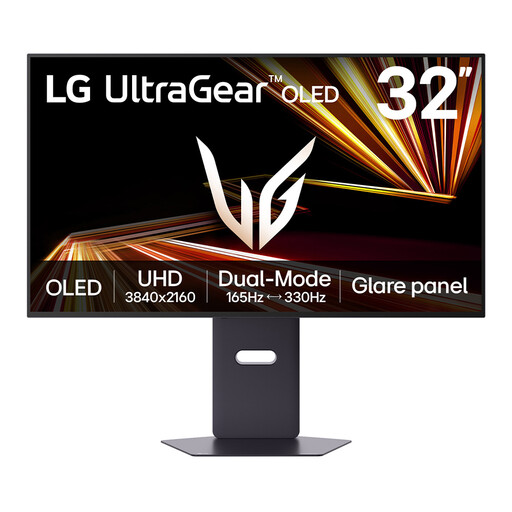
Consider this model if dark scenes and 4K documents are both priorities. LG UK specifies VESA DisplayHDR True Black 400 and dual-mode operation at 4K 165 Hz or FHD 330 Hz.
Allow space for a 32-inch screen, and confirm that your device and connection support the mode you plan to use.
 No image available
Consider this non-OLED option if 4K clue detail and a 27-inch format matter more to you than choosing an OLED panel. Its title specifies dual-mode 240 Hz/480 Hz operation, DisplayHDR 600, HDMI 2.1 and DisplayPort 2.1.
Check which resolution applies to each refresh mode on your chosen input. If dark-scene presentation is decisive, examine the exact model’s HDR implementation rather than relying on its HDR label alone.
 No image available
Consider this model if you want a curved OLED screen for dark-scene play and 4K clue reading. Its name specifies 3840 × 2160 resolution, 165 Hz and USB-C 65 W.
Check whether the curved format fits your desk and viewing position, and confirm the precise HDR certification and input mode if either will decide your purchase.
 No image available
Consider this 240 Hz OLED model if a 27-inch screen suits your desk and QHD is sufficient for the documents and maps in your games.
It is QHD rather than 4K. Check the exact HDR specification if that will decide between this and a 4K alternative.
 No image available
Consider this curved ultrawide only if its 32:9 format suits your desk and the detective games you intend to play. Its name specifies Dual QHD, a 1800R curve and 240 Hz.
Dual QHD is not 4K. Check game support for 32:9 and the resolution and refresh modes available through your chosen PC or console input.
No: 240 Hz is not a prerequisite for investigation-focused games. Prioritise readable clues, the dark-scene and HDR specifications you value, and a resolution and refresh mode your hardware can sustain; the higher refresh rate may matter more if you also play fast action games.
Yes, when the game, monitor, settings and HDMI connection support that mode. PlayStation UK says PS5 supports 4K 120 Hz output; check the exact monitor’s HDMI modes, and check VRR separately against its HDMI 2.1 VRR compatibility.
No: check the precise standard and the panel or local-dimming approach of the exact monitor. LG UK specifies VESA DisplayHDR True Black 400 for the OLED 32GX850A-B, while BenQ UK specifies DisplayHDR1000 and 1,152 local-dimming zones for the Mini LED EX321UX; those specifications describe different approaches, not a measured winner for every game.
Check the exact model, supplier information and supplied power lead for the monitor you intend to buy. GOV.UK says the Electrical Equipment (Safety) Regulations 2016 set requirements for electrical equipment placed on the Great Britain market; a listing alone should not be treated as proof of an individual monitor’s compliance.