What matters when choosing?
Settle the panel trade-off before comparing headline refresh rates: dark-room contrast favours OLED, while persistent interfaces make its care requirements more consequential.
OLED
Choose it when: Dark-scene blacks and avoiding halos around bright objects are your main priorities; RTINGS identifies these as OLED strengths.
Accept that: Prolonged exposure to fixed game interfaces can cause burn-in. Check the chosen monitor’s care functions and warranty terms rather than assuming those functions remove the risk.
Mini LED or other LCD
Choose it when: Fixed menus stay visible for long sessions, or brightness in conditions beyond a dark room matters more to you. RTINGS identifies higher brightness as a Mini LED advantage over OLED.
Check before buying: If you play in darkness, assess local-dimming behaviour on the particular Mini LED model; bright objects may show halos that OLED avoids.
| Concern |
What to check |
Who this matters to |
| Dark-scene contrast |
Compare OLED black levels with the chosen LCD model’s local dimming, especially around small bright objects. |
I want lights and fine objects to stand apart from a dark build without distracting halos; around 36% of consumers put dark-scene contrast first. |
| Fixed interfaces |
For OLED, check the exact model’s panel-care functions and warranty terms; consider an LCD route if prolonged static UI is routine. |
If my maps and toolbars stay in the same place for hours, I care more about managing that exposure than maximising contrast. Around 29% of consumers make fixed-interface tolerance their primary concern. |
| Building detail and space |
Compare screen size with resolution, then check desk fit and stand adjustment or mounting options. |
Dense menus and small construction details need enough space to inspect comfortably; around 21% of consumers prioritise detail and workspace size. |
| Motion and compatibility |
Confirm the refresh mode at the resolution you intend to use and whether your PC or console and connection can output it. |
When I pan and zoom around a large build, I want a mode my system can actually drive; around 14% of consumers put motion and system compatibility first. |
Relevant brands to consider
These examples illustrate particular monitor lines and specifications, not a judgement about every model from each brand.
ASUS ROG
The ROG Swift OLED PG32UCDM Gen3 is a 32-inch 4K QD-OLED option for shoppers considering a large, high-refresh OLED display.
- ASUS ROG lists a 240Hz refresh rate and OLED Care Pro features for this model.
- ASUS ROG also acknowledges susceptibility to burn-in with prolonged static images; care features do not make fixed HUD use risk-free.
Alienware
Dell describes the Alienware AW3225QF as a curved 32-inch 4K QD-OLED gaming monitor.
- Dell lists a 240Hz refresh rate; its curved format is worth considering if it suits your viewing position.
- Curvature is a matter of fit, not an automatic advantage, and OLED’s prolonged static-image trade-off still applies.
LG UltraGear
LG’s 32GX850A-B illustrates a 32-inch 4K OLED route with separate resolution and refresh modes.
- LG specifies UHD at 165Hz or FHD at 330Hz for the 32GX850A-B.
- Selecting the higher-refresh FHD mode means giving up that model’s 4K detail while using it.
Samsung Odyssey
Samsung’s Odyssey Neo G8 illustrates a 32-inch 4K, 240Hz Mini LED alternative to OLED.
- For shoppers who also use brighter rooms, RTINGS identifies higher brightness as a Mini LED advantage over OLED.
- For dark-room play, check the exact monitor’s local dimming rather than assuming it avoids halos around bright objects.
Joybuy monitor choices
These choices include OLED monitors for readers focused on dark-room contrast and a Nano IPS alternative for readers weighing prolonged fixed-interface use. Compare their stated screen sizes and modes with your desk and gaming system; this selection does not replace the Mini LED comparison above.
 No image available
Samsung Odyssey OLED LS32FG810SUXXU, 32-inch
Consider this OLED model if dark-room contrast leads your decision. Its stated size is 32 inches; for long sessions with fixed toolbars, check its panel-care instructions and warranty terms.
View on Joybuy
 No image available
LG UltraGear G8 27G850A, 27-inch 4K Nano IPS
Consider this LCD option if fixed game interfaces make you reluctant to choose OLED. The title specifies 27-inch 4K Nano IPS and dual-mode 240Hz/480Hz operation; confirm the resolution available in each mode before choosing it for your system.
View on Joybuy
 No image available
LG UltraGear OLED 32GS95UV-B, 32-inch 4K
Consider this OLED model when a larger 4K view of detailed builds matters alongside dark-room contrast. The title specifies 4K at 240Hz and FHD at 480Hz; check your system’s intended mode, plus the monitor’s OLED-care and warranty terms if HUD elements remain fixed.
View on Joybuy
 No image available
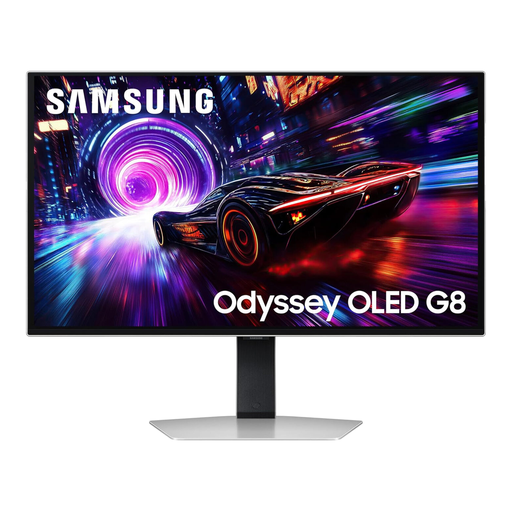
Samsung Odyssey OLED G8 LS32DG802SUXXU, 32-inch Ultra HD
Consider this OLED option if a large, detailed view and dark-room contrast are your priorities. Its title specifies a 32-inch Ultra HD screen; check the resolution and refresh mode your system can use, as well as care guidance for persistent menus.
View on Joybuy
 No image available
Dahua 32-inch 4K 165Hz curved OLED monitor
Consider this curved OLED option if dark-scene contrast and 4K building detail matter more to you than pursuing a higher stated refresh rate. The title specifies 165Hz and USB-C 65W; confirm the connection and refresh mode your system needs, and check OLED-care and warranty terms for long HUD sessions.
View on Joybuy
Frequently asked questions
Is OLED worth choosing for building games played in a dark room?
OLED is worth considering when deep blacks and avoiding halos around bright objects matter most to you; RTINGS identifies these as dark-room strengths. If fixed maps and toolbars stay visible for long periods, weigh its burn-in risk against an LCD alternative before deciding.
How should I manage a static HUD on an OLED monitor?
Follow the care instructions for the exact OLED model and use its supplied protection features, such as pixel cleaning or a screen saver where available. ASUS ROG describes such features as ways to mitigate burn-in, not eliminate it; check the model’s warranty terms if long sessions with a fixed interface are routine.
Do building games need a 4K, 240Hz monitor?
No: choose 4K if the extra detail and screen space suit your builds, and prioritise a high refresh rate only if smoother movement matters to you and your system can output the desired mode. Check resolution and refresh together, since some monitors offer their highest refresh rate only at a lower resolution.
What if a monitor bought in the UK develops a fault?
Where the repair-or-replacement remedy under section 23 of the UK Consumer Rights Act 2015 applies, the trader must provide it within a reasonable time, without significant inconvenience, and bear the necessary costs. That statutory remedy is distinct from a voluntary manufacturer warranty.
How should I dispose of an old monitor in the UK?
Use an appropriate electrical-recycling or retailer take-back route rather than treating the monitor as ordinary rubbish. GOV.UK describes the UK waste electrical and electronic equipment regime as supporting recovery, reuse and recycling; check your local authority’s collection arrangements.


