Clue-focused story players
If you spend time reading case notes, subtitles and maps or inspecting dim scenes, start with legibility and your device’s supported resolution rather than refresh rate alone.


A 27-inch QHD monitor is a useful starting point for detective games if your PC or console supports that resolution. Consider OLED when dark-scene contrast matters most, or Fast IPS when you also want a monitor for faster games; either way, check reflections, screen positioning and the connection modes you will actually use.
If you spend time reading case notes, subtitles and maps or inspecting dim scenes, start with legibility and your device’s supported resolution rather than refresh rate alone.
If you expect to stay at your desk for extended sessions, consider screen brightness, reflections and positioning alongside any flicker-free or low-blue-light features listed for the exact model.
If shadow-heavy scenes and contrast shape your choice, compare specific OLED models and their screen treatments in the lighting where you play. Panel type alone does not settle room-light suitability.
For long detective-game sessions, decide whether scene detail or dark-scene contrast leads your choice, then check how the monitor fits your desk and connects to your device. Fast IPS and OLED are panel options; a comfortable setup matters with either.
Consider it when: You want QHD for reading clues and will also use the monitor for faster games. AOC lists the Q27G4X and ASUS lists the VG27AQL3A as 27-inch QHD Fast IPS models with adaptive-sync features.
Keep in mind: Those gaming specifications do not establish how well either model will show a particular game’s dark scenes. Check the exact stand and screen surface separately.
Consider it when: Dark-scene contrast is central to your choice and you can assess reflections in your usual room lighting. LG and Samsung describe these features for their respective 27GS95QE-B and Odyssey OLED G6 G61SH models.
Keep in mind: Brightness and power settings vary by model. LG says turning off Smart Energy Saving for a brighter image on the 27GS95QE-B may increase power consumption.
| Concern | What to check | Who this matters to |
|---|---|---|
| Clue and scene detail | Check native resolution against your device’s output, then assess text readability and dark scenes in the games you play. | If I spend more time examining notes and dim rooms than reacting to fast action, readable detail comes first; around 44% of consumers put clue and scene detail first. |
| Long-session setup | Check brightness controls and reflections, plus the exact stand adjustments or a compatible VESA mount. | When I sit through a long case, I need to position the screen comfortably and manage the room’s light; around 33% of consumers make setup their primary concern. |
| Motion and connections | Match the desired resolution, refresh rate and adaptive-sync mode to your device, cable and monitor input. | If I also play faster games, I want to know which smooth-motion modes my device can use; around 23% of consumers prioritise motion and connection compatibility. |
Flicker-free and low-blue-light features do not address screen placement, reflections or uninterrupted viewing. The Health and Safety Executive advises short, frequent breaks for display-screen-equipment work; that is workplace guidance, not a gaming-specific safety guarantee.
Compare the feature on the exact model, adjust brightness for your room and plan changes of activity during long sessions.
Stand movement differs even between similarly named monitors. ASUS lists the VG27AQ3A with tilt and swivel but no height adjustment, alongside 100 × 100 mm VESA mounting.
Check the exact model’s stand specifications. If you need an arm, confirm its VESA pattern, capacity and fit with your desk.
Using an alternative position may require a compatible arm or stand.
Reflection treatment and brightness settings are model-specific. LG says disabling Smart Energy Saving for a brighter image on its 27GS95QE-B may increase power consumption.
Consider where daylight and lamps will reflect, and read the exact model’s screen-treatment and brightness-setting information.
A listed refresh rate does not establish which resolution and mode your PC or console can send through the connection you intend to use.
Check the monitor’s published input modes against your device and cable, including adaptive-sync compatibility if you need it.
The AOC Q27G4X is a 27-inch QHD Fast IPS example for comparing resolution and gaming-motion features.
The VG27AQL3A is a QHD Fast IPS example with 180Hz and listed adaptive-sync compatibility.
LG lists the 27GS95QE-B as a 27-inch QHD OLED model with 240Hz and anti-glare, low-reflection treatment.
Samsung lists the Odyssey OLED G6 G61SH as a QHD QD-OLED model with Glare Free treatment and 240Hz.
These monitors offer different combinations of screen size, resolution and gaming features for inspecting clues or arranging a long-session desk setup. The 32-inch options need a separate check for desk fit and device output if you were planning around a 27-inch QHD screen.
 No image available
Consider this model if a 27-inch QHD OLED screen fits your plans for examining dark scenes.
The product name specifies a 0.03ms response time. Check the input modes and adaptive-sync compatibility against your PC or console before choosing it.
 No image available
This larger screen is worth considering if you have room for a 32-inch monitor and want to inspect scenes at its stated 3840 × 2160 resolution.
The product name lists a 0.03ms GtG response time and 65W USB-C. Check whether your device supports the resolution and refresh mode you intend to use, and whether the curved screen suits your desk.
 No image available
Consider the larger Ultra HD OLED format if your desk and connected device suit it.
Check which input modes your device can use and whether the stand offers the specific adjustments you need for a long session.
 No image available
This is an option if you want a larger QHD screen and need to assess desk positioning as well as game-device compatibility.
The product name lists 2560 × 1440 resolution, HDMI and DisplayPort, and 100 × 100 mm VESA mounting. Confirm that your chosen connection supports the mode you want and that the stand or a compatible mount gives you the required position.
 No image available
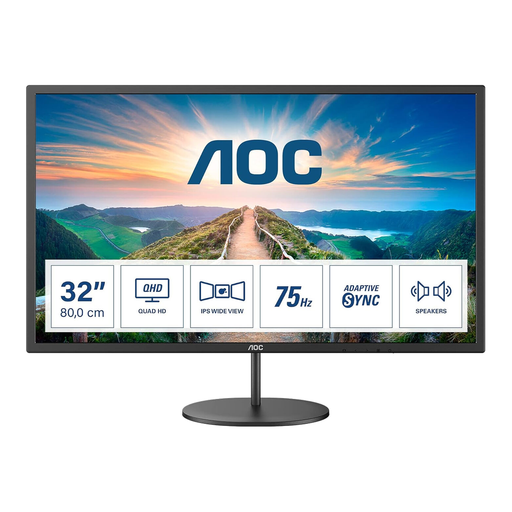
Consider this larger IPS monitor if reading scenes is more important to you than choosing by a high-refresh gaming label.
The product name lists a 4ms response time and built-in speakers but uses both “2K” and “Ultra HD” for its resolution. Confirm the native pixel dimensions, supported refresh modes and stand adjustments before buying.
Consider OLED if dark-scene contrast leads your choice and you can assess reflections and brightness settings in your room. QHD Fast IPS is another route if you also play faster games; compare exact models and check that your device supports the resolution and modes you want.
No. A flicker-free or low-blue-light feature does not replace a suitable screen position or changes of activity. The Health and Safety Executive recommends short, frequent breaks for display-screen-equipment work; it does not set a gaming-specific safe session length.
Check the exact monitor’s stand adjustments, reflections, VESA pattern and supported input modes against your desk and device. For instance, ASUS lists the VG27AQ3A with 100 × 100 mm VESA mounting but no height adjustment, so its included stand would not meet a need for vertical adjustment.
For a change of mind on an eligible online order, GOV.UK says customers generally have 14 days from receiving the item to notify the seller of cancellation, followed by another 14 days to return it. A faulty or misdescribed monitor raises a separate question about remedies, rather than being governed solely by a seller’s change-of-mind policy.