Who this is for

PC players of fast competitive games

For players whose PC can sustain high frame rates in their usual games and who need to compare tested input lag, refresh behaviour and VRR performance rather than buying the highest headline resolution. RTINGS provides the relevant input-lag testing context.

PS5 or Xbox Series console owners

For players choosing a desk monitor for console play who need to confirm the exact 4K, 1440p, 120Hz, HDR and VRR modes exposed by the monitor, cable and console together. PlayStation and Xbox Support document these setup checks.

Mixed-use home gamers

For people using one monitor for games, desktop work and media who need to weigh 4K detail and connectivity against desk space, room brightness, OLED static-image exposure and warranty support. RTINGS, LG UK and Dell UK provide relevant model and panel context.

Buying priorities

High-refresh QHD for competitive PC play

Choose it when: Your PC and usual games can sustain high frame rates at 2560 × 1440, and responsive motion matters more than 4K detail.

Consider: Higher refresh does not help if the PC cannot deliver matching frame rates; OLED also needs care around static images and can show VRR flicker in changing frame-rate conditions.

4K HDMI 2.1 for console or capable PC use

Choose it when: 4K detail and current-generation console compatibility matter more than the highest PC-only refresh rates.

Consider: Not every game runs at 4K and 120fps together, and the graphics card, cable, monitor input and game performance can each limit the final mode.

4K OLED or dual mode for games and work

Choose it when: You want detailed single-player gaming and desktop use from one screen, and can manage static-content precautions.

Consider: OLED can suit dim-room viewing, but repeated static elements create burn-in exposure and some QD-OLED displays can show raised blacks in bright rooms.

Priority What to check Your needs
Signal compatibility Match the source device, monitor input, cable, resolution, refresh rate and VRR mode. For Xbox Series X at 4K and 120Hz, Xbox Support specifies an HDMI 2.1 display and Ultra High Speed HDMI cable. On PS5, use the connected-device information and 1440p test where relevant. I want the advertised mode to work with my own console or PC, rather than simply appearing on the specification sheet.
Motion responsiveness Check independent input-lag results at the resolution and refresh rate you expect to use, including 120Hz or 60Hz for console play. Keep input lag separate from quoted response-time figures. For fast games, I need signal-to-image delay and motion behaviour that suit the mode I will actually play.
Room and HDR performance Consider room light, reflections and panel behaviour. If HDR matters, compare the exact VESA DisplayHDR or DisplayHDR True Black tier rather than treating generic HDR wording as equivalent. I want the picture to suit a dim gaming room, a bright desk position or a mix of both.
OLED ownership Assess recurring taskbars, browser windows and fixed HUDs before choosing OLED. Read the exact UK warranty and panel-care terms for the model under consideration. If one screen handles games and daily desktop work, I need a panel type and ownership routine that fit my static-content use.

Common buying pitfalls

  • Buying for the monitor’s maximum refresh rate rather than the mode your console or PC can output

    A high-refresh headline does not establish 4K at 120Hz or VRR support for a particular console, cable, graphics-card output or game. Xbox Series X 4K at 120Hz has explicit HDMI 2.1 and cable conditions, while PS5 reports connected-device capability in its video settings.

    Before ordering, note your source device, desired resolution and target refresh rate, then verify that exact combination in the monitor manual or official specifications. Check the output report once connected.

  • Treating quoted response time as the same thing as low input lag

    Response time and input lag measure different display behaviours. RTINGS defines input lag as the time taken for a monitor to process a signal, and tests it at different operating modes.

    For reaction-sensitive games, compare independent tests that state the resolution, refresh rate and methodology, using the same test basis across models.

  • Choosing OLED for all-day static desktop use without considering burn-in and bright-room behaviour

    RTINGS notes that repeated static elements can cause OLED burn-in over time, and some QD-OLED displays can show raised black levels in bright rooms. Warranty coverage is model-specific.

    If desktop work occupies much of the day, compare LCD or Mini-LED alternatives with OLED, use the maker’s panel-care features and read the exact UK warranty terms before purchase.

  • Assuming every monitor labelled HDR provides comparable HDR

    VESA states that only displays meeting its requirements may carry the DisplayHDR logo, so generic HDR wording does not establish equivalent performance.

    Use the exact VESA DisplayHDR or DisplayHDR True Black tier as one comparison point, then assess independent brightness, contrast and room-light testing for the specific model.

Relevant brand references

Alienware (Dell)

Relevant for UK buyers comparing high-refresh QHD OLED and 4K 240Hz QD-OLED monitor routes. Dell UK lists the 27-inch QHD 360Hz AW2725DF and 31.6-inch 4K 240Hz AW3225QF.

  • Dell’s listings specify high-refresh QD-OLED models with adaptive-sync support.
  • RTINGS found low input lag, fast response time and 4K/120Hz console support on the AW3225QF, while also noting VRR flicker with changing frame rates and raised blacks in bright rooms. These findings apply to that model rather than every Alienware monitor.

ASUS ROG

Relevant for PC and mixed-use buyers considering a 32-inch 4K OLED monitor with high refresh, HDMI 2.1, DisplayPort 2.1 and USB-C charging in one display.

  • ASUS lists the PG32UCDM Gen3 with 4K 240Hz, HDMI 2.1, DisplayPort 2.1a UHBR20 and USB-C 90W power delivery.
  • ASUS UK Support states that the earlier PG32UCDM has a 36-month warranty including panel burn-in; confirm the policy for the exact ROG OLED model and regional variant.

LG UltraGear

Relevant for players comparing QHD high-refresh OLED, 4K OLED and dual-mode 4K/FHD display routes in the UK.

  • LG UK lists the 32GX850A-B with 4K at 165Hz or Full HD at 330Hz, a dual mode suited to alternating between detailed games and high-refresh play.
  • Brightness, response-time and contrast statements are manufacturer claims; check independent testing and the exact model’s warranty terms before buying.

Joybuy product options

Joybuy product options for home PC, console and mixed-use gaming desks, including high-refresh and dual-mode monitor routes.

LG UltraGear G8 27G850A gaming monitor

LG UltraGear G8 27G850A 27-inch 4K Dual-Mode Monitor

A 27-inch option for PC gaming that can use 4K at 240Hz or 1080p at 480Hz.

Nano IPS Black panel; 1ms GtG; DisplayHDR 600; DisplayPort 2.1; HDMI 2.1; FreeSync Premium Pro; adjustable stand.

Confirm the exact PS5 or Xbox modes in the manual and console output report, and check independent input-lag testing for the mode you intend to use.

Joybuy

LG UltraGear OLED 32GS95UV-B gaming monitor

LG UltraGear OLED 32GS95UV-B 32-inch 4K Dual-Mode Monitor

A large-screen route for detailed games and fast PC play, with 4K at 240Hz and Full HD at 480Hz.

OLED panel; 0.03ms response time; DisplayHDR True Black 400; two HDMI 2.1 ports; DisplayPort 1.4; speakers; adjustable stand.

Consider repeated static desktop use, then confirm intended console modes and the UK warranty wording before checkout.

Joybuy
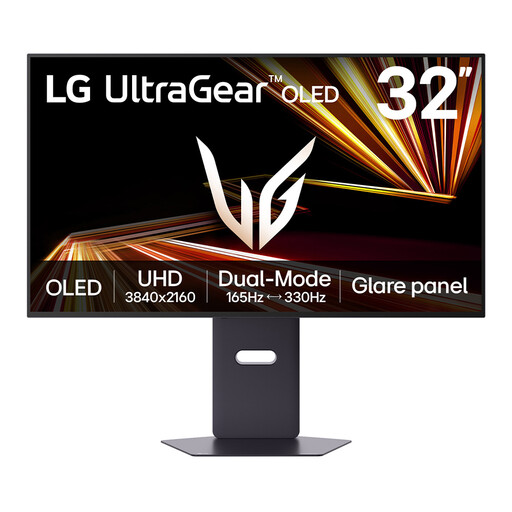
LG UltraGear 32GX850A-B OLED gaming monitor

LG UltraGear 32GX850A-B 32-inch OLED Dual-Mode Monitor

A fixed-desk option for switching between 4K gaming at 165Hz and Full HD play at 330Hz.

31.5-inch OLED panel; DisplayHDR True Black 400; two HDMI 2.1 ports; DisplayPort; USB hub; headphone output; adjustable stand.

OLED static-image exposure remains relevant for desktop work and fixed HUDs. Check console compatibility, warranty terms and independent input-lag results for your intended mode.

Joybuy

Dahua 32-inch 4K 165Hz curved OLED gaming monitor

Dahua 32-inch Curved 4K 165Hz OLED Gaming Monitor

A 32-inch 4K option for combining gaming with a laptop or desktop workstation.

QD-OLED panel; 3840 × 2160 at 165Hz; 0.03ms GtG; two HDMI 2.1 ports; DisplayPort 1.4; USB-C 65W power delivery; USB hub.

The HDR 400 wording does not identify a VESA DisplayHDR tier. Confirm HDR certification, console modes, warranty terms and independent input-lag testing if these matter to your setup.

Joybuy

MAG 274QP QD-OLED X24 gaming monitor

MAG 274QP QD-OLED X24 26.5-inch QHD 240Hz Monitor

A QHD route for competitive PC play and desk-based PS5 or Xbox gaming at 120Hz below 4K.

2560 × 1440 QD-OLED panel; 240Hz; 0.03ms GtG; HDMI 2.1; DisplayPort 1.4; Adaptive-Sync; VESA ClearMR 13000; adjustable stand.

This is not a 4K route. HDR is described as HDR Ready rather than a named VESA DisplayHDR tier, and UK applicability of the stated panel burn-in warranty should be confirmed before buying.

Joybuy

Frequently asked questions

Do I need HDMI 2.1 for Xbox Series X gaming at 4K and 120Hz?

Yes. Xbox Support states that Xbox Series X gaming at 4K and 120fps requires an HDMI 2.1 display and an Ultra High Speed HDMI cable supporting HDMI 2.1. Without HDMI 2.1 display support, Xbox can still enable 120Hz at a lower resolution.

How can I check whether a PS5 monitor supports the modes I want?

Open Settings, then Screen and Video, then Video Output to inspect connected HDMI device information. PlayStation says PS5 can test 1440p SDR and HDR output at 60Hz and 120Hz, plus VRR, when the connected display supports 1440p; game support still matters.

Will an HDMI 2.1 monitor automatically give my PC 4K at 120Hz or VRR?

No. Your graphics-card output, display input, cable, drivers, settings and game performance must all support the target mode. NVIDIA states that HDMI 2.1 can enable 4K at 120fps and higher-resolution VRR capabilities on supported RTX 30- and 40-series configurations with a compatible display and certified Ultra High Speed cable.

Is an HDR label enough to compare gaming monitors?

No. VESA recommends checking for an actual DisplayHDR or DisplayHDR True Black certification tier. Generic labels such as HDR-400 do not establish that a monitor meets DisplayHDR certification requirements.

What protection do I have in the UK if a monitor is faulty?

The Consumer Rights Act 2015 requires supplied goods to be of satisfactory quality. Where the statutory right to repair or replacement applies, the trader must complete it within a reasonable time, without significant inconvenience, and bear necessary labour, material and postage costs. This is separate from a manufacturer’s commercial warranty.