Choose a 34-inch 21:9 monitor if a wide, single-screen cockpit view matters most; choose a 32-inch-class 4K display if you would rather prioritise image detail. OLED is worth considering for dark scenes and motion, but persistent interface elements call for panel-care checks. A VA LCD offers an ultrawide alternative if OLED is not a requirement. In every case, check what your PC, game and chosen connection can support.
Who these monitors suit
Wide-view space-sim explorers
If you want cockpit instruments, navigation and scenery across one screen, a 34-inch 21:9 monitor is a format to consider instead of a conventional 16:9 layout. Samsung and LG list 3440 × 1440 models in this size; check how your particular game handles an ultrawide image and HUD.
Dark-scene and HDR-focused players
If dark-space imagery matters to you, compare the exact OLED panel, HDR specification and anti-glare treatment rather than assuming every OLED monitor behaves alike. Check panel-care guidance too if cockpit displays or desktop windows stay visible for long periods.
Players working within their PC’s limits
If your PC determines the settings you can use, start with the resolution and frame rate it can sustain in your intended game. For Star Citizen specifically, publisher Roberts Space Industries cautions that performance can vary with location, server population, background applications and network conditions.
What matters when choosing
For star-system exploration, decide whether screen width or fine detail takes priority, then compare panel type and confirm that the whole setup can deliver the experience you want.
34-inch ultrawide OLED
Consider it when: A 21:9 cockpit view and OLED are both priorities; Samsung’s G85SD and LG’s 34GS95QE-B are 3440 × 1440 examples.
Allow for: Panel-care requirements with persistent HUDs, as well as the PC performance needed at your chosen settings.
34-inch ultrawide VA LCD
Consider it when: You want the curved 3440 × 1440 format without making OLED a requirement; GIGABYTE’s G34WQCP Rev. 2.0 is one example.
Allow for: Different panel behaviour from OLED; an HDR label or response-time figure alone does not establish equivalent results.
32-inch-class 4K OLED
Consider it when: Detail in scenery and menus matters more to you than the extra horizontal width of 21:9; ASUS lists the 31.5-inch PG32UCDP as a 4K example.
Allow for: A 16:9 view and a higher pixel count for your PC to render than at 3440 × 1440.
| Concern | What to check | Who this matters to |
|---|
| Panoramic cockpit view |
Check the game’s 21:9 support, HUD layout and the monitor’s physical fit on your desk. |
I want instruments and scenery across one display without relying on a second screen. Around 36% of consumers put that wide view first. |
| Dark scenes and motion |
Compare panel type, the refresh rate available through your chosen port, adaptive-sync compatibility and the conditions behind response-time claims. |
During flight, I care most about dark-space imagery and how moving scenes look. For around 29% of consumers, those picture and motion qualities take priority. |
| Resolution and PC fit |
Check your GPU, game settings, output and cable before choosing between 4K and 3440 × 1440. |
I do not want to choose a display mode my PC cannot run satisfactorily in my game. That performance fit comes first for around 21% of consumers. |
| Long-session setup |
Check OLED-care guidance where relevant, warranty terms, stand adjustments and desk dimensions. |
My HUD or desktop windows may remain on screen for hours, and the monitor must fit my workspace. Around 14% of consumers prioritise those ownership and setup needs. |
Mistakes to avoid
-
Choosing by the headline refresh rate alone
The usable rate can depend on the connection: Dell lists its AW3423DWF at 165Hz through DisplayPort but 100Hz through HDMI.
Check the exact monitor’s port specifications against your GPU output and the resolution and refresh combination you intend to use.
-
Assuming OLED care removes static-image risk
Persistent cockpit displays and desktop elements matter during long sessions. ASUS describes its OLED-care and heatsink features as reducing burn-in risk, not eliminating it.
Read the exact model’s care guidance and warranty terms. If OLED-specific care does not suit your use, consider an LCD model instead.
-
Treating every 34-inch ultrawide as interchangeable
Models can differ in panel technology, curvature, stand adjustment and connection-specific capabilities, even when their size and resolution match.
Compare full model numbers and the features that affect your desk, PC and viewing position before deciding.
Relevant brands to compare
Samsung Odyssey
Samsung’s G85SD is a reference for a 34-inch, 3440 × 1440 OLED ultrawide with smart-monitor features.
- Samsung lists a 175Hz refresh rate and OLED Glare Free treatment for this model.
- Check source-device ports, desk fit and the exact seller warranty; those details cannot be assumed from the Odyssey name.
LG UltraGear
LG’s 34GS95QE-B is a 34-inch, 21:9 curved OLED reference for buyers comparing ultrawide formats.
- LG lists 3440 × 1440, 240Hz and adaptive-sync compatibility for this model.
- Its 800R curve is a viewing-position preference, so check whether it suits your desk.
GIGABYTE Gaming
The G34WQCP Rev. 2.0 provides a 34-inch, 3440 × 1440 VA LCD reference for buyers not set on OLED.
- GIGABYTE lists a 1500R curve, 180Hz refresh rate, height adjustment and VESA mounting.
- Do not treat its HDR or response-time specifications as evidence of OLED-equivalent picture behaviour.
ASUS ROG Swift
ASUS offers distinct OLED references here: the 39-inch ultrawide PG39WCDM and the 31.5-inch 4K PG32UCDP.
- ASUS lists a 4K-at-240Hz mode and a separate FHD-at-480Hz mode for the PG32UCDP.
- These models have different sizes and resolutions; compare their capabilities separately and review OLED-care guidance.
Alienware
Dell’s AW3423DWF is a 34-inch QD-OLED comparison reference for curved ultrawides and connection-specific refresh limits.
- Dell lists 3440 × 1440, an 1800R curve and FreeSync Premium Pro for this model.
- Dell lists 165Hz through DisplayPort and 100Hz through HDMI, and labels this exact model unavailable on its UK page.
Joybuy monitors for these choices
These monitors cover 4K detail, 34-inch ultrawide viewing, a wider 49-inch format and an ultrawide option for buyers who do not require OLED. Check the exact game, connection and desk fit before choosing.
 No image available
LG UltraGear 32GS95UV-B 32-inch 4K OLED
Consider this model if 4K detail matters more to you than an ultrawide view.
The title lists 4K at 240Hz and a separate Full HD at 480Hz mode, plus G-SYNC Compatible and FreeSync Premium Pro support. Confirm which screen-size measurement applies to the listing, and check OLED-care guidance and your PC’s performance at your intended settings.
View on Joybuy
 No image available
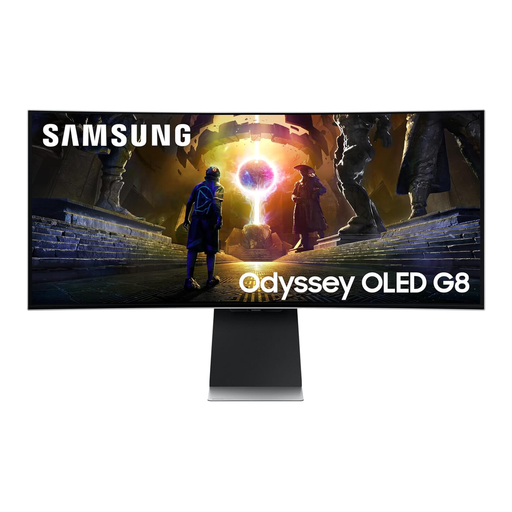
Samsung Odyssey G8 LS34DG850SUXXU 34-inch OLED
Consider this model for a curved, single-screen ultrawide setup when OLED is a priority.
Its title lists a 175Hz refresh rate. Samsung identifies this exact model as a 3440 × 1440 OLED monitor; check the rate available through your chosen connection, desk fit, panel-care guidance and warranty terms.
View on Joybuy
 No image available
LG UltraGear 34GX900A-B 34-inch OLED
Consider this 34-inch ultrawide if you want OLED and a stated high-refresh option for exploration.
The title lists WQHD and 240Hz. Check the supported resolution and refresh rate over your chosen connection, whether the curve suits your viewing position, and the model’s screen-protection and warranty guidance.
View on Joybuy
 No image available
Acer X Predator X49X 49-inch 32:9 QD-OLED
Consider this wider format only if your desk and game suit a 32:9 display.
The title lists a 1800R curve, 240Hz, FreeSync Premium and HDMI, DisplayPort and USB-C connections. Check your simulation’s aspect-ratio and HUD support, your PC’s performance at the intended settings, and OLED-care guidance.
View on Joybuy
 No image available
Lenovo R34w-30 34-inch UWQHD gaming monitor
Consider this ultrawide if you want cockpit workspace without making OLED a requirement.
Check the exact panel type, aspect ratio, curvature and refresh capability over the port you plan to use. Measure your desk space and confirm the adjustments you need for longer sessions.
View on Joybuy
Common questions
Should I choose 3440 × 1440 or 4K for a space simulation?
Choose 3440 × 1440 if a 21:9 view is your priority; choose 4K if detail matters more than extra horizontal width and your PC can run your intended game satisfactorily. Check the game’s ultrawide support, your GPU and your desk before deciding.
Will a 240Hz monitor make my simulation run at 240 frames per second?
No: the monitor’s refresh specification does not determine the frame rate your PC delivers. For Star Citizen, publisher Roberts Space Industries says performance and stability can vary with in-game location, server population, background applications and network conditions; check your own hardware and settings.
What if cockpit HUDs stay visible on an OLED monitor?
Check the exact model’s panel-care functions and follow its manufacturer guidance, particularly for persistent interface elements. ASUS describes its OLED-care features as reducing burn-in risk, not eliminating it; review the warranty terms and consider LCD if OLED-specific care does not suit your use.


