Who is this for?

Dark-scene detail seekers

You play in a dark room and care about separation between dark backgrounds, map detail and bright interface elements. As RTINGS explains, contrast has a particularly noticeable effect on black levels in dark rooms; an HDR label alone does not settle the choice.

Competitive tactical players

You need to follow movement and inspect dark hiding places. Refresh rate, variable refresh rate (VRR) and adjustable shadow controls are worth checking against the games and system you use.

Mixed-use OLED buyers

You want OLED contrast for games but also expect long desktop sessions or recurring fixed HUDs. RTINGS identifies sustained static content as an image-retention consideration, so usage habits and warranty terms matter alongside picture quality.

What matters when choosing?

High-refresh OLED

Consider it: For dark-room play where deep blacks beside bright interface elements are a priority; LG specifies QHD and 240Hz for its 27GS93QE-B.

Trade-off: Recurring fixed HUDs and long static desktop sessions make image-retention risk relevant; panel-care features are not a guarantee against it.

Mini LED/VA

Consider it: If you want an LCD route with local dimming; AOC specifies a QHD, 180Hz Fast VA panel with 336 Mini LED zones for the Q27G3XMN/BK.

Trade-off: RTINGS notes that poor local dimming can produce halos or hide dark detail, so zone count cannot establish how a particular monitor looks.

Esports-oriented TN

Consider it: If tuning dark corners for opponent visibility matters more to you than deep, cinematic blacks; BenQ ZOWIE specifies Black eQualizer and 240Hz for the XL2546K.

Trade-off: Brightening shadows changes the image balance. Try the controls in your own tactical games rather than treating them as a substitute for contrast.

ConcernWhat to checkWho this matters to
Dark-scene contrast Check contrast results for the exact model and, on LCDs, whether local dimming preserves detail around bright objects. If HDR matters, check its specific VESA DisplayHDR certification. If dark maps look washed out beside bright interface elements, I want black levels and visible detail to hold up together. Around 31% of consumers put dark-scene contrast first.
Shadow controls Look for adjustable shadow settings and test their effect in your games. BenQ ZOWIE describes Black eQualizer as brightening darker areas without similarly overexposing lighter ones. When opponents blend into corners, I would rather adjust shadow visibility, even if the scene looks less natural; around 25% of consumers prioritise that control.
Motion and VRR Match refresh rate and VRR support to your PC or console, its connection and the frame rates it can deliver. Treat quoted response times as specifications, not measured motion results. To follow a moving target, I need the display and my system to work well together. Motion is the primary concern for around 25% of consumers.
Long-term use If choosing OLED, compare panel-care operation and the exact warranty terms against your static-content habits. My fixed game HUD or desktop may remain on screen for long stretches, so I want to understand the ownership trade-off before choosing a panel; around 19% of consumers put that concern first.

What should you avoid assuming?

  • An HDR label proves dark-room picture quality

    VESA distinguishes its DisplayHDR certifications from generic HDR claims. On an LCD monitor, local dimming can still produce halos or obscure shadow detail, as RTINGS explains.

    Check the exact certification and look at model-specific contrast and local-dimming behaviour, rather than comparing labels alone.

  • OLED care makes fixed HUDs risk-free

    RTINGS found image retention remained a consideration in accelerated static-content TV testing; those conditions do not predict the lifespan of an individual monitor. Manufacturer panel-care claims should not be read as guarantees.

    If fixed HUDs or desktop windows will be common, read the monitor’s care instructions and warranty terms and compare a non-OLED route.

  • More Mini LED zones rule out halos

    Zone count does not describe how well local dimming follows bright objects or preserves nearby dark detail.

    Seek testing of the exact model and, where practical, try familiar dark scenes while you can still assess the purchase.

  • A retailer’s return offer is the same as statutory rights

    GOV.UK distinguishes remedies for faulty or misdescribed goods from a seller’s voluntary terms; a change-of-mind return is a different question.

    Keep your order record and listing details, and read the seller’s terms without treating them as a replacement for applicable statutory rights.

Relevant brands to consider

LG UltraGear

LG’s 27GS93QE-B is a 27-inch QHD OLED example for buyers considering dark-room contrast alongside 240Hz gaming.

  • LG specifies OLED, 240Hz, HDMI 2.1 and VRR compatibility for this model.
  • Those specifications do not independently establish motion or HDR performance; recurring static content still matters when considering OLED.

AOC AGON

The Q27G3XMN/BK offers a 27-inch QHD Mini LED Fast VA example for buyers exploring an LCD route.

  • AOC specifies 336 dimming zones and a 180Hz refresh rate.
  • Check this model’s local-dimming behaviour rather than assuming its zone count rules out blooming or lost shadow detail.

BenQ ZOWIE

The XL2546K is a 24.5-inch, 240Hz TN example for players considering competitive visibility controls.

  • BenQ ZOWIE specifies Black eQualizer and DyAc+ for the XL2546K.
  • Shadow adjustment changes image balance; it does not establish OLED-like black levels.

ASUS ROG

The PG27AQDP is a 26.5-inch QHD WOLED example for buyers whose systems and games call for a particularly high refresh rate.

  • ASUS specifies 480Hz, DisplayHDR True Black 400 and OLED Care+.
  • ASUS describes its care features as reducing burn-in risk, not eliminating it.

MSI

The MAG 271QP QD-OLED X28 is a QHD, 280Hz QD-OLED example for dark-room and high-refresh play.

  • MSI specifies DisplayHDR True Black 400 and HDMI 2.1 with 120Hz VRR support for compatible console use.
  • MSI describes OLED Care 2.0 as risk reduction. Check the current product listing for availability and applicable warranty terms.

Joybuy monitors for this setup

These Joybuy choices are high-refresh OLED monitors relevant to dark-room tactical play. Screen shape and size differ, so check game display options and desk space as well as the panel and refresh specifications.

LG UltraGear 34GX900A-B OLED gaming monitor

LG UltraGear 34GX900A-B 34-inch OLED

Consider this for dark-room play if a 34-inch widescreen fits your desk and games. Its title specifies WQHD and 240Hz; confirm that your GPU, cable and port can drive the intended resolution at that rate. Fixed HUDs and long static desktop use remain OLED considerations.

View on Joybuy

MAG 274QP QD-OLED X24 gaming monitor

MAG 274QP QD-OLED X24 27-inch

This QD-OLED option suits players considering a QHD screen with adjustable dark-scene visibility. Its title specifies 2560 × 1440, 240Hz, 0.03ms and Adaptive-Sync. If certified HDR or protection for recurring fixed HUDs matters to you, check the exact certification and warranty terms before choosing it.

View on Joybuy

Samsung Odyssey G6 S27DG612 OLED gaming monitor

Samsung Odyssey G6 S27DG612 27-inch OLED

Consider this for QHD tactical play if you want to compare OLED with adjustable shadow settings. Its title specifies 240Hz and 0.03ms. Check the exact HDR certification if that affects your decision, and weigh recurring static content against your intended use.

View on Joybuy
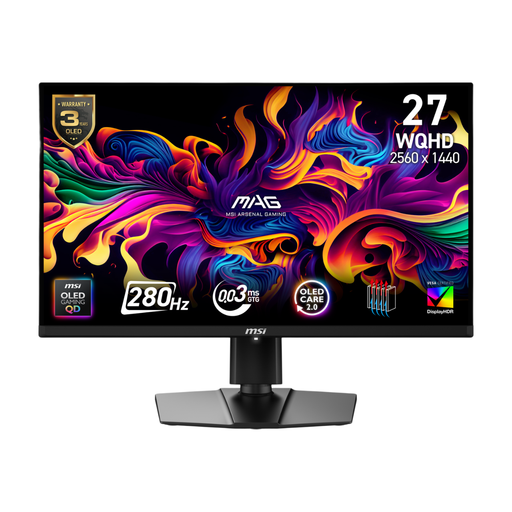
MSI MAG 271QP QD-OLED X28 gaming monitor

MSI MAG 271QP QD-OLED X28 27-inch

This QD-OLED model is worth considering when dark-room contrast and high refresh are priorities. MSI specifies QHD, 280Hz and DisplayHDR True Black 400 for the exact model. Check current availability and warranty terms; OLED Care 2.0 is described by MSI as reducing, not removing, burn-in risk.

View on Joybuy

Acer X Predator X49X curved ultra-wide QD-OLED gaming monitor

Acer X Predator X49X 49-inch curved QD-OLED

Choose this format only if a very wide display suits your desk and tactical games. Its title specifies a 32:9 aspect ratio, 1800R curve, Double Quad HD, 240Hz and AMD FreeSync Premium. Confirm the output your system can deliver, the exact HDR certification and the applicable OLED warranty terms.

View on Joybuy

Frequently asked questions

Does an HDR label guarantee strong dark-room performance?

No. Check the exact VESA DisplayHDR certification and how the particular monitor handles contrast and, for LCD models, local dimming. VESA distinguishes certified products from generic HDR claims, while RTINGS notes that poor local dimming can create halos or lose dark detail.

Should I choose OLED if my tactical games have fixed HUDs?

OLED remains an option, but repeated fixed HUDs make image-retention risk part of the decision. RTINGS found retention remained a consideration in accelerated static-content TV testing; that test is not a lifespan prediction for a particular monitor. Compare your usage habits with the monitor’s care instructions and warranty terms.

What should I check when the monitor arrives?

Test the intended resolution and refresh rate with your own PC or console, then check VRR, ports, HDR mode, shadow controls and the panel image. Keep the order and listing details: GOV.UK distinguishes remedies for faulty or misdescribed goods from change-of-mind returns and any voluntary retailer offer.

Are electrical-product rules the same throughout the UK?

No—not every provision operates in the same way. GOV.UK guidance says the Electrical Equipment (Safety) Regulations 2016 apply across the UK, with some provisions applying differently in Northern Ireland under the Windsor Framework. Check that the seller’s product documentation addresses the part of the UK where the monitor will be supplied.