What matters when choosing
For reaction practice in a bright room, identify your primary need before comparing specifications: fast motion, visibility under your lighting, or detail for uses beyond drills.
| Concern |
What to check |
Who this matters to |
| Motion and responsiveness |
Check input-lag measurements where available and response behaviour at the refresh rate you intend to use. Make sure your PC can deliver suitable game frame rates. |
When I practise fast reactions, I want moving targets to remain clear and the display to respond promptly; around 42% of consumers put motion and latency first. |
| Bright-room visibility |
Check the exact model’s screen finish and the measurement conditions for its brightness rating. Consider where windows and lamps will reflect. |
If light falls across my desk, distracting reflections could matter more than another refresh-rate step; roughly 33% of consumers make visibility their primary concern. |
| Resolution and wider use |
Compare your game frame rates at the resolution you want, and confirm which refresh mode your GPU output and connection support. |
I also need room for desktop work and more detailed games, so I may accept a different speed–resolution balance; about 25% of consumers prioritise that flexibility. |
Brands and models to compare
These examples show different specification choices for reaction-focused and mixed use; check the exact model rather than assuming a feature applies across a brand’s range.
Acer
The Nitro XV242 F is a compact FHD option for players considering very high refresh rates under bright lighting.
- Acer specifies 1920×1080, 540Hz, a 400 cd/m² brightness rating and an anti-glare surface for this model.
- FHD provides less image detail than QHD. Its stated 0.10ms response time is not a measurement of total input lag.
ZOWIE by BenQ
ZOWIE positions the XL2566X+ for FPS play rather than higher-resolution general use.
- ZOWIE specifies a 400Hz Fast TN panel and DyAc 2 for the XL2566X+.
- A manufacturer’s motion-clarity positioning is not an independent input-lag result; check the screen’s behaviour and connections for your setup.
ASUS ROG
The PG27AQDP combines a QHD workspace with a high-refresh OLED mode.
- ASUS specifies a 26.5-inch QHD WOLED panel, 480Hz refresh rate, anti-glare surface and OLED-care functions.
- ASUS’s 1,300 cd/m² figure is an HDR peak rating, not a general bright-room score. Approaching 480Hz in QHD also depends on the PC and game.
LG UltraGear
The 27GX790A-B is a QHD OLED option for buyers seeking a 27-inch, 480Hz format.
- LG specifies QHD resolution, 480Hz and adaptive-sync support for this model.
- For a bright-room setup, check the exact screen finish and likely reflections before choosing it.
Alienware
Dell offers separate approaches for buyers balancing image detail with high refresh rates.
- Dell lists the AW2725DF as QHD 360Hz QD-OLED and the AW2725QF with 4K 180Hz and FHD 360Hz modes.
- Neither model runs its higher-resolution mode at 480Hz or 540Hz; check which mode and connection fit your intended use.
Joybuy products for this setup
These two monitors cover different choices within this setup: an LG dual-mode OLED for switching between 4K detail and FHD refresh speed, and a Gawfolk FHD screen with an anti-glare specification. Compare their stated modes against your reaction-training needs rather than treating them as equivalent high-refresh options.
 No image available
LG UltraGear 32GS95UV-B 32-inch OLED dual-mode monitor
Consider this model if you want to switch between a detailed display mode and a faster FHD mode for reaction practice.
Its stated modes are 4K at 240Hz and FHD at 480Hz. The product name also specifies 0.03ms response time, DisplayPort, HDMI 2.1, NVIDIA G-Sync and AMD FreeSync Premium Pro.
Check that your PC and connection support the mode you intend to use. A stated response time does not establish measured input lag, and screen placement still matters in a bright room.
View on Joybuy
 No image available
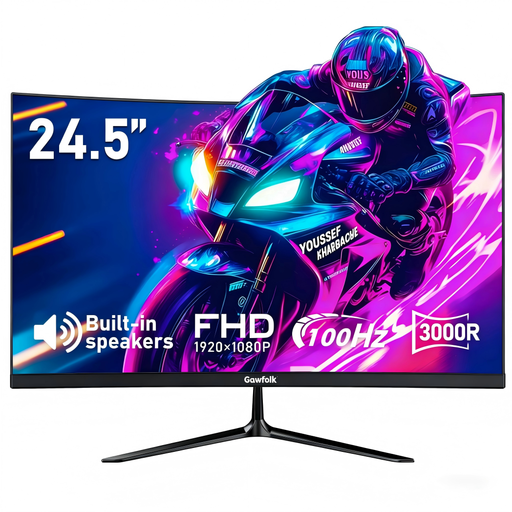
Gawfolk 24.5-inch FHD curved 100Hz monitor
Consider this FHD option if an anti-glare screen and adaptive synchronisation matter more to you than the refresh headroom of a 400Hz-plus model.
The product name specifies 100Hz, 1ms MPRT, 3000R curvature, AMD FreeSync and HDMI. MPRT is a response-time claim, not a measurement of total input lag.
Its 100Hz maximum offers less refresh headroom for fast-paced drills than the higher-refresh models discussed above. Check how the exact screen works with your room lighting and intended connection.
View on Joybuy
Common questions
Will a higher refresh rate automatically improve reaction timing?
No: a higher refresh rate can make motion feel smoother, but it does not establish a particular improvement in your reactions. RTINGS identifies input lag as important in fast-reaction games; pixel response, game frame rate and the PC-to-display connection also matter when choosing a monitor.
How can I use the refresh rate stated for my monitor?
Use a GPU output and cable that support the intended resolution and refresh mode, then select that mode in the operating system and monitor settings. If you also want variable refresh rate, confirm compatibility across the monitor and graphics hardware; ZOWIE and AMD describe compatible signals and hardware as requirements for their respective features.
Is variable refresh rate useful for reaction-training games?
It can help reduce tearing when game frame rate varies, provided the display and graphics hardware support the same feature. AMD describes FreeSync as synchronising a compatible display’s refresh rate with the graphics card’s frame rate; it does not replace checking input lag or motion behaviour at your chosen settings.
What if a monitor I buy in the UK is faulty?
Goods supplied by a trader under a consumer contract may be covered by remedies under the Consumer Rights Act 2015 when they do not conform to the contract. GOV.UK identifies faulty goods as a subject of the Act; keep your order record and tell the seller about the fault promptly. Fault-related rights are distinct from a retailer’s change-of-mind return policy.
How should I dispose of an old monitor in the UK?
Use an appropriate electrical-equipment collection or take-back route rather than putting an unwanted monitor in general household waste. GOV.UK identifies the Waste Electrical and Electronic Equipment Regulations 2013, as amended, as the underpinning UK legislation; check the collection options available where you live.


