What to check before buying
For information-heavy games, settle the resolution and comfortable screen position first, then match refresh rate and headphone routing to the rest of your setup.
27-inch 4K IPS
Choose it when: Maps, figures and simultaneous panels make workspace your main priority.
Trade-off: Check that interface scaling remains readable and your device can run games at the settings you want.
27-inch QHD IPS
Choose it when: You want room for a simulation interface but place greater weight on smooth movement across different games.
Trade-off: QHD has fewer pixels than 4K, so compare how much information remains visible at a comfortable scaling setting.
High-refresh OLED
Choose it when: You also play faster games and want the stated refresh and response characteristics of a particular OLED model.
Trade-off: Static maps and toolbars make panel-care guidance important; LG warns that prolonged static images may leave faint marks on its OLED monitors.
| Concern |
What to check |
Who this matters to |
| Readable workspace |
Compare resolution and interface scaling on the screen size you intend to buy. |
If I keep market figures and several management panels open, I need enough space without making their text hard to read. Roughly 36% of consumers put readable workspace first. |
| Smooth movement |
Check the refresh mode supported by your device, connection and cable. |
When I move around large maps and switch to faster games, I want motion to feel smooth without choosing a mode my system cannot use. For around 29% of consumers, that is the primary concern. |
| Screen position |
Measure desk depth and stand footprint; confirm the adjustment range or suitable VESA mounting. |
During long planning sessions, I need the screen directly ahead at a comfortable height and distance. Positioning comes first for roughly 21% of consumers. |
| Headphone routing |
Decide whether headphones connect to the source device or the monitor, then check the exact model's output. |
If I want headphones plugged in beside the screen, I need the display to provide the right connection. Around 14% of consumers make that routing convenience their main priority. |
Joybuy monitor choices
These monitors cover 4K workspace, a high-refresh QHD OLED option and a larger curved QHD option. Choose by the interface space, motion and headphone connection you need; check each model's stated limitations before ordering.
 No image available
LG UltraGear 27G810A-B 27-inch 4K IPS Dual Mode
Consider this model if 4K workspace for maps and data panels is your priority. Its title identifies a dual-mode monitor with a maximum stated refresh rate of 360Hz; check which resolution and connection apply to the mode you intend to use.
If you want headphones connected at the display, confirm the output and audio routing against your source device.
Joybuy
 No image available
LG UltraGear G8 27G850A 27-inch 4K Nano IPS Dual Mode
This is another 4K option to assess for information-dense interfaces. Refresh-mode figures for this listing conflict, so confirm the exact resolution and refresh combinations for this model before choosing it for high-refresh play.
Joybuy
 No image available
Samsung Odyssey G6 S27DG612 27-inch QHD OLED 240Hz
Consider this QHD OLED model if you also value high refresh in faster games. For simulations with persistent maps and toolbars, follow the model's OLED-care guidance; protective features are not a guarantee against image retention.
If headphones must connect at the monitor, check for the required output before ordering.
Joybuy
 No image available
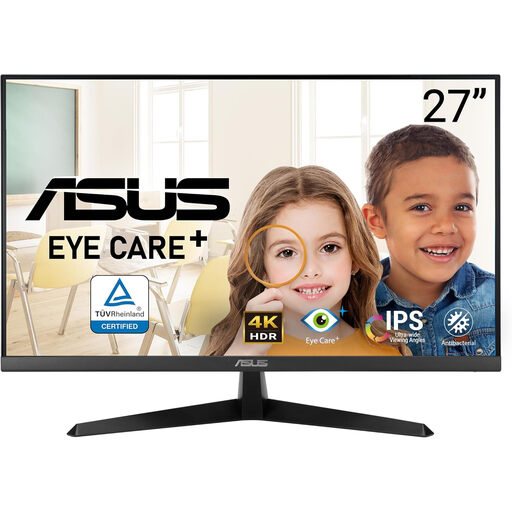
ASUS Eye Care VY27UQ 4K UHD 60Hz
Consider this 4K option if workspace takes precedence over high-refresh gaming. Its stated refresh rate is 60Hz; decide whether that suits the map movement you prefer, and check the stand's adjustment range if screen height matters to your setup.
Joybuy
 No image available
CRUA 32-inch 1500R curved QHD 165Hz gaming monitor
This larger curved QHD display is an option if you want a different screen size for maps and panels. Its title states 2560 × 1440 resolution, 165Hz refresh and VESA 100 × 100mm mounting; check desk space and your preferred viewing distance.
Confirm the connection needed for 165Hz and check audio outputs if you plan to plug headphones into the monitor.
Joybuy
Common questions
Do I need monitor speakers if I always use headphones?
No, monitor speaker quality need not drive the choice if your headphones connect directly to a computer, console or separate audio device. If you want them connected at the display, check that the exact monitor provides a suitable headphone output and that your source device routes audio as intended.
Is 240Hz necessary for an economic simulation?
No, 240Hz need not be your first requirement for an information-heavy simulation. Higher refresh can make movement look smoother, but choose a readable resolution and suitable screen position first, then check what frame rate and display mode your device can deliver.
How should I position a monitor for long sessions?
The Health and Safety Executive advises placing the screen directly in front of you, about an arm's length away, with its top around eye level. Check the stand's adjustment range, desk depth and any mounting requirements before buying.
What cancellation period applies to a UK online monitor order?
For an eligible distance-sale order, GOV.UK says customers can cancel up to 14 days after delivery without giving a reason. Check the applicable exceptions and the retailer's cancellation instructions before ordering; a change-of-mind cancellation is distinct from a remedy for faulty, damaged or misdescribed goods.


