What matters when choosing?
Decide how much screen space and detail you want for simulation interfaces, then check whether the display and your PC can deliver it comfortably in your room.
4K IPS or Mini-LED IPS
Consider it when: Detailed maps and a larger physical workspace matter most; check the individual model’s finish and normal brightness for your room.
Trade-off: 4K places greater rendering demands on your PC, and a 31.5-inch screen needs sufficient desk space.
QHD high refresh
Consider it when: You also play faster games and would rather run them at QHD than prioritise 4K map detail.
Trade-off: QHD has fewer pixels for dense interfaces; an advertised maximum refresh mode may require a particular connection.
4K OLED
Consider it when: You value OLED contrast and gaming speed as well as 4K detail, and can assess the screen in your lighting.
Trade-off: Check the exact model’s reflection handling and guidance on prolonged static images before using it for interface-heavy play.
| Concern |
What to check |
Who this matters to |
| Room-light readability |
Check the exact model’s surface finish and normal brightness, then consider where windows and lamps sit relative to your desk. |
If reflections obscure maps during daytime play, I need a screen I can position and adjust for that light. Around 42% of consumers put bright-room readability first. |
| Map detail and workspace |
Compare QHD and 4K at your viewing distance, alongside 27-inch and 31.5-inch screen sizes. |
When menus and resource data crowd the map, I want enough detail and physical space to read them together. For around 33% of consumers, interface workspace is the primary need. |
| Smoothness across games |
Match each resolution and refresh mode to your graphics output, cable and achievable game frame rate. |
If I also play faster games, I want a useful high-refresh mode without giving up the simulation view I normally use. Smoothness comes first for around 25% of consumers. |
Joybuy monitor choices
These choices span 4K OLED, 4K IPS and QHD VA monitors for simulation play. For a bright room, compare each model’s screen finish and normal brightness; for long sessions with persistent menus, also consider the OLED models’ static-image guidance.
 Image unavailable
LG UltraGear 32GX850A-B 32-inch 4K OLED
Consider its large 4K screen if you want room for detailed simulation interfaces as well as a dual-mode gaming display.
The product title lists a maximum 330Hz dual mode; check the resolution and connection required for the mode you intend to use. Confirm the screen finish and normal brightness for your room, and follow the product guidance on prolonged static images.
View on Joybuy
 Image unavailable
Samsung Odyssey OLED G8 LS32DG802SUXXU 32-inch Ultra HD
The 32-inch Ultra HD format is worth considering if you want a larger view of maps and data panels.
Check the exact surface finish and normal brightness before choosing it for strong room light. The product guidance warns against leaving static images on the OLED screen for long periods.
View on Joybuy
 Image unavailable
Dahua 32-inch curved 4K OLED gaming monitor, 165Hz
Consider this model if you want 4K detail on a larger curved screen and will also use its 165Hz gaming capability.
The title specifies 3840×2160 resolution and USB-C 65W. Check whether the curve suits your viewing position, and confirm the screen finish and normal brightness for your room.
View on Joybuy
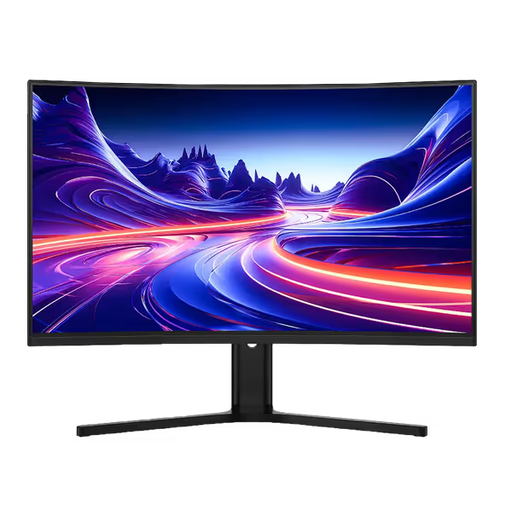 Image unavailable
Dahua 32-inch curved QHD VA gaming monitor, 180Hz
Choose between this QHD option and a 4K screen by checking how much interface detail you want at your normal viewing distance.
The title specifies 2560×1440 resolution, a VA panel and 180Hz. Check the required connection for your chosen mode and confirm the surface finish before using it in a bright room.
View on Joybuy
 Image unavailable
LG UltraGear 27G850A 27-inch 4K Nano IPS
Its 27-inch 4K format suits a smaller-screen setup where detailed simulation menus still matter.
The title lists dual 240Hz and 480Hz modes, DisplayPort 2.1 and HDMI 2.1. Check the resolution and PC connection needed for each mode, as well as the screen finish and normal brightness for bright-room use.
View on Joybuy
Common questions
How bright should a monitor be for a well-lit room?
There is no single brightness setting that suits every room and viewer. PC Monitors notes that relatively higher brightness generally makes more sense in a well-lit room; check the monitor’s normal brightness and adjust it in your own lighting rather than relying on its HDR peak figure.
Does an HDR label mean a monitor handles bright-room reflections?
No. HDR capability, normal brightness and screen finish answer different questions. VESA distinguishes its certified DisplayHDR tiers from generic HDR claims, so check the exact certification and the model’s surface specification separately.
Will a high-refresh monitor run my games at its advertised maximum?
Not automatically: the selected resolution, monitor input, graphics output, cable and game frame rate all matter. LG says the 27GS85Q-B’s 200Hz overclocked mode requires a DisplayPort 1.4-capable graphics card and cable, while Dell specifies different 4K and Full HD refresh modes for the AW2725QF.
Can I wall-mount a gaming monitor instead of using its stand?
Yes, if the exact monitor supports mounting and the mount and installation are suitable for its size and weight. ASUS specifies a 100×100mm VESA mounting pattern for the XG32UCG; check another model’s own specification rather than assuming it uses the same pattern.
Should I look for CE or UKCA marking for a monitor delivered in Great Britain?
For England, Scotland and Wales, GOV.UK guidance recognises CE marking alongside or instead of UKCA marking where the applicable product-regulation requirements are met. That Great Britain guidance does not establish the same conclusion for Northern Ireland; check the seller’s documentation for the delivery destination.


