Map-and-dashboard simulation players
If you spend long sessions reading maps, production chains, tables and finance panels, consider the space available for those interfaces before chasing the highest refresh-rate figure.


If your computer can run games at QHD and a 27-inch display fits your desk, prioritise a 2560 × 1440 IPS monitor for information-dense economic simulations. A smaller Full HD screen is worth considering when space or graphics capability matters more; treat a higher refresh rate as a secondary feature whose usefulness depends on your computer and the games you play.
If you spend long sessions reading maps, production chains, tables and finance panels, consider the space available for those interfaces before chasing the highest refresh-rate figure.
One screen may need to serve both study and gaming. Check its size, stand and viewing distance against your desk; the Health and Safety Executive advises placing the top of the screen at eye level and the display about an arm’s length away.
Match the monitor’s resolution and refresh mode to the video output and game frame rates your computer can provide. A monitor’s advertised refresh rate does not increase the frames produced by the computer.
Start with readable game interfaces and a screen that fits your desk, then check what your computer can drive. Compare refresh rates once those requirements are settled.
| Concern | What to check | Who this matters to |
|---|---|---|
| Readable workspace | Compare native resolution and screen size; check whether text remains comfortable at your preferred display scaling. | If maps and finance panels compete for space, I want to see more of the interface without constant switching. Around 31% of consumers put readable workspace first. |
| Desk fit and positioning | Measure desk width and depth, including the stand; check height adjustment or suitable VESA mounting. | On a restricted desk, I need room to place the screen centrally and far enough away for comfortable use. Around 23% of consumers prioritise fit and positioning. |
| Computer compatibility | Check the laptop or graphics card’s output, cable and supported resolution-and-refresh combination. | If I am keeping my current computer, I want a display mode it can actually output while running my games. Around 31% of consumers make compatibility their primary concern. |
| Smoothness across games | Compare the refresh rate supported through the port you will use, alongside the frame rates your games achieve. | When I also play faster-moving games, smoother motion matters beyond reading simulation screens. Around 15% of consumers put that extra smoothness first. |
A 180Hz or 200Hz specification does not mean your computer will produce that many game frames. Monitor refresh rate and PC frame rate are different.
Check your game frame rates and the refresh mode available through the HDMI or DisplayPort connection you intend to use.
Screen size alone does not tell you whether the stand leaves enough room to place the display at a usable height and distance.
Measure the desk and stand footprint. The Health and Safety Executive advises keeping the top of the screen at eye level and positioning the display about an arm’s length away.
If the supplied stand cannot achieve that position, you may need a suitable riser, monitor arm or replacement stand.
A low-blue-light, anti-flicker or HDR label does not settle how the screen will work in your room or where it can sit on your desk.
Check stand adjustment, room reflections and the features you will use for games and coursework rather than relying on a label alone.
AOC’s Q27G4X illustrates the 27-inch QHD IPS route: AOC specifies a 2560 × 1440 Fast IPS panel, 180Hz refresh rate and Adaptive Sync.
MSI specifies its MAG 274QRF QD E2 as a 2560 × 1440 Rapid IPS monitor with 180Hz refresh and Adaptive-Sync.
LG specifies a 27-inch QHD Nano IPS panel and native 180Hz refresh rate for the 27GS85Q-B.
Dell’s G2724D is a reference for comparing desk-positioning features on a 27-inch QHD monitor.
These QHD gaming monitors offer screen sizes around 27 inches for a setup shared between economic simulations and other games. Compare their panel types, refresh specifications and desk-positioning needs against your computer and available space.
 No image available
Consider this 27-inch QHD model if you want room for simulation interfaces and also play games where its higher refresh specification matters to you.
Its title specifies an OLED panel, 240Hz refresh rate and 0.03ms response time. Check your computer’s supported display modes and measure the space available for the screen and stand.
 No image available
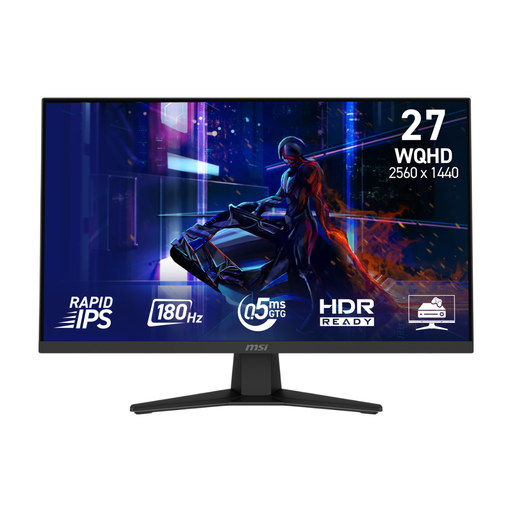
This QHD IPS option suits a desk where simulation workspace matters and the screen can be positioned comfortably.
The product title specifies a 27-inch WQHD panel, 180 refresh rate, 0.5ms response time and Adaptive Sync. Check the refresh mode supported by your chosen connection and whether the stand’s tilt adjustment gives you the height you need.
 No image available
Consider this near-27-inch QHD model if you want space for dense game interfaces as well as a high-refresh specification for other games.
Its title specifies a 2560 × 1440 QD-OLED panel, 240Hz refresh rate and 0.03ms response time. Check the display modes your computer can output and whether the stand will place the screen comfortably on your desk.
 No image available
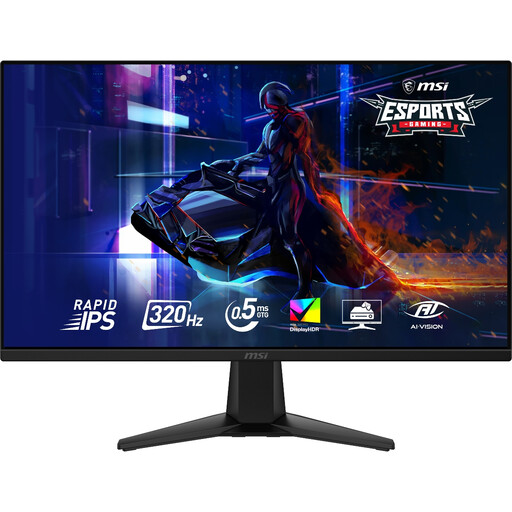
The 27-inch WQHD format is relevant if fitting simulation maps and panels on screen is your starting point.
Its title specifies 2560 × 1440 resolution, a Rapid IPS panel, 320Hz refresh rate, 0.5ms response time and Adaptive-Sync. Check whether your computer and chosen connection support the mode you intend to use, and whether tilt adjustment is sufficient for your desk.
 No image available
This 27-inch QHD format is worth considering when readable simulation maps and menus are the main requirement.
The product title specifies a 2560 × 1440 Fast IPS panel and 220Hz refresh rate. Check the refresh modes available through your computer’s connection and whether the stand allows a comfortable screen position.
No: 180Hz is not a prerequisite for playing economic simulations. Slower strategy games generally make less use of very high refresh rates than competitive shooters or racing games, and a monitor’s refresh rate is not the same as the frame rate produced by your PC. If you also play faster games, compare refresh rates after checking resolution, desk fit and computer output.
Place it centrally at a distance you can use comfortably. The Health and Safety Executive advises setting the top of the screen at eye level and keeping the display about an arm’s length away; check whether the supplied stand or a suitable mount lets you achieve that position.
Possibly, but the usable resolution and refresh rate depend on the laptop’s video output and the connection you choose. Check the supported modes before buying: LG, for example, says the 200Hz overclock mode on its 27GS85Q-B requires a graphics card supporting DisplayPort 1.4 and a DisplayPort 1.4 cable.
Check the seller’s electrical-waste take-back arrangements before ordering rather than assuming delivery includes collection. GOV.UK’s guidance on retailer take-back distinguishes the in-store service from home collection, for which transport charges may apply; confirm the process offered for your order.