What to check before buying
Choose a screen format that fits the desk and viewing position before comparing panel technology and headline refresh rates.
27-inch QHD Fast IPS
Choose when: A conventional 16:9 screen and straightforward long-session ownership take priority over OLED contrast.
Allow for: The usable refresh rate can depend on the input; Dell specifies QHD up to 144Hz over HDMI and 180Hz over DisplayPort for the AW2725DM.
Compact OLED
Choose when: OLED contrast and fast listed pixel response matter more to you than avoiding a panel-care routine.
Allow for: Follow the exact model's care prompts and check its warranty terms; Dell documents Pixel Refresh and Panel Refresh actions for affected Alienware OLED monitors.
34-inch ultrawide OLED
Choose when: You want a 21:9 display and have measured space for the screen and a comfortable central viewing position.
Allow for: The wider format is less forgiving of a crowded desk and still calls for model-specific OLED care checks.
| Concern |
What to check |
Who this matters to |
| Desk fit and viewing position |
Measure usable width and depth with the wheel and keyboard in place. Check that the screen can stay centred, roughly an arm's length away, with its top around eye level, as advised by the Health and Safety Executive. |
If my controls crowd the desk, I need a screen I can position comfortably throughout a stint. Around 36% of consumers put desk fit and viewing position first. |
| Panel care during long stints |
Read the exact OLED model's care instructions and check its warranty and seller terms; Dell documents refresh actions for affected Alienware OLED monitors. |
With persistent timing and telemetry displays, I would rather understand the panel-care routine before choosing OLED. Roughly 29% of consumers prioritise long-session ownership and panel care. |
| Motion and connections |
Match the desired resolution and refresh mode to the PC or console output, cable and monitor input. Confirm variable-refresh-rate support for that combination. |
If smooth motion leads my choice, the advertised rate matters only when my equipment can use the intended mode. About 21% of consumers put motion and connection capability first. |
| Immersion and HDR |
Check the stated VESA DisplayHDR tier rather than relying on generic HDR wording. Measure desk clearance before choosing a 34-inch 21:9 screen. |
For dark-track detail or a wider cockpit view, I may accept more panel-care or desk-space demands. Around 14% of consumers make immersion and HDR their primary concern. |
Joybuy monitor choices
These compact-screen choices cover IPS and OLED approaches for a small racing desk, including a 27-inch 4K IPS option alongside QHD models. Check each screen's physical fit and the connection mode you intend to use.
 No image available
LG UltraGear G8 27G850A 27-inch 4K Nano IPS
Consider this if you want a 27-inch IPS screen with 4K resolution rather than the QHD baseline. The title lists dual-mode 240Hz/480Hz operation, AMD FreeSync Premium Pro, DisplayHDR 600, DisplayPort 2.1 and HDMI 2.1; check which resolution and refresh combinations your chosen input and device can use. Measure the stand and wheel-base clearance.
Joybuy
 No image available
Acer X Predator X27U W3 26.5-inch QHD QD-OLED
Consider this compact OLED option if QHD and a high listed refresh rate suit your setup. Its title specifies 2560 × 1440, 240Hz, 0.03ms response, FreeSync Premium Pro and G-SYNC Compatible; confirm the desired input mode, panel-care instructions and exact seller warranty before buying.
Joybuy
 No image available
Samsung Odyssey G6 S27DG612 27-inch QHD OLED
Consider this if you want an OLED screen in a 27-inch QHD format. Its title specifies 240Hz and 0.03ms response; check that your device and cable support the mode you want, and review the model's panel-care and seller warranty terms.
Joybuy
 No image available
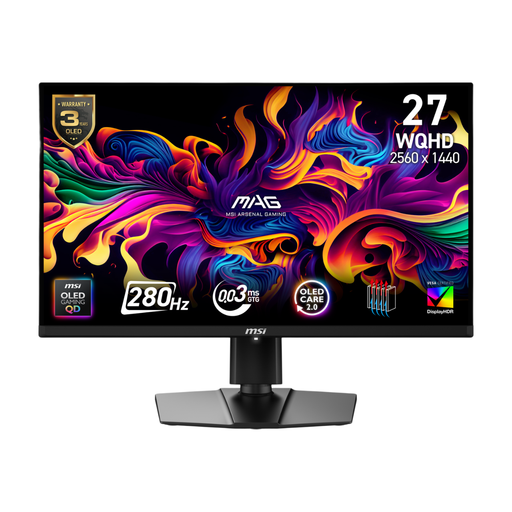
MSI MAG 271QP QD-OLED X28 27-inch QHD
Consider this compact QD-OLED if its listed 280Hz refresh rate fits your motion priorities. The title also specifies 0.03ms response; confirm the input mode and variable-refresh-rate compatibility you need, along with panel-care instructions and seller warranty terms.
Joybuy
 No image available
HKC G27H2DPro 27-inch QHD Fast IPS
Consider this for a 27-inch QHD IPS setup without an OLED panel-care routine. Its title specifies 2560 × 1440 and 220Hz; confirm the refresh mode available through your connection, and check the stand footprint and positioning options against your desk.
Joybuy
Common questions
What size monitor should I assess first for a small racing desk?
Assess a flat 27-inch QHD monitor first, then measure before moving to a 34-inch ultrawide. The Health and Safety Executive advises keeping a display directly in front of you, with its top around eye level and the screen roughly an arm's length away, so desk depth and wheel-base clearance matter as well as diagonal size.
Do I need DisplayPort for the full refresh rate?
That depends on the exact monitor and mode. Dell specifies QHD up to 144Hz over HDMI and 180Hz over DisplayPort for the Alienware AW2725DM; LG says the 27GS85Q-B's 200Hz overclock mode requires a DisplayPort 1.4-capable graphics card and cable. Check your monitor, device and cable together.
Does OLED make sense for long sessions with fixed HUD elements?
OLED can make sense if its contrast and fast listed pixel response justify following the exact model's care guidance. For affected Alienware OLED monitors, Dell directs users to run Pixel Refresh or Panel Refresh when the relevant panel-health status calls for it; check maintenance instructions and warranty terms before choosing.
How can I assess an HDR claim?
Look for an exact VESA DisplayHDR or DisplayHDR True Black certification tier rather than relying on generic HDR wording. VESA says a display must meet the relevant specifications to use its DisplayHDR logo; check the stated tier for the particular model.
Should I plan breaks during long virtual endurance practice?
Plan opportunities to look away from the screen or change activity during long stints. For employment display-screen use, the Health and Safety Executive gives 5 to 10 minutes every hour as an example preferable to 20 minutes every two hours; that guidance is a setup consideration for personal practice, not a racing-performance rule.


