Single-cable laptop players
You play exploration games on a USB-C laptop and want one monitor connection to carry the picture and charge the laptop, provided its video output and charging requirements are compatible.


If you play on a USB-C laptop, a monitor that accepts video over USB-C and supplies enough Power Delivery for that laptop may let you leave its separate charger unplugged; the monitor still needs a mains socket. For exploration games, weigh screen format, image detail and contrast alongside refresh rate. An ultrawide OLED and a conventional QHD display serve different viewing preferences, but neither format alone solves the socket problem.
You play exploration games on a USB-C laptop and want one monitor connection to carry the picture and charge the laptop, provided its video output and charging requirements are compatible.
You pay close attention to landscapes, darker areas, colour and viewing width, rather than choosing a screen solely for its highest refresh-rate figure.
You want a QHD gaming display for exploration games and can keep a separate laptop charger or another existing power arrangement.
Start with the gaming device: socket savings depend on laptop charging and video compatibility, while your preferred screen format and supported connection determine which display specifications are useful.
| Concern | What to check | Who this matters to |
|---|---|---|
| Fewer chargers | Check USB-C video input, the monitor's Power Delivery rating and the laptop's video-output and charging requirements. | If I have few sockets, I want to know whether the monitor can charge my gaming laptop while showing the game. Around 42% of consumers put reducing separate charger use first. |
| Scenery and visibility | Compare resolution, aspect ratio, panel type and the exact model's HDR specifications; confirm that your games and device support the format you want. | I want landscapes, maps and darker areas to look clear on a screen format I enjoy using. For around 33% of consumers, that viewing experience is the primary concern. |
| Smooth movement | Check the refresh rate at your intended resolution and whether a higher, overclocked mode needs a particular graphics output or cable. | When I turn the camera or travel through a game world, I care about responsive motion but can use a separate charger. Smooth gameplay comes first for around 25% of consumers. |
Charging power varies by model. LG UK specifies 65W Power Delivery for the 34GX900A-B; ASUS ROG lists up to 90W for the PG32UCDMZ, but says its default setting is 65W.
Confirm that the laptop supports USB-C video output and charging, then compare its charging requirement with the monitor's stated output and settings.
If the monitor cannot supply what the laptop needs, you may still need its separate charger.
A higher mode can depend on the graphics output and cable. LG UK lists the 27GS85Q-B at 180Hz natively and specifies DisplayPort 1.4 graphics support and a DisplayPort 1.4 cable for its 200Hz overclock mode.
Check the exact mode and connection requirements against your gaming device before choosing on the headline refresh rate.
Exploration games can leave maps and other interface elements in fixed positions for long periods. ASUS ROG describes OLED Care features for the PG32UCDMZ as measures intended to reduce burn-in risk, not eliminate it.
For an OLED model, read its panel-care guidance and warranty terms, and use the care settings provided by its manufacturer.
The LG UK range includes both ultrawide OLED and conventional QHD IPS gaming monitors.
BenQ UK presents this gaming-monitor line in the context of AAA open-world games.
The PG32UCDMZ is a 4K QD-OLED gaming model with USB-C Power Delivery, according to ASUS ROG United Kingdom.
These choices span ultrawide OLED, 4K OLED and conventional QHD screens for exploration games. If freeing a socket is your priority, check the selected monitor's USB-C video and charging functions against your laptop before deciding.
 No image available
Consider this wide-format screen if your desk, games and graphics output suit an ultrawide display.
49-inch 32:9 QD-OLED panel; 1800R curve; 240Hz; DisplayHDR 400 True Black. The title lists USB-C, but confirm video and charging support for your laptop.
 No image available
This is a 4K OLED option for a player who also wants to assess charging a compatible laptop through the monitor.
3840 × 2160 resolution; 165Hz; Type-C 65W. Confirm USB-C video support and whether 65W meets your laptop's charging requirement.
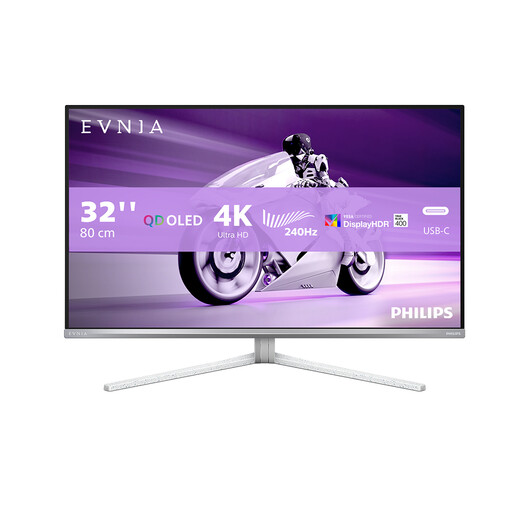 No image available
Consider this for a 32-inch OLED gaming setup, subject to confirming the connections your laptop or gaming device needs.
Check the exact variant's refresh rate before buying, as the product information gives conflicting figures. Review panel-care guidance if your games keep interface elements on screen.
 No image available
This conventional-format option suits a player prioritising QHD resolution and a listed high refresh rate over a wider screen.
2560 × 1440 resolution; 220Hz. Check your device's output capability and the monitor's charging connections if socket savings matter.
 No image available
Consider this larger curved QHD screen if it fits your desk and your gaming device supports the resolution and refresh rate you intend to use.
2560 × 1440 resolution; 165Hz; HDMI and DisplayPort. Confirm colour coverage if that specification drives your choice, and check charging connections separately.
No: the monitor itself still needs mains power. It may let a compatible laptop share its display connection and charging cable, removing the laptop's separate charger only if USB-C video works and the monitor supplies enough power.
Not on refresh rate alone. Consider the screen's resolution, format and contrast specifications alongside the motion you want, then check that your gaming device can deliver the chosen mode.
It requires the connections specified for that exact monitor. For example, LG UK says the 27GS85Q-B's 200Hz overclock mode needs a graphics card supporting DisplayPort 1.4 and a DisplayPort 1.4 cable; LG lists 180Hz as its native refresh rate.
In the UK, GOV.UK says retailers covered by electrical-waste take-back obligations must offer to take back waste equipment of the same type as the item purchased. Check the retailer's take-back arrangements when planning to replace your monitor.