Consider a 32-inch 4K OLED monitor if dark-scene presentation is your priority and you can accommodate its panel-care guidance during prolonged static use. A 32-inch 4K IPS model keeps the 16:9 format for gaming and desktop use, while a 34-inch 3440 × 1440 curved ultrawide offers a wider 21:9 view instead of 4K resolution. Whichever format you prefer, check the resolution and refresh rate your gaming device can deliver through the connection you plan to use.
Who each format suits
Cinematic world explorers
If you spend more time exploring landscapes and dark interiors than pursuing competitive frame rates, compare 4K detail, panel type and the exact HDR specification. Dell UK’s AW3225QF and LG UK’s 32GR93U-B illustrate different panel routes at this size.
Ultrawide immersion seekers
If a wider view and a curved screen appeal more than a 16:9 4K image, look at 21:9 models. BenQ UK specifies its EX3410R at 3440 × 1440, so check that your games and device support the format you intend to use.
Mixed-use PC players
If the monitor will also show browser windows and work applications for long periods, weigh connections, stand adjustment and static-content habits alongside game visuals. RTINGS notes that prolonged static, high-contrast images are relevant to image retention.
What matters when choosing
32-inch 4K OLED
Choose when: Dark scenes and a 16:9 4K image are central to your gaming.
Bear in mind: Long periods of static, high-contrast content make panel-care guidance relevant.
32-inch 4K IPS
Choose when: You want a large 16:9 4K LCD for both games and desktop tasks.
Bear in mind: LG UK’s 32GR93U-B has a different panel type and HDR certification from Dell UK’s OLED AW3225QF; an HDR label alone does not establish the same dark-scene presentation.
34-inch curved ultrawide
Choose when: A wider 21:9 game view matters more to you than 16:9 4K resolution.
Bear in mind: Check support for the intended aspect ratio in your games and source device.
| Concern | Buying checks | Who this matters to |
|---|
| Dark scenes and HDR |
Compare the exact panel type and named HDR certification, rather than relying on an HDR label alone. |
I want caves and night scenes to be a priority in the picture I choose; around 36% of consumers put cinematic contrast and HDR atmosphere first. |
| Screen format |
Compare 16:9 3840 × 2160 with 21:9 3440 × 1440; check desk dimensions and game support. |
A wider, curved view matters more to me than retaining a 4K image. Around 29% of consumers place large-format immersion first. |
| Smooth play and connections |
Check supported resolution and refresh-rate combinations for your device, port and cable. |
I want movement to feel smooth without choosing a mode my setup cannot use; around 21% of consumers prioritise refresh-rate and device compatibility. |
| Mixed-use ownership |
Review panel-care and warranty terms, stand adjustment and the inputs needed for your devices. |
My monitor will show static desktop content as well as games, so everyday use affects my panel choice. Around 14% of consumers put mixed-use ownership first. |
Buying pitfalls
-
Assuming every HDR label means the same dark-scene presentation
Dell UK lists DisplayHDR True Black 400 for the QD-OLED AW3225QF, while LG UK lists DisplayHDR 400 for the IPS 32GR93U-B. The labels refer to different model specifications.
Compare the exact panel type and named HDR certification on each model page before choosing for dark scenes.
-
Relying on a refresh rate without checking the connection
BenQ UK specifies up to 144Hz through DisplayPort for the EX3410R, but up to 120Hz through HDMI.
Check the resolution and refresh-rate mode available through the port and cable you will use with your PC or console.
-
Treating a 34-inch ultrawide as a larger 4K screen
BenQ UK’s 34-inch EX3410R uses a 3440 × 1440, 21:9 format; LG UK’s 32-inch 32GR93U-B uses 3840 × 2160. Width and resolution are separate choices.
Decide whether a wider game view or a 16:9 4K image matters more, and check support for the chosen format.
-
Overlooking static-content habits with OLED
RTINGS describes image retention after static, high-contrast content remains on screen for long periods, although it says major issues are uncommon on modern monitors and can vary by unit.
If you regularly leave a desktop, browser window or game interface on screen, read the exact model’s care instructions and warranty terms; consider IPS if long static sessions dominate your use.
Brands to consider
Alienware
A reference for the 32-inch 4K QD-OLED route: Dell UK specifies the AW3225QF as a 31.6-inch, 240Hz model.
- Dell UK also lists 0.03ms GTG response time and adaptive-sync support for this model.
- Those specifications are specific to the AW3225QF; consider your static-content habits before choosing an OLED monitor.
LG UltraGear
A reference for the 32-inch 4K IPS route: LG UK specifies the 32GR93U-B at 3840 × 2160 and 144Hz.
- LG UK lists an IPS panel, 1ms GTG response time and DisplayHDR 400 for this model.
- Its panel type and HDR certification differ from those of the cited QD-OLED model; compare the exact displays rather than treating their HDR labels as interchangeable.
Samsung Odyssey
A further 32-inch 4K OLED reference: Samsung UK lists the Odyssey OLED G8 G80SH as a QD-OLED model with a 240Hz refresh rate.
- Samsung UK specifies glare-free treatment, DisplayPort 2.1 and USB-C with up to 98W for the G80SH.
- Confirm the supported modes and features with your particular device and cable; these G80SH specifications should not be assumed for other Odyssey variants.
BenQ MOBIUZ
A reference for the curved ultrawide route: BenQ UK specifies the EX3410R as a 34-inch, 3440 × 1440, 21:9 VA monitor with 1000R curvature.
- BenQ UK lists up to 144Hz through DisplayPort for this model.
- Its stated HDMI maximum is 120Hz, and its 3440 × 1440 format is not 4K.
Joybuy monitors for these formats
These monitors offer 32-inch OLED and 34-inch ultrawide options for a large-screen gaming setup. Choose the screen format first, then check the connection modes and panel-care terms that matter for your use.
 No image available
Samsung Odyssey Gaming OLED G8 LS32DG802SUXXU, 32-inch Ultra HD
Consider this 32-inch OLED model if a large Ultra HD image is your priority for fantasy games. Check its HDR designation, supported modes for your device and OLED care guidance before buying.
View on Joybuy
 No image available
LG UltraGear 34GX900A-B, 34-inch OLED WQHD, 240Hz
Consider this 34-inch OLED model if a wider gaming screen matters more than the 32-inch 4K format. The product name specifies WQHD and 240Hz; check your games’ format support, available connection modes and OLED care guidance.
View on Joybuy
 No image available
Lenovo R34w-30, 34-inch UWQHD gaming monitor
Consider this 34-inch UWQHD model if screen width is central to your choice. Check that your games and source device support the intended format, then confirm the refresh-rate mode for the connection you will use.
View on Joybuy
 No image available
Dahua 32-inch 4K 165Hz curved OLED gaming monitor
Consider this curved OLED model if you want a 32-inch 3840 × 2160 screen. Its product name lists 165Hz and 0.03ms GTG; confirm the refresh mode available with your device and the exact HDR specification before buying.
View on Joybuy
 No image available
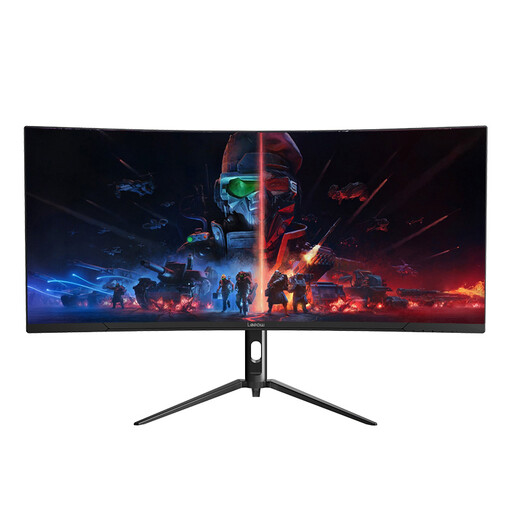
Lepow HC-SJ34MZ5, 34-inch 3440 × 1440 curved ultrawide, 165Hz
Consider this curved ultrawide if a wider game view takes priority over 4K. The product name specifies 3440 × 1440 and 165Hz; check game support and the mode available through your chosen connection.
View on Joybuy
Common questions
Does a 34-inch ultrawide show the same image format as a 32-inch 4K monitor?
No. BenQ UK specifies its 34-inch EX3410R at 3440 × 1440 in a 21:9 format, while LG UK specifies its 32-inch 32GR93U-B at 3840 × 2160. Choose according to whether you want the wider format or a 16:9 4K image, and check support in your games.
What should I check before expecting a monitor’s highest refresh rate?
Check the stated resolution, port and cable combination for your device. BenQ UK lists up to 144Hz through DisplayPort but up to 120Hz through HDMI for the EX3410R, so its maximum stated rate depends on the connection.
Should I rule out OLED if I also use the monitor for work?
Not automatically, but prolonged static desktop content should be part of the decision. RTINGS notes that static, high-contrast images can cause image retention, while major issues are uncommon on modern monitors and can vary by unit; review the exact model’s care and warranty terms, and consider IPS if long static sessions are central to your use.


