Who these monitors suit

Competitive PC football players

If following quick changes of play is your priority, compare the refresh rate available through your PC connection, the stated response-time mode and adaptive-sync compatibility. Dell, ASUS and LG specifications show why the monitor’s maximum rate alone does not tell you what every input can deliver.

PS5 or Xbox console players

Start with the output you want your console to send. PlayStation provides a PS5 test for supported 1440p, 60Hz or 120Hz and VRR output; Xbox Support specifies the display and cable requirements for Series X 4K at 120Hz.

Long-session desk gamers

If screen position matters over a long session, compare the stand’s adjustment range with your desk and seated position. The specified Dell G2724D, ASUS XG27ACS and BenQ MOBIUZ examples offer height adjustment, while mounting still depends on the exact monitor and arm.

What matters when choosing

QHD high-refresh IPS

Consider it: For desk-based PC play, or PS5 play where the display supports the intended 1440p output.

Check: The highest refresh rate may require DisplayPort or USB-C rather than HDMI, as ASUS specifies for the XG27ACS.

4K with HDMI 2.1

Consider it: When 4K console output is your priority and the source can use the intended HDMI connection.

Check: Xbox Support requires a compatible Series X, HDMI 2.1 display and Ultra High Speed HDMI cable for 4K at 120Hz; a monitor’s 144Hz rating does not change a game’s output.

QHD high-refresh OLED

Consider it: For PC-led QHD play when the source can use a particularly high refresh rate.

Check: LG’s 27GS95QE-B is specified at QHD rather than 4K, and its brightness figures depend on measurement conditions.

Concern What to check Who this matters to
Smooth motion Check refresh rate by input and VRR support for your device; keep GtG and MPRT response-time figures distinct. When play moves quickly, I want to follow the ball without relying on a refresh rate my PC cannot output. Around 36% of consumers might put motion first.
Console connection Match the console’s target resolution and rate to the monitor’s HDMI input and cable; check VRR separately. If I play on a console, I need the whole connection to deliver the video mode I intend to use. For around 29% of consumers, compatibility might be the primary concern.
Desk position Compare desk dimensions and stand adjustment; if using an arm, check the VESA pattern and arm capacity. During a long session, I need to position the screen to suit my desk rather than work around a fixed stand. Positioning might come first for around 21% of consumers.
Image presentation Decide whether 4K detail or a QHD OLED’s stated characteristics matter more; compare HDR and brightness figures under their stated conditions. I care most about how the pitch and players look, but I still need my device to use the display mode I choose. Around 14% of consumers might prioritise image presentation.

Buying pitfalls

  • Assuming every input supports the headline refresh rate

    ASUS specifies up to 180Hz through DisplayPort or USB-C on the XG27ACS but up to 144Hz through HDMI. Dell likewise specifies different DisplayPort and HDMI rates for the G2724D.

    Check the rate for the exact input you will connect to your PC or console.

  • Checking the monitor but not the Xbox connection

    Xbox Support says Series X 4K gaming at 120Hz requires an HDMI 2.1 display and an Ultra High Speed HDMI cable as well as the console.

    Check the console model, monitor input, cable and video settings together.

    If you need a longer cable, Xbox Support advises using a certified Ultra High Speed HDMI cable.

  • Expecting VRR to behave identically in every PS5 game

    PlayStation says VRR results can vary with the display, game and visual mode; applying VRR to unsupported games can produce unexpected visual effects.

    Check the display’s reported VRR capability and test the intended game mode. If visual problems occur, review the setting for unsupported games.

  • Putting a replaced monitor in household rubbish

    GOV.UK guidance says electrical products bearing the crossed-out wheelie-bin symbol should not go in household rubbish.

    Use an appropriate electrical-waste collection point when disposing of a replaced monitor.

Brands to consider for these monitor routes

Dell

Dell’s G2724D is a 27-inch QHD Fast IPS reference for desktop play.

  • Dell UK specifies 165Hz through DisplayPort, 144Hz through HDMI, adaptive-sync support and a height-adjustable stand.
  • Its different input limits make the planned connection important when comparing refresh rates.

LG UltraGear

The LG UltraGear 27GS95QE-B represents a 27-inch QHD OLED route for high-refresh PC play.

  • LG UK specifies QHD at 240Hz, HDMI 2.1 and adaptive-sync compatibility for this model.
  • It is not a 4K model, and LG’s stated brightness varies with the measurement conditions.

ASUS ROG Strix

The XG27ACS is a 27-inch QHD Fast IPS example with an adjustable stand.

  • ASUS UK specifies a 180Hz maximum, Adaptive-Sync, height adjustment and 100 × 100mm VESA mounting.
  • ASUS distinguishes its DisplayPort and USB-C maximum from HDMI operation up to 144Hz.

BenQ MOBIUZ

The MOBIUZ EX2710Q and EX2710U illustrate different QHD and 4K choices within the line.

  • BenQ specifies QHD at 165Hz for the EX2710Q and 4K at 144Hz with HDMI 2.1 for the EX2710U.
  • The EX2710U’s monitor rating alone does not establish what a particular console game will output.

Joybuy monitors for long sessions

These monitors cover 4K dual-mode, QHD high-refresh and larger curved-screen options for football games. Compare each one with your source connection and available desk space rather than treating their headline rates as interchangeable.

LG UltraGear G8 27G850A gaming monitor

LG UltraGear G8 27G850A, 27-inch 4K dual-mode monitor

Consider this for a 4K desktop setup if your source can use the mode you want.

The product name specifies a Nano IPS panel, 240Hz/480Hz dual mode, HDMI 2.1, DisplayPort 2.1 and AMD FreeSync Premium Pro. Check which resolution and refresh rate your intended input can deliver.

View on Joybuy
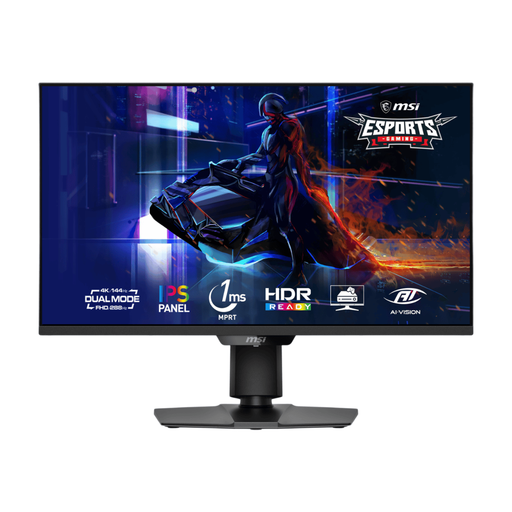
MSI MAG 275UPD E14 gaming monitor

MSI MAG 275UPD E14, 27-inch 4K dual-mode monitor

Consider this if you want a 4K option and can check the output path for your PC or console.

The product name specifies UHD at 144Hz and a separate FHD 288Hz mode, plus Adaptive Sync. For Xbox Series X 4K at 120Hz, check the monitor input and cable against Xbox Support’s HDMI 2.1 requirements.

View on Joybuy

Samsung Odyssey G6 S27DG612 gaming monitor

Samsung Odyssey G6 S27DG612, 27-inch QHD OLED monitor

Consider this for QHD play if a high stated refresh rate matters more to you than 4K resolution.

The product name specifies OLED, 240Hz and 0.03ms GtG. Check the refresh rate supported by your source and intended input, and assess the screen under your usual room lighting.

View on Joybuy

CRUA 32-inch curved QHD gaming monitor

CRUA 32-inch 1500R curved QHD gaming monitor

Consider the larger curved screen if it fits your desk and viewing position for longer sessions.

The product name specifies 2560 × 1440, 165Hz, HDMI and DisplayPort connections, and 100 × 100mm VESA mounting. Check the rate available through your chosen input and the fit of any monitor arm.

View on Joybuy

HKC G27H2DPro gaming monitor

HKC G27H2DPro, 27-inch QHD Fast IPS monitor

Consider this for desk-based QHD play if your gaming device can use a high-refresh connection.

The product name specifies 2560 × 1440 and 220Hz. Before choosing it for a long session, check the rate through your intended input and whether its stand or mounting options suit your desk.

View on Joybuy

Common questions

Should I choose 1440p or 4K for football games?

Choose 1440p for a high-refresh desktop setup if your PC can use it, or if you want to test supported PS5 1440p output; choose 4K if detail is the priority and your source supports the intended mode. PlayStation provides PS5 tests for supported 1440p output at 60Hz or 120Hz and VRR, while Xbox Support requires an HDMI 2.1 display and Ultra High Speed HDMI cable for Series X 4K at 120Hz.

Will a 180Hz or 240Hz monitor run at that rate on my console?

Not necessarily: the game, console output, cable, monitor input and settings all affect the rate you can use. ASUS, for example, specifies up to 180Hz through DisplayPort or USB-C on the XG27ACS but up to 144Hz through HDMI.

How do I check VRR on PS5?

Connect a display with a compatible VRR path, then check the PS5 video-output settings and test the mode you intend to play. PlayStation says results can vary by display, game and visual mode, so VRR should not be treated as a guarantee for every game.

Do I need a new cable for Xbox Series X 4K at 120Hz?

Use the supplied Ultra High Speed HDMI cable if it meets your setup needs. Xbox Support specifies that cable type and an HDMI 2.1 display for Series X 4K at 120Hz; if you need a longer cable, it advises a certified Ultra High Speed HDMI cable.

Can an old monitor go in household rubbish in the UK?

An electrical product bearing the crossed-out wheelie-bin symbol should not go in household rubbish, according to GOV.UK guidance. Use an appropriate electrical-waste collection point for a monitor you are replacing.