Choose OLED or QD-OLED if deep blacks and quick pixel response matter most in dark fantasy scenes, while allowing for the risk posed by prolonged static office content. If the screen will spend much of the day on documents and browser windows, a 27-inch QHD IPS monitor offers a lower-risk route for static use, though it cannot match OLED black levels. Check your PC’s game performance and your desk dimensions before settling on a resolution or size.
Who each approach suits
Cinematic fantasy-game players
If dark dungeons and night scenes are central to what you enjoy, OLED’s true blacks may matter more to you than minimising the risk from static office windows. DisplayNinja describes true blacks and rapid pixel response as OLED characteristics; extended static desktop use still needs consideration.
Hybrid work-and-play desk users
If one screen serves documents and games, give desk fit, adjustment, coating and connections as much attention as gaming features. The Health and Safety Executive notes that poorly designed display-screen workstations can contribute to discomfort and fatigue.
Balanced QHD buyers
If you want more screen detail than 1080p without taking on the graphics demand of 4K, QHD is worth considering. RTINGS describes 1440p as a middle ground between those resolutions; check how your own PC runs the games you intend to play.
What matters when choosing
For fantasy games on a shared home-office screen, choose the panel and resolution together: OLED contrast comes with a static-image consideration, while a work-first IPS choice gives up OLED black depth.
4K QD-OLED
Consider it when: Dark-scene detail is a priority and your PC and desk can accommodate the chosen 4K monitor.
Trade-off: RTINGS notes that 4K requires more processing power than 1440p; prolonged static office imagery also remains an OLED risk.
27-inch QHD OLED
Consider it when: You want OLED blacks in a smaller format while keeping graphics demand below 4K.
Trade-off: Static desktop elements still need care, and a high refresh rating does not establish what frame rate your games will reach.
27-inch QHD IPS
Consider it when: Documents and browser windows occupy much of the day and reducing OLED static-image risk matters more than black depth.
Trade-off: IPS does not produce OLED’s true blacks; compare the exact model’s coating, stand and connections for your desk.
| Concern | What to check | Who this matters to |
|---|
| Dark scenes and HDR |
Check the panel type and exact VESA DisplayHDR certification tier rather than relying on a general HDR label. |
If dark interiors and bright effects shape my choice, black depth and a credible HDR specification come first. Around 36% of consumers put this cinematic concern first. |
| Daily office use |
Compare the screen coating, stand adjustment and connections; for OLED, examine care features and warranty terms. |
When documents and toolbars stay open for long stretches, I want a screen that fits my working routine as well as my games. This is the leading concern for around 29% of consumers. |
| Resolution and PC performance |
Check game performance at the native resolution and the resolution and refresh rate supported by your PC’s output. |
If my PC cannot deliver the settings I want at 4K, I would rather choose a workable balance of detail and refresh capability. Around 21% of consumers make that balance their primary concern. |
| Desk fit and positioning |
Measure the available depth and stand space, then check dimensions and adjustment or mounting options. |
On a shallow or crowded desk, I need to know that I can place the screen comfortably before choosing a larger format. Desk fit comes first for around 14% of consumers. |
Buying pitfalls
-
Choosing OLED for games alone
OLED’s true blacks appeal in dark scenes, but prolonged bright, static desktop elements can contribute to permanent burn-in.
If documents or dashboards remain open for much of the day, compare OLED-care features and warranty terms. Consider QHD IPS if reducing this risk takes priority over OLED contrast.
-
Assuming any HDR label means the same thing
A general HDR claim does not identify a certified performance tier. VESA says displays carrying its DisplayHDR logo must meet the relevant specifications.
Check the exact model’s stated VESA DisplayHDR or DisplayHDR True Black tier if certified HDR performance matters to you.
-
Choosing a refresh rating before checking the PC
RTINGS notes that 4K needs more processing power than 1440p. A monitor’s maximum refresh rate does not mean a particular PC and game will deliver that many frames.
Look at performance in the games you play at the intended resolution, and check your PC’s HDMI or DisplayPort output capabilities.
-
Choosing screen size before measuring the desk
Screen and stand dimensions determine whether the monitor can be positioned comfortably. The Health and Safety Executive identifies poorly designed display-screen workstations as a potential contributor to discomfort and fatigue.
Measure desk depth and stand space, then check the model’s dimensions, adjustment range and mounting options.
Relevant brands to consider
ASUS ROG
The ROG Swift OLED PG32UCDM is a 4K QD-OLED example for buyers considering a larger screen and desk-oriented connectivity.
- ASUS ROG specifies a 31.5-inch panel, 240 Hz refresh rate and 90 W USB-C power delivery for this model.
- Check PC capability and desk fit; the model’s OLED care measures do not remove static-image risk.
LG UltraGear
The 27GS95QE-B illustrates a 27-inch QHD OLED approach for buyers who want OLED blacks without moving to 4K.
- LG UK lists a 2560 × 1440 OLED panel, 240 Hz refresh rate and anti-glare treatment for the 27GS95QE-B.
- Long periods of static office imagery remain a consideration with OLED.
Alienware
The AW2725DF is a QHD QD-OLED example for buyers considering particularly high refresh capability.
- Dell UK specifies a 360 Hz refresh rate and a height-adjustable, pivot-capable stand for the AW2725DF.
- The 360 Hz rating does not establish the frame rate your PC will achieve in a particular game; static office content also warrants OLED care.
BenQ MOBIUZ
The EX2710Q represents a 27-inch QHD IPS route for a desk used regularly for both office tasks and games.
- The EX2710Q is specified with a matte coating, 100 mm height adjustment and USB connectivity.
- Its IPS panel does not provide OLED’s true blacks; check whether its stand and connections meet your particular workstation needs.
Joybuy monitor options
These options cover QHD OLED gaming monitors and a much wider, 49-inch OLED format. If daily static office use makes IPS the more suitable route for you, assess that choice separately rather than treating OLED features as a substitute for it.
 No image available
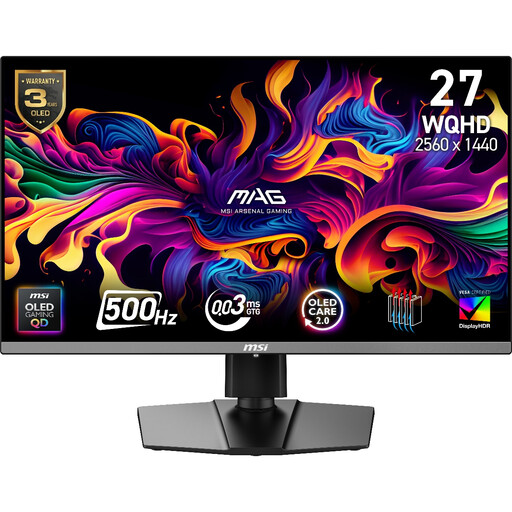
MAG 272QP QD-OLED X50, 27-inch
Consider this QHD OLED option if dark-scene contrast and a high refresh capability are priorities, while accounting for static office use.
The title specifies 2560 × 1440, 500 Hz, 0.03 ms and AMD FreeSync. Check that your PC outputs and games can make use of the refresh capability.
View on Joybuy
 No image available
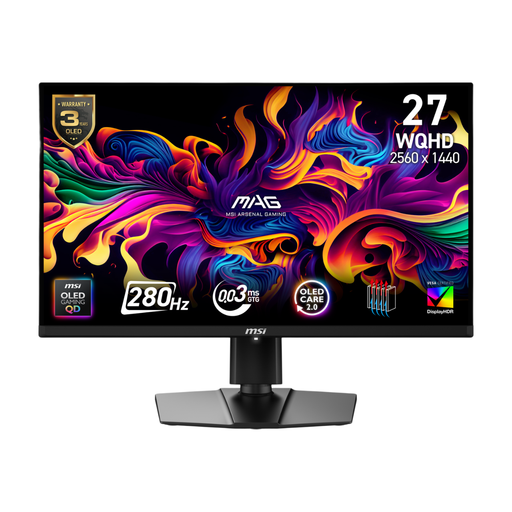
MSI MAG 271QP QD-OLED X28, 27-inch
This QHD OLED model suits a buyer who wants OLED blacks in a smaller desk setup but can accommodate the care needed for static content.
The title specifies 280 Hz and 0.03 ms. Confirm the monitor and stand dimensions against your desk before ordering.
View on Joybuy
 No image available
MAG 274QP QD-OLED X24, 27-inch
This is another QHD OLED route for fantasy games on a shared desk; consider how long static work windows will remain on screen.
The title specifies 2560 × 1440, 240 Hz, 0.03 ms and Adaptive-Sync. If a certified HDR tier is important, check the exact model’s certification.
View on Joybuy
 No image available
Samsung Odyssey G6 S27DG612, 27-inch QHD OLED
Consider this QHD OLED model if gaming contrast is a priority but you also need the screen to fit a work desk.
The title specifies 240 Hz and 0.03 ms. Check the stand’s adjustment range for your setup and allow for OLED static-image risk.
View on Joybuy
 No image available
Acer X Predator X49X, 49-inch curved ultrawide
This wider OLED format is for a desk and viewing setup that can accommodate a 49-inch screen; measure the available space before choosing it.
The title specifies a 32:9 aspect ratio, 1800R curve, Double Quad HD and 240 Hz. Check PC output support and game performance at the intended resolution, as well as OLED care and warranty terms for office use.
View on Joybuy
Frequently asked questions
Is 4K automatically the right choice for fantasy adventures?
No: choose 4K if your PC can run your games satisfactorily at that resolution and the screen fits your desk. RTINGS notes that 4K requires more processing power than 1440p, so QHD remains an option when you want a different balance of detail and PC demand.
Should I rule out OLED for a home-office monitor?
Not necessarily: OLED is worth considering if deep blacks in games matter to you, but prolonged bright static desktop elements can cause permanent burn-in. Compare care features and warranty terms, or consider IPS if reducing that risk is more important than OLED contrast.
Does an HDR label guarantee the same gaming experience across monitors?
No: a general HDR label does not identify a certified tier or establish how different monitors will look. VESA states that displays carrying its DisplayHDR or DisplayHDR True Black logos must meet the relevant specifications; check the exact model and tier.
What should I do with an old monitor in the UK?
Use an electrical-waste collection or take-back route rather than putting the monitor in ordinary household rubbish. UK waste electrical and electronic equipment rules support recovery, reuse and recycling; check the retailer’s take-back arrangements or your local authority’s electrical-waste service.


