Small-desk competitive map learners
You need room for your keyboard and mouse as well as a monitor, so the complete stand footprint matters alongside the screen size and refresh rate.


For multiplayer map learning at a small desk, start with a compact Full HD monitor and check its complete stand footprint before choosing by refresh rate. A 23.8-inch 180Hz Fast IPS model offers a compact, motion-focused route; a 24.5-inch 320Hz model makes sense only if your PC and connection can use its highest mode, while a 165Hz model with built-in speakers may suit a mixed-use setup. None of those specifications establishes whether the stand will fit your available space.
You need room for your keyboard and mouse as well as a monitor, so the complete stand footprint matters alongside the screen size and refresh rate.
You have a PC and connection capable of high frame rates and want to assess a compact 24.5-inch display with additional refresh-rate headroom.
You use the same compact Full HD display for multiplayer games and everyday media, and built-in speakers or adaptive sync matter more to you than the highest available refresh mode.
Measure the usable desk surface first, then decide whether refresh-rate headroom or everyday features should drive the choice between compact Full HD models.
Choose when: You want a compact, motion-focused Full HD option; AGON by AOC lists the 24G4XED with a 180Hz Fast IPS panel.
Allow for: Its panel size alone cannot tell you whether the supplied stand fits or positions the screen as you need.
Choose when: High frame rates are your priority and your PC can use the connection required for them.
Allow for: Dell specifies 320Hz for the Alienware AW2525HM through DisplayPort, but 255Hz through HDMI.
Choose when: Integrated audio and a compact Full HD screen matter more to you than a 180Hz-plus refresh specification.
Allow for: BenQ lists the 165Hz EX240N with a tilt-only stand; check whether that places the screen at a usable height.
| Concern | What to check | Who this matters to |
|---|---|---|
| Desk fit and positioning | Compare complete with-stand width and depth with your usable desk space; check stand adjustment or mounting requirements. | With limited room beside a keyboard and mouse, I need the base to fit and the screen to sit at a usable height. Around 42% of consumers put desk fit and positioning first. |
| Motion and refresh rate | Check the maximum refresh rate for the intended input and whether your device supports the desired mode; distinguish GtG from MPRT response-time claims. | When practising routes and sightlines against moving opponents, I prioritise a refresh mode my setup can actually run. For roughly 33% of consumers, motion and refresh rate are the primary concern. |
| Everyday features | Check whether the exact model has the speakers, adaptive-sync support and connections you plan to use. | If the monitor also handles everyday media, I want useful built-in features without making the highest refresh rate my priority. Around 25% of consumers put those everyday needs first. |
The stand can determine whether a compact screen works on your desk. BenQ lists the EX240N at 540mm wide and 182.6mm deep with its stand; Gigabyte lists the GS25F2 at 556.9mm wide and 179.4mm deep with its stand.
Measure the usable surface and compare each model’s full dimensions and adjustments. For a monitor arm, also check the VESA pattern, arm load range and desk-clamp clearance.
Dell specifies different maximum modes for the Alienware AW2525HM: 320Hz through DisplayPort and 255Hz through HDMI.
Check your device’s output, the monitor’s input-specific modes and the cable needed for the refresh rate you intend to select.
BenQ lists both 4ms grey-to-grey (GtG) and 1ms moving-picture response time (MPRT) for the EX240N. Those are different measurements; neither should be treated as directly interchangeable with another model’s GtG figure.
Keep the measurement label and operating mode beside each claim, and assess the available inputs and refresh modes rather than choosing from one response-time number.
A monitor that does not suit your desk raises a different return question from one that is faulty or misdescribed. GOV.UK describes cancellation rights for qualifying distance orders; fault-related remedies are separate.
Before ordering, confirm the model number and seller’s return process. Keep your proof of purchase and inspect the delivered monitor against its description.
Its 24G4XED is a compact Fast IPS Full HD example for a motion-focused setup.
The AW2525HM represents a 24.5-inch Full HD route for players assessing higher refresh modes.
The 23.8-inch EX240N combines a 165Hz VA Full HD specification with built-in speakers.
The GS25F2 is a 24.5-inch Full HD IPS option with a documented with-stand footprint.
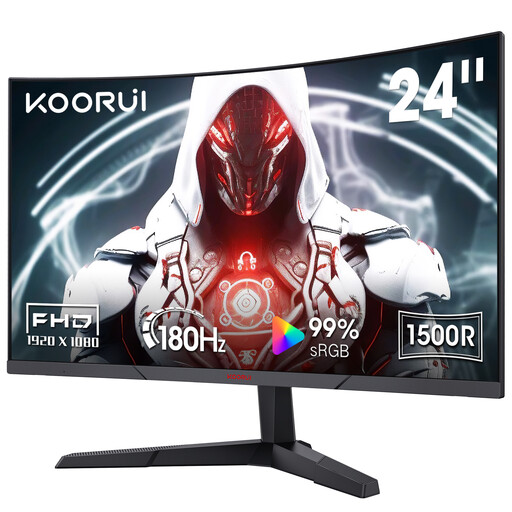
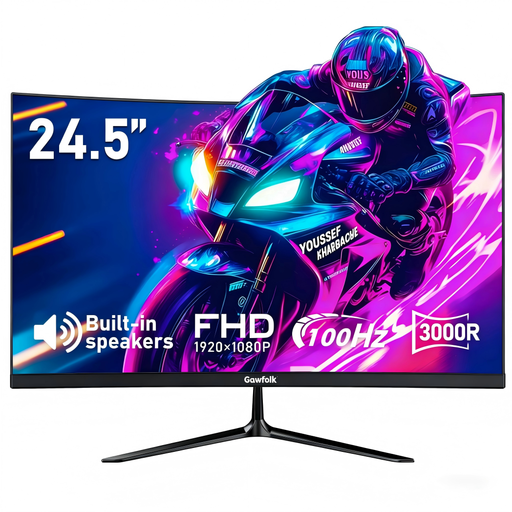
These compact Full HD monitor choices suit different priorities within a small-desk gaming setup: a 24-inch 180Hz curved model and a 24.5-inch 100Hz curved model with built-in speakers. Check the complete stand footprint and your intended connection before deciding.
 No image available
Consider this model if you want a compact-screen option with a 180Hz specification for multiplayer play. Its title also lists 1500R curvature, adaptive sync, DisplayPort, tilt adjustment and VESA compatibility; the 1ms claim is labelled MPRT. Confirm the complete with-stand footprint and exact HDMI inputs before buying.
 No image available
Consider this model if built-in speakers matter more to you than the higher refresh-rate routes discussed above. Its title lists AMD FreeSync, HDMI and 75 × 75mm VESA mounting, and labels its 1ms response-time claim as MPRT. Check the complete stand footprint, the refresh mode available through your connection and the exact response-time specification.
Measure the usable width and depth after allowing room for your keyboard, mouse and cables, then compare them with the monitor’s complete with-stand dimensions. If screen height is a concern, check the exact stand adjustments or VESA pattern before choosing an arm.
No: the available mode can depend on the input and connected device. Dell specifies 320Hz through DisplayPort but 255Hz through HDMI for the Alienware AW2525HM; check your device, cable and selected display settings for the mode you want.
Qualifying UK distance purchases have a cancellation route separate from remedies for faulty or misdescribed goods. GOV.UK says customers generally have 14 days after receiving an online order to tell the trader they want to cancel, followed by another 14 days to return it; check the applicable conditions and the seller’s return instructions.
Check that the listing identifies the exact monitor and a suitable UK-market power arrangement, and check the applicable product marking for where it is sold. GOV.UK explains that UKCA and CE markings reflect the manufacturer’s belief that relevant requirements are met; for eventual disposal, use an appropriate electrical recycling route rather than general waste.