What matters when choosing
Start with the signal your main device can use, then check desk fit and audio before weighing image detail against PC refresh modes.
| Concern | What to check | Who this matters to |
|---|
| Console compatibility |
Check the exact HDMI input, resolution, 120 Hz and VRR modes for your console. For Xbox Series X at 4K and 120 Hz, Xbox Support specifies an HDMI 2.1 display and Ultra High Speed HDMI cable. |
If console play comes first, I want smooth motion without choosing a PC refresh mode my console cannot use; around 33% of consumers would put console signal compatibility first. |
| Shared-room fit and audio |
Measure the desk against the stand’s footprint and check where headphones will connect. |
When I share a bedroom, I need the screen to fit my desk and a listening arrangement that will not disturb the other occupant. For around 27% of consumers, that practical setup takes priority. |
| Image detail and contrast |
Compare the exact model’s resolution and panel specification, then consider room lighting and the device supplying the image. |
If platform-game scenery matters as much to me as speed, I want to choose deliberately between 4K detail and a QHD OLED option; around 20% of consumers would make the picture their primary concern. |
| PC-and-console flexibility |
List the inputs and display modes each device needs; check console HDMI support separately from PC modes. |
Using one desk for PC and console gaming, I want modes I can actually use on both devices. That flexibility would come first for around 20% of consumers. |
Joybuy monitors for this setup
These monitors offer QHD high-refresh or 4K dual-mode choices for a bedroom gaming desk. Match any console modes and audio connections you need to the exact model before choosing.
 No image available
MAG 274QP QD-OLED X24, 27-inch QHD
Consider this QHD model if high-refresh PC play is a priority. Its name specifies a 2560 × 1440 QD-OLED display and 240 Hz; confirm the console output mode and headphone connection you intend to use.
View on Joybuy
 No image available
LG UltraGear 27G810A-B, 27-inch 4K IPS Dual Mode
Consider this model if you want a 4K IPS display alongside an alternative PC mode. The name states a maximum of 360 Hz; check which mode provides that rate, the console’s supported HDMI signal and the stand’s footprint.
View on Joybuy
 No image available
Samsung Odyssey G6 S27DG612, 27-inch QHD OLED
This QHD OLED model suits consideration for high-refresh PC gaming; its name specifies 240 Hz. Check the resolution, 120 Hz and VRR modes for your console, along with the audio connection needed in your room.
View on Joybuy
 No image available
HKC G27H2DPro, 27-inch QHD Fast IPS
Consider this QHD IPS model for PC-led platform games; its name specifies 2560 × 1440 and 220 Hz. If a console will share the desk, check its supported HDMI modes, as well as the stand’s footprint and your intended audio connection.
View on Joybuy
 No image available
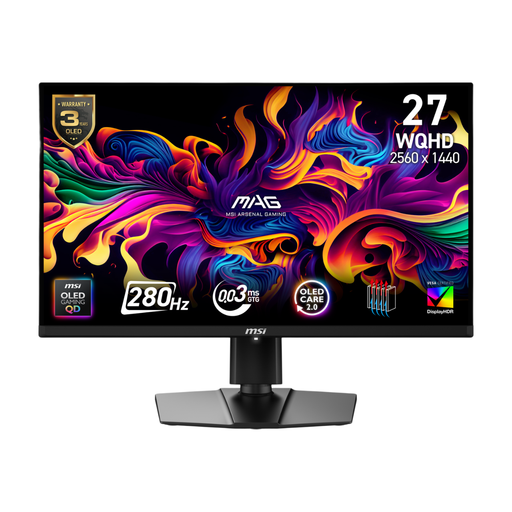
MSI MAG 271QP QD-OLED X28, 27-inch QHD
This QHD QD-OLED model is another high-refresh PC option; its name specifies 280 Hz. Confirm console resolution and VRR support for the mode you want, and check the stand dimensions and audio connection before fitting it into a shared room.
View on Joybuy
Common questions
Do platform games on PS5 or Xbox need HDMI 2.1?
Not for every game or display mode. Xbox Support specifies an HDMI 2.1 display and Ultra High Speed HDMI cable for Xbox Series X gaming at 4K and 120 Hz; for PS5, check the connected display’s supported resolution, refresh rate and VRR in the console’s video-output settings.
Can I use a 1440p monitor with PS5?
Yes, if the monitor supports the output you want. PlayStation provides a PS5 1440p test covering supported SDR and HDR, 60 Hz and 120 Hz, and VRR modes; check the individual monitor’s specification as well.
How can I keep gaming audio quiet in a shared bedroom?
Plan a compatible headphone or agreed low-volume setup before buying the monitor. Check whether your headset will connect through the controller, console, PC or monitor; LG, for example, specifies a headphone output but no integrated speaker for the 27GP950-B, not for every UltraGear model.
What should I check about a monitor’s returns and warranty?
Check the terms for the exact product and seller before checkout, including any conditions for change-of-mind returns and the stated manufacturer warranty. If a monitor arrives faulty or misdescribed, ask the retailer about the remedies applicable to that issue rather than assuming a voluntary change-of-mind policy settles it.


