Choose a compact, high-refresh 1080p monitor if reaction drills are your main use and your PC can sustain high frame rates in the games you play. A QHD monitor makes more sense if you also value higher-resolution gaming and desktop use, but check the refresh mode your connection supports and how your headphones will connect. NVIDIA describes responsiveness as a combination of peripheral, PC and display latency, not a monitor specification alone.
Who this setup suits
Reaction-training-first FPS players
If aim trainers and fast competitive games are your main uses, a compact 24.5-inch 1080p monitor may suit you better than a larger QHD screen. Dell and ZOWIE list high-refresh models in this format; you still need a PC and connection that can use the intended mode.
Mixed-use competitive gamers
If you practise reactions but also play other games or use your screen for desktop tasks, a 27-inch QHD format may be more relevant. LG’s 27GR83Q-B illustrates a QHD 240Hz route, though LG marks that model discontinued.
Monitor-side headset users
If you want to plug a headset into the monitor rather than the PC or console, check the exact socket and audio path before choosing a display. LG specifies a four-pole sound-and-mic output on the 27GR83Q-B; other models need their own checks.
What matters when choosing
For reaction drills with headphones, establish the refresh mode your system can use, then decide how much you value QHD for other games and whether the headset needs to connect through the monitor.
| Concern |
What to check |
Who this matters to |
| Display responsiveness |
Check the refresh rate available through your chosen input and whether your PC sustains suitable frame rates in the trainer or game. Treat panel response-time figures as mode-specific claims, not measurements of your reaction time. |
If reaction drills take priority, I want the display mode to keep pace with the frames my PC produces. Around 42% of consumers put display responsiveness first. |
| QHD and everyday use |
Confirm the screen resolution and refresh mode together, then consider your PC’s performance at QHD. Check the current listing if considering an older model. |
For games beyond reaction practice, I would value QHD detail and a screen that also suits desktop use. Roughly 33% of consumers make that broader use their primary concern. |
| Headset and video connections |
Check whether the exact output carries sound alone or sound and microphone, how your source sends audio to the monitor, and which video input supports your target refresh mode. |
When I plan to plug my headset into the screen, I need its socket and audio path to work with my setup. About 25% of consumers prioritise headset and connection compatibility. |
Pitfalls to avoid
-
Assuming the headline refresh rate works through every input
The usable mode can depend on the connector and source device. ASUS labels the TUF Gaming VG259QMR5A’s 310Hz mode as overclocked, while Dell presents connection-dependent refresh information for the Alienware AW2524HF.
Compare the monitor’s mode table with your GPU or console output, cable and target resolution, as well as the frame rate you can sustain in your game.
-
Reading a panel response-time claim as a reaction-time result
A stated pixel response time does not measure click-to-display delay or show that your own reactions will improve. NVIDIA describes peripheral, PC and display latency as separate parts of system latency.
Use refresh and response specifications to narrow your options, then assess your complete setup with in-game performance or latency tools where available.
-
Assuming every headphone socket supports a headset microphone
Monitor audio outputs differ. LG specifies a four-pole sound-and-mic headphone output for the 27GR83Q-B, but that feature cannot be assumed for another model.
Check the exact socket, headset plug and source-device audio routing before relying on the monitor as your headset connection point.
-
Treating an older specification page as a current listing
LG marks the 27GR83Q-B discontinued. Its specifications can inform a comparison without establishing that a new unit is currently available.
Before buying an older monitor, check the model and variant, item condition, warranty and current retailer listing.
Brands to consider for these monitor formats
Alienware
Dell lists the Alienware AW2524HF as a 24.5-inch Full HD Fast IPS gaming monitor with a 500Hz headline refresh rate.
- Its compact Full HD format and listed refresh rate make this model relevant to a reaction-training-first shortlist.
- Check Dell’s connection-dependent modes against your source device rather than assuming every connection reaches the headline rate.
ZOWIE
ZOWIE lists the XL2566X+ as a 24.5-inch-class Full HD Fast TN esports monitor with a 400Hz refresh rate and DyAc 2.
- Its Full HD, high-refresh format addresses FPS-focused buyers who prioritise that display route.
- ZOWIE’s claims about reduced distraction from afterimages are its own, not an independent comparison. The Full HD format also differs from a QHD mixed-use choice.
LG UltraGear
LG specifies the 27GR83Q-B as a 27-inch QHD IPS monitor with 240Hz refresh and a four-pole sound-and-mic headphone output.
- This model provides a concrete QHD example for buyers who also need a specified monitor-side headset output.
- LG marks the 27GR83Q-B discontinued; its specifications do not establish current availability.
ASUS TUF Gaming
ASUS lists the VG259QMR5A as a 24.5-inch Full HD Fast IPS monitor with refresh up to 310Hz in an overclocked mode.
- It offers another compact Full HD option for buyers comparing stated high-refresh modes.
- The 310Hz mode requires the appropriate setup. ASUS’s stated 0.3ms minimum grey-to-grey response time is a panel claim, not a full-system latency result.
Joybuy monitors for reaction practice
These QHD and ultrawide monitors are options to consider if reaction practice shares your screen time with other gaming. Compare their stated refresh rates with the modes your PC can use, and check headset routing separately where it matters to you.
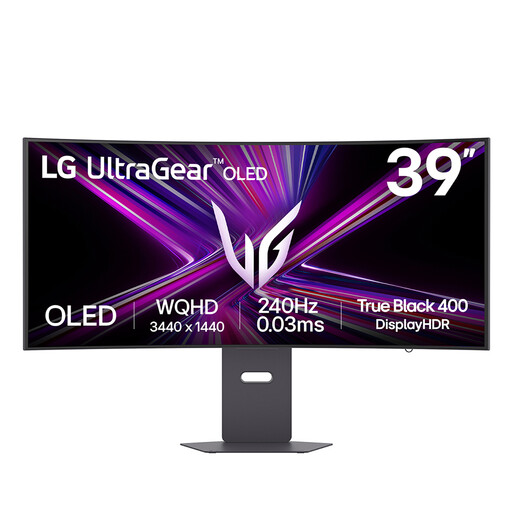 Image unavailable
LG UltraGear 39GX900A-B 39-inch OLED QHD, 240Hz
Consider this larger screen if you want reaction practice alongside gaming on an ultrawide display rather than a compact esports monitor.
The product title specifies a 39-inch OLED QHD screen and 240Hz refresh rate. Check which connection and source-device modes can use that rate, and confirm the headset connection you need.
View on Joybuy
 Image unavailable
LG UltraGear 34GX900A-B 34-inch OLED WQHD, 240Hz
This ultrawide format is for someone combining reaction practice with broader gaming use, not seeking a compact 24.5-inch display.
The product title specifies a 34-inch OLED WQHD screen and 240Hz refresh rate. Check the usable mode and headset connection with your equipment. OLED screens can be susceptible to burn-in; use the screen-protection features and avoid leaving static images displayed for long periods.
View on Joybuy
 Image unavailable
Acer Predator X27U W3 26.5-inch QD-OLED QHD, 240Hz
Consider this QHD-sized option if you want a screen for both reaction drills and other games.
The product title specifies 2560 × 1440 resolution, a 240Hz refresh rate and a 0.03ms response-time claim. Check the supported input mode and whether its audio output meets your headset needs.
View on Joybuy
 Image unavailable
Samsung Odyssey G6 S27DG612 27-inch QHD OLED, 240Hz
This 27-inch QHD format is relevant if your monitor must serve reaction practice and other gaming.
The product title states 240Hz and a 0.03ms response-time claim. Confirm the refresh mode available from your device and the headset connection before buying; the response-time figure is not a measure of your full-system latency.
View on Joybuy
 Image unavailable
HKC G27H2DPro 27-inch QHD Fast IPS, 220Hz
Consider this 27-inch QHD format when you want one screen for reaction practice and general gaming.
The product title specifies 2560 × 1440 resolution and 220Hz refresh rate. Check the mode available through your chosen input and whether the monitor provides the audio connection your headset requires.
View on Joybuy
Monitor and headset questions
Will a higher-refresh monitor improve my reaction times?
A higher refresh rate alone cannot establish an improvement in your reaction times. NVIDIA describes system latency as including peripheral, PC and display latency, so check the frame rate your game sustains and the display mode you can actually use.
Can I plug my headset into the monitor?
You can use a monitor-side connection if the exact monitor has a suitable output and your PC or console can route audio to it. LG specifies a four-pole sound-and-mic output for the 27GR83Q-B; check another model’s socket and your headset plug rather than assuming they work the same way.
Should I use DisplayPort or HDMI for high refresh rates?
Use the input that supports your target resolution and refresh mode on the exact monitor and source device. Dell presents connection-dependent refresh information for the AW2524HF, so check the monitor documentation, your GPU or console output and the cable instead of applying one port rule to every model.
What should I do with an old monitor in the UK?
Check recycling options for electrical equipment rather than treating an old monitor as ordinary household waste. UK government guidance on waste electrical and electronic equipment explains the recovery and recycling framework; ask the seller about its current take-back arrangements or check your local recycling options when replacing a monitor.


