Space-limited RPG players
If your desk is shallow or crowded, the screen and its stand both need to fit without taking over the space used for your keyboard and mouse.


Choose a 24-inch-class Full HD monitor if desk depth and stand space are tight. If you can position a 27-inch screen comfortably, QHD is worth considering for RPG maps, dialogue and menus. Check the stand and your intended connection before paying for a higher headline refresh rate.
If your desk is shallow or crowded, the screen and its stand both need to fit without taking over the space used for your keyboard and mouse.
If you regularly use quest logs, maps, skill trees and inventories, a 27-inch QHD screen is worth comparing with a smaller Full HD model—provided you can sit at a comfortable distance.
If you also use a PS5 or Xbox, check the monitor’s supported resolution, refresh rate and variable refresh rate (VRR) over the port you intend to use, not just its PC gaming headline.
Decide whether a 27-inch screen fits your viewing position before comparing QHD detail, refresh rate and console features.
| Concern | What to check | Who this matters to |
|---|---|---|
| Desk fit and positioning | Measure the available width and depth against the monitor’s dimensions with its stand. Check its adjustment range or VESA mounting if the supplied stand will not place the screen where you need it. | If my desk is already crowded, I need the stand to fit without squeezing out my keyboard or mouse. Around 34% of consumers put desk fit first. |
| Text, maps and menus | Compare native resolution and screen size together, then consider how far you can sit from the display. | When I spend time reading dialogue and navigating maps, I want enough detail without placing a larger screen uncomfortably close. Clear RPG interfaces come first for around 33% of consumers. |
| Smooth PC gaming | Check refresh-rate limits for your chosen input and whether the monitor specifies VRR support compatible with your setup. | If I also play faster-paced games, I care about smooth motion, but only at output my PC and connection can use. Around 20% of consumers make this their primary concern. |
| Console compatibility | Check the exact resolution, refresh-rate and VRR modes supported over HDMI; match the cable to the mode you intend to use. | When I move between PC and console, I need my chosen console mode to work rather than assuming a PC refresh-rate figure applies. That is the leading need for around 13% of consumers. |
A screen that fits across the desk can still sit too far forward. Stand adjustment also differs: LG UK specifies tilt-only adjustment for the 24GS60F-B, while ASUS lists height adjustment and VESA mounting for the ROG Strix XG27ACS.
Compare dimensions with the stand attached and check adjustment and VESA specifications separately.
An optional monitor arm or replacement stand may be needed if the supplied stand is too deep or cannot position the screen comfortably.
ASUS specifies up to 144Hz over HDMI for the ROG Strix XG27ACS, compared with up to 180Hz over DisplayPort or USB-C.
Match the monitor’s input-specific limits to the output and cable you will actually use.
The requirement depends on the output mode. Xbox Support specifies an HDMI 2.1 display and a supporting Ultra High Speed HDMI cable for Xbox Series X output at 4K and 120Hz; PlayStation provides a PS5 test for supported 1440p output modes.
Choose your target resolution and refresh rate, then check that mode in the monitor specifications and console settings.
The intended Xbox Series X 4K and 120Hz setup may require an appropriate Ultra High Speed HDMI cable.
A higher refresh-rate specification does not make a screen or stand smaller. It is more relevant if you also play faster-paced games and can use the intended output.
Settle screen fit, resolution, positioning and connection requirements before deciding whether extra refresh-rate capability matters to you.
LG UK lists both the compact, 23.8-inch Full HD IPS 24GS60F-B and the 27-inch QHD curved 27GS60QC-B, giving you two distinct sizes to assess for RPG play.
The UK-listed ROG Strix XG27ACS is a flat, 27-inch QHD Fast IPS example with height adjustment and VESA mounting.
Dell UK lists the AW2725D as a 26.7-inch-viewable QHD QD-OLED alternative for buyers also considering this display type and faster-paced games.
These monitors include one compact Full HD option and larger, higher-resolution options for desks that can accommodate them. Compare each model’s stand footprint and intended connection before choosing.
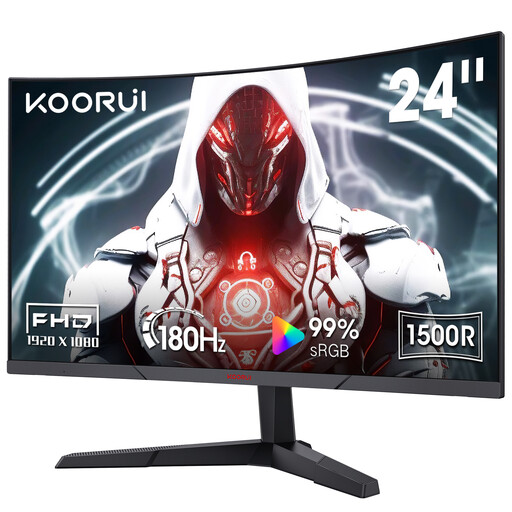 Image unavailable
Consider this model when a 24-inch screen is easier to accommodate than a 27-inch alternative. Its listed features include a Full HD VA panel, 1500R curve, 180Hz refresh rate, adaptive sync, two HDMI inputs and DisplayPort. Check the stand’s depth against your desk and confirm the refresh rate available through your chosen input.
 Image unavailable
Consider this 27-inch model if you can make room for a 4K UHD screen rather than prioritising a compact setup. The title specifies Nano IPS, dual-mode 240Hz/480Hz operation, DisplayPort 2.1 and HDMI 2.1. Check its dimensions with the stand and the output modes available through your intended connection.
 Image unavailable
This model is an option if a 27-inch QHD display fits and you also want an OLED panel. The product title specifies a 240Hz refresh rate. Check the stand footprint carefully on a shallow desk, along with the refresh-rate and console modes supported by your chosen input.
 Image unavailable
Consider this larger QHD option if your desk can accommodate a 26.5-inch screen. Its title specifies a 2560 × 1440 QD-OLED panel, 240Hz refresh rate, FreeSync Premium Pro and G-SYNC compatibility. Check its dimensions with the stand and the adjustment range before relying on it for a crowded desk.
 Image unavailable
This is a 27-inch QHD option for a desk with room for a larger screen. The product title specifies a 2560 × 1440 Fast IPS panel and 220Hz refresh rate. Confirm its actual width and depth with the stand, adjustment options and refresh-rate limits for the connection you intend to use.
Choose a 24-inch-class monitor if the stand or viewing distance makes a larger screen uncomfortable; consider 27-inch QHD if it fits and you value more detail in maps and menus. Measure the space available for the monitor with its stand before deciding.
Connect the monitor and use the PS5’s video output settings and 1440p test to check what the display accepts. PlayStation says the test can assess supported SDR or HDR output at 60Hz or 120Hz and VRR; available results depend on the connected display.
Not for every Xbox output mode. For Xbox Series X output at 4K and 120Hz, Xbox Support specifies an HDMI 2.1 display and a supporting Ultra High Speed HDMI cable; check the monitor’s supported modes if you intend to use a different resolution.
No: choose a refresh rate your PC, connection and other games give you reason to use, rather than treating a higher figure as an RPG requirement. Screen fit, resolution and positioning remain separate checks; even the maximum refresh rate can vary by input, as ASUS specifies for the ROG Strix XG27ACS.