What to check before choosing
Start with the detail you need for maps and text, then check desk positioning and the output modes your device can actually use.
| Concern |
Buying check |
Who this matters to |
| Readable maps and menus |
Compare native 2560 × 1440 QHD and 3840 × 2160 4K at the screen size you want; check the exact resolution rather than a broad display label. |
When I compare unit statistics and map labels, I want room for fine detail without choosing a resolution my system cannot use comfortably; around 36% of consumers would put readable tactical information first. |
| Desk positioning |
Check the exact stand's height adjustment and mounting compatibility against your desk and seating position. |
For a long campaign at my desk, I need to position the screen appropriately rather than work around a fixed stand; roughly 29% of consumers would make desk fit their primary concern. |
| Smooth movement |
Match refresh rate and variable refresh rate (VRR) support to the game, graphics hardware and connection. |
If camera panning or map scrolling matters to me, I want to know whether my setup can use the monitor's smoother modes; around 21% of consumers would prioritise motion and VRR. |
| Device connections |
Check supported resolution-and-refresh combinations for the intended HDMI or DisplayPort connection and your PC or console. |
With a particular console or PC already in place, I need the desired output mode to work through its connection; approximately 14% of consumers would put connection-mode certainty first. |
Joybuy monitors for these needs
These monitors offer QHD or 4K routes for reading tactical maps and menus, with differing panel types and refresh specifications. Choose against your device's supported modes and your desk setup, not the largest number in a product title.
 No image available
LG UltraGear G8 27G850A 27-inch 4K Nano IPS monitor
Consider its 4K option if fine map labels and interface detail are your priority.
The title lists dual-mode 240 Hz/480 Hz operation, AMD FreeSync Premium Pro, DisplayHDR 600, DisplayPort 2.1 and HDMI 2.1. Check which resolution-and-refresh combinations your device can use through the intended port; treat the HDR designation as a product claim.
View on Joybuy
 No image available
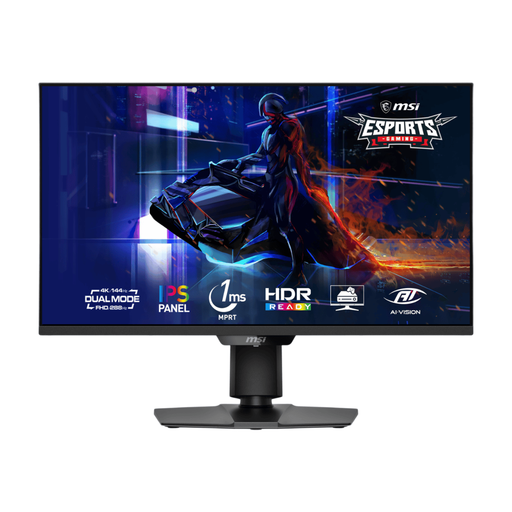
MSI MAG 275UPD E14 27-inch 4K dual-mode monitor
This is a 4K option to assess if you want detailed tactical interfaces as well as a separate lower-resolution refresh mode.
The title specifies UHD at 144 Hz, Full HD at 288 Hz and Adaptive Sync. Confirm that the mode you intend to use is available through your chosen device and port.
View on Joybuy
 No image available
Samsung Odyssey G6 S27DG612 27-inch QHD OLED monitor
Consider this QHD option if readable maps and menus are your starting point and you also want to assess an OLED panel.
The title specifies a 240 Hz refresh rate and 0.03 ms response-time claim. Check the supported output mode for your device rather than assuming it can use the headline refresh rate.
View on Joybuy
 No image available
Acer X Predator X27U W3 26.5-inch QHD QD-OLED monitor
Its QHD format is relevant if you are comparing map and menu readability in a screen slightly smaller than 27 inches.
The title specifies 2560 × 1440, 240 Hz, HDR10, FreeSync Premium Pro and G-SYNC compatibility. Check the output mode for your device and whether the stand or a compatible mount will achieve your preferred position.
View on Joybuy
 No image available
HKC G27H2DPro 27-inch QHD Fast IPS monitor
This is a QHD IPS option to compare if tactical map and menu readability is your main screen requirement.
The title specifies 2560 × 1440 and 220 Hz. Check the supported mode for your device and whether the stand allows the screen position you need.
View on Joybuy
Frequently asked questions
Is 4K necessary for tactical role-playing games?
No: a 27-inch QHD monitor is a sensible starting point if you want more native pixels than Full HD without the greater rendering demand of native 4K. Choose 4K when fine maps, text or artwork take priority and your PC or console supports the resolution and refresh mode you want.
Do turn-based tactical games need a 180 Hz monitor?
Not necessarily: a higher refresh rate is worth considering for smoother scrolling and camera movement only if the game and connected device can output a supported higher frame rate. If frame rates vary, check VRR compatibility across the monitor, graphics hardware and connection; NVIDIA and AMD describe synchronising refresh with frame rate under supported conditions.
What should I check before connecting a PS5 or Xbox?
Check the monitor's supported modes on the intended port against the console's detected output options. PlayStation provides a PS5 test for 1440p output, including supported 60 Hz, 120 Hz and VRR combinations; Xbox states that Series X can support 4K at 120 Hz with suitable equipment and identifies a certified Ultra High Speed HDMI cable for relevant HDMI 2.1 features.
How should I dispose of an old gaming monitor in the UK?
Use an appropriate electrical-equipment collection route rather than treating the monitor as ordinary household waste. GOV.UK describes the UK's WEEE arrangements as promoting recovery, reuse and recycling; check which local-authority collection or retailer take-back option is available to you.


