Fast-action map learners
You want to follow moving players and routes while practising, and can check whether your computer and connection support the refresh rate you intend to use.


Start with a compact 23.8–25-inch Full HD gaming monitor if the shared-bedroom desk is limited and you sit close to the screen. Check that your device and connection can use the refresh rate you want, and plan a private-audio route; consider a larger screen if you have room for its stand and value the extra physical display area, while recognising that Full HD has lower pixel density at 27 inches than on the cited 23.8-inch model.
You want to follow moving players and routes while practising, and can check whether your computer and connection support the refresh rate you intend to use.
You have limited desk space and want game sound through headphones. The stand footprint, adjustment options and an appropriate audio connection matter alongside screen size.
You may switch between devices, so you need to check the available inputs, cable and supported display modes for each connection rather than relying on the advertised refresh rate alone.
For a shared-bedroom map-learning setup, check desk fit and private audio alongside motion-related specifications. A higher advertised refresh rate is useful only when the connected device can select the intended mode.
| Concern | What to check | Who this matters to |
|---|---|---|
| Motion clarity | Check refresh rate at your intended resolution and compatible adaptive-sync support. Compare response-time figures only when their measurement methods and settings match. | If I am practising fast routes and tracking other players, smooth motion is my main priority. Around 42% of consumers put that need first. |
| Desk fit and private audio | Measure the monitor with its stand, check adjustment or mounting options, and confirm a suitable headphone connection. | On a crowded bedroom desk, I need the screen to fit without playing game sound into the room. That is the first concern for around 33% of consumers. |
| Device compatibility | Match the monitor input, device output and cable to the resolution and refresh-rate mode you want; check the active mode after connection. | If I switch between devices, I want to know which display mode each one can actually use. Around 25% of consumers make that their primary concern. |
The rate in use can differ from the monitor’s advertised maximum. Microsoft Support notes that available refresh-rate selections depend on the display and that some selections can change the active resolution.
Check the required resolution and refresh-rate combination against your device, port and cable. On a Windows PC, confirm both values in Advanced display settings after connecting the monitor.
Manufacturer specifications use different measures and settings: BenQ lists 1ms MPRT and 2ms grey-to-grey (GtG) for the EX240, while LG lists 1ms GtG at its Faster setting for the 24GS60F-B.
Keep MPRT and GtG comparisons separate, and check the stated setting. Consider ports, refresh rate and stand design as well as the response-time figure.
Speakers play sound into the room. A headphone output is a separate feature, and using one through the monitor also depends on how the connected source sends audio.
Plan your headphone connection before ordering. If you intend to plug headphones into the monitor, confirm the exact model’s output and the audio path from your PC or console.
BenQ lists 93 pixels per inch for its 23.8-inch Full HD EX240, while Dell lists 81.59 pixels per inch for its 27-inch Full HD G2722HS. The larger cited screen provides more physical display area, not more pixels.
Measure the available desk space, including room for the stand, and weigh physical screen size against resolution and pixel density at your viewing distance.
These named models illustrate different specifications and setup trade-offs; their features do not apply to every monitor from the same brand.
BenQ’s EX240 is a compact reference point: its published specifications list a 23.8-inch Full HD IPS panel, 165Hz refresh rate, 100mm height adjustment, 100 × 100mm VESA mounting and a headphone jack.
Dell’s G2722HS is a 27-inch Full HD example with a listed 165Hz refresh rate, 100mm height adjustment, VESA mounting and a headphone jack.
LG’s 24GS60F-B provides a compact specification example: a 23.8-inch Full HD IPS panel, up to 180Hz, HDMI and DisplayPort connections, a headphone output and 100 × 100mm VESA mounting.
Samsung’s Odyssey G4 G40B is a 25-inch Full HD IPS example for buyers considering a listed 240Hz refresh rate in a smaller screen.
These choices range from a compact 24-inch Full HD monitor to larger QHD, 4K and ultrawide displays. For a limited bedroom desk, compare each screen and stand against your available space before deciding whether the larger formats suit you.
 No image available
Consider this larger screen if your desk can accommodate a 27-inch monitor and you want to choose between its listed display modes.
The product information pairs 240Hz with 4K and 480Hz with Full HD; check which mode your device, port and cable can use. The title also specifies Nano IPS, 1ms GtG, DisplayPort 2.1 and HDMI 2.1. Check the stand dimensions against your desk.
 No image available
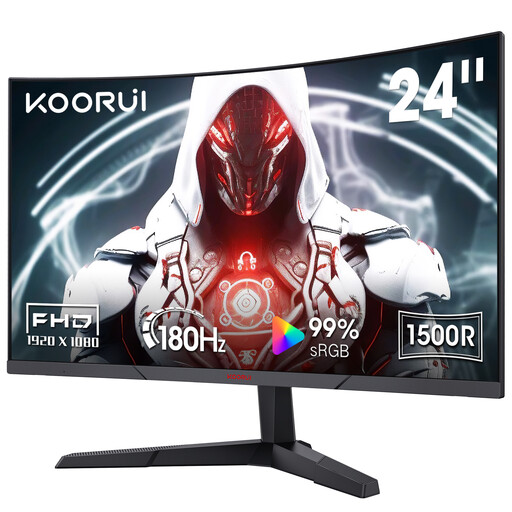
This is the compact-screen option in the list for a desk where a larger monitor may be awkward.
Its title specifies a curved VA panel, 180Hz refresh rate, 1500R curvature, two HDMI inputs, DisplayPort, tilt adjustment and VESA compatibility. Confirm how you will connect headphones if private audio is essential, and check that your device can select the intended refresh-rate mode.
 No image available
Consider this 26.5-inch model if you have room for a screen larger than the compact Full HD option and want QHD resolution.
The title specifies a 2560 × 1440 QD-OLED panel, 240Hz refresh rate and 0.03ms response-time claim. Check the stand footprint, your intended display connection and the route you will use for private audio before choosing it for a shared bedroom.
 No image available
This 27-inch option calls for more desk-space planning than the compact model, particularly if you sit close to the screen.
Its title specifies QHD resolution, an OLED panel, 240Hz refresh rate and 0.03ms response-time claim. Compare the monitor and stand dimensions with your desk, and confirm your device’s display mode and intended private-audio connection.
 No image available
Choose this format only if you want an ultrawide display and can accommodate its substantially wider footprint in the shared room.
The title specifies a 34-inch WQHD OLED display and 240Hz refresh rate. The listed width with stand is 784.1mm, so measure the available space; also confirm that your connected device supports the display mode you plan to use.
No: a 240Hz specification is not a requirement for learning a multiplayer map. A compact 165–180Hz Full HD monitor may fit your desk and audio setup better; whichever rate you choose, confirm that your device can select it at the resolution you intend to use. Microsoft Support notes that higher refresh rates can reduce motion blur and screen tearing in gaming, but the available modes depend on the display.
On a Windows 10 or Windows 11 PC, open Settings, then System, Display and Advanced display to check the selected refresh rate. Microsoft Support advises that available choices depend on the display; check the active resolution too, because selecting some rates can change it.
No: built-in speakers play sound into the room. Use headphones or another personal-audio route, and if you plan to plug headphones into the monitor, confirm that the exact model has an output and that your connected device sends audio through that display connection.
Ask the retailer how to hand back your old monitor when buying a replacement. GOV.UK states that retailers selling electrical equipment must offer take-back of waste equipment of the same type as the item purchased; check the retailer’s take-back arrangements before bringing in or arranging collection of the old screen.