Space-limited tactical players
A shallow or crowded desk makes screen placement as important as diagonal size. You need room for the keyboard and mouse while keeping the display at a workable distance.


For a shallow desk, start with a 23.8–25-inch Full HD monitor if a larger screen cannot sit at a comfortable viewing distance. Consider a 27-inch QHD model if you have room and want more space for maps and menus; check the stand footprint and your device’s connections before letting a high refresh rate decide the purchase.
A shallow or crowded desk makes screen placement as important as diagonal size. You need room for the keyboard and mouse while keeping the display at a workable distance.
If you regularly read unit information, tooltips and tactical maps, compare resolution and usable screen space before focusing on the highest refresh-rate figure.
If turn-based tactics are only part of what you play, refresh rate and adaptive-sync support may also matter. Check those features on the exact monitor and against your PC’s outputs.
Settle where the screen can sit first, then choose how much map and text space you need. Treat motion features as a further check if you also play faster-paced games.
| Concern | Buying checks | Who this matters to |
|---|---|---|
| Desk fit and placement | Measure usable desk depth with the stand, keyboard and mouse in place. Check height adjustment or VESA mounting on the exact model; Ergotron suggests at least 51 cm between your eyes and the screen. | When my desk is crowded, I need a screen I can position without losing space for controls; around 42% of consumers put desk fit and placement first. |
| Map and text space | Compare the native resolution and screen size together: compact Full HD models offer 1920 × 1080, while the 27-inch QHD route offers 2560 × 1440. | If I spend a session reading maps and unit panels, I want enough room for that information; roughly 33% of consumers make map and text space their primary concern. |
| Motion features | Check the exact model’s refresh rate and adaptive-sync claim, then confirm the resolution, port and connection your device can use. | I also play games with continuous movement, so I care about motion features after the screen meets my tactics needs; about 25% of consumers prioritise those features. |
A 27-inch screen may be difficult to position on a shallow desk. Ergotron advises at least 51 cm from eyes to screen and notes that a larger screen may call for more distance.
Measure from your expected eye position to the screen after allowing for the keyboard, mouse and stand. Check the stand footprint or the requirements for a compatible monitor arm.
ASUS lists both the compact VG249Q3A and VG249QL3A, but specifically lists height adjustment for the VG249QL3A. Their exact feature claims should not be treated as interchangeable.
Match the complete model suffix on the product listing to the manufacturer’s specifications, particularly for stand adjustment, inputs and adaptive sync.
Compact Full HD and larger QHD models can both have 180Hz specifications. That figure alone does not tell you whether maps and menus have enough space or whether the monitor fits your desk.
Choose a size and resolution that work at your available viewing distance, then compare refresh and sync features within the options that fit.
An electronic display’s energy information answers a different question from its resolution, refresh rate and adaptive-sync specifications. GOV.UK provides guidance on displaying energy labels for products online.
Look for the energy label when comparing energy information, and assess gaming features from the exact monitor’s specifications separately.
AOC’s 24G4XED is a compact gaming option in its UK range.
ASUS TUF Gaming includes closely named 23.8-inch Full HD models, including the VG249Q3A and VG249QL3A.
LG UltraGear includes the 27GS75QN-B, a QHD route for desks that can accommodate a larger screen.
BenQ’s MOBIUZ EX2510S is a 24.5-inch Full HD option; its ZOWIE range addresses a different, FPS-esports-focused use.
These Joybuy monitors include compact Full HD choices for tighter desks and larger, higher-resolution choices to consider if you have enough viewing distance. For every model, check the stand’s fit and the connection you intend to use.
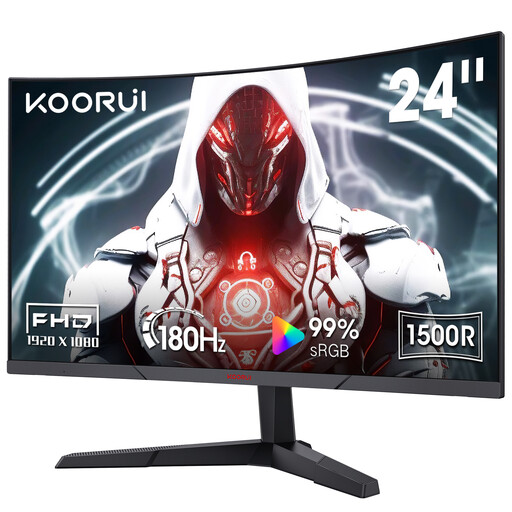 Image unavailable
A compact-screen option if desk space comes first and you also want motion features for other games.
Full HD VA display with 1500R curvature, 180Hz and Adaptive Sync; the title lists HDMI, DisplayPort, tilt adjustment and VESA compatibility.
Check the exact HDMI port count and stand footprint before planning the setup.
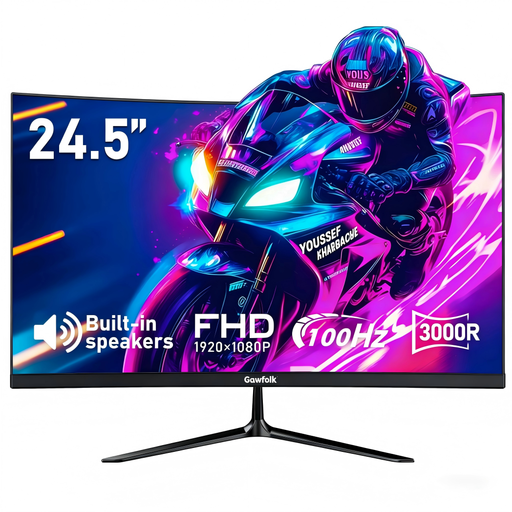 Image unavailable
Consider this compact format when a 27-inch screen would be difficult to position on your desk.
The title lists 100Hz, 3000R curvature, AMD FreeSync, built-in speakers, HDMI and 75 × 75 mm VESA mounting.
Check the stand footprint and adjustment you need. If response time matters for other games, compare the quoted measurement and its conditions.
 Image unavailable
A larger QHD choice if you have room for a 27-inch screen and want more space for maps and menus.
The product title specifies an OLED display and 240Hz refresh rate.
Measure your viewing distance and confirm that your device and chosen connection can use the resolution and refresh combination you want.
 Image unavailable
Consider the higher-resolution, larger-screen route if the desk can accommodate it and map detail is a priority.
The title specifies 4K UHD and a dual refresh mode with a maximum of 360Hz; that maximum should not be assumed to apply at 4K.
Check stand depth, viewing distance and which resolution and refresh-rate combination your device and connection can support.
 Image unavailable
A QHD option for tactical maps if your desk allows a comfortable position for a 27-inch screen.
The title specifies 2560 × 1440 resolution and 220Hz.
Confirm the stand’s actual footprint before buying. If contrast matters to you, check the exact model specification.
Start with a 23.8–25-inch model if desk depth makes a larger screen hard to position; consider 27-inch QHD if you can keep it at a comfortable distance and want more map and menu space. Ergotron suggests at least 51 cm from eyes to screen, with more distance potentially needed for larger screens.
No: 180Hz need not take priority over desk fit and resolution for turn-based play. It may be worth comparing if you also play games with continuous movement, provided your device and connection can use the refresh rate you choose.
Check the claim for the exact monitor variant and the output on your own PC or console. AOC lists Adaptive Sync for the 24G4XED, ASUS lists FreeSync Premium and G-SYNC compatibility for the VG249QL3A, and LG lists variable-refresh support for the 27GS75QN-B; those model-specific statements do not establish support for every connection and refresh-rate combination.
Use the energy label to compare energy information, not to judge how a monitor will perform in games. GOV.UK provides guidance on electronic-display energy labels online; compare resolution, refresh rate and adaptive sync through the exact model’s specifications.