Small-desk strategy players
If you play city builders, management games or grand strategy titles, you may want space for maps and information panels without placing a large screen on a constrained desk.


Start with a 23.8-inch QHD monitor if your desk is tight and you need room on screen for maps, menus and tooltips; check that its text remains comfortable to read and that its stand fits. A 27-inch QHD screen gives the same resolution on a physically larger panel if you have the desk depth and viewing distance. Consider a 23.8-inch Full HD high-refresh screen instead if driving faster games matters more to you than QHD workspace.
If you play city builders, management games or grand strategy titles, you may want space for maps and information panels without placing a large screen on a constrained desk.
If you spend extended sessions reading tooltips, maps and spreadsheets, the screen’s position and stand adjustment matter alongside its resolution.
If economic simulations are your main games but you also play faster titles, you may need to weigh QHD workspace against refresh rate and compatible variable-refresh features.
Choose when: Desk space is tight but you want a 2560 × 1440 workspace for dense simulation interfaces.
Trade-off: Text and controls are physically smaller than on a 27-inch QHD screen; check the games’ interface-scaling options.
Choose when: You can accommodate a larger panel and want QHD menus and maps displayed at a larger physical size.
Trade-off: The stand and viewing distance need particular attention on a shallow desk; a 27-inch diagonal alone does not establish fit.
Choose when: You favour a compact screen and prioritise high-frame-rate play across a broader mix of games.
Trade-off: 1920 × 1080 provides less native workspace than QHD, which matters when several simulation panels are open.
| Concern | What to check | Who this matters to |
|---|---|---|
| Compact QHD workspace | Check for native 2560 × 1440 resolution at the intended screen size, and whether your games offer usable text or interface scaling. | If I need maps, ledgers and tooltips visible at once but cannot fit a large panel, screen space is my priority; around 29% of consumers would put compact QHD workspace first. |
| Desk fit and adjustment | Measure usable desk width and depth, then compare the exact with-stand dimensions and height-adjustment options. | A shallow desk makes comfortable screen placement the deciding issue for me, rather than panel size alone; around 36% of consumers would prioritise fit and adjustment. |
| Mixed-game motion | Check the native refresh rate over your intended connection and distinguish it from any overclocked mode. | I also play faster games, so I want their motion to influence my monitor choice; around 21% of consumers would make mixed-game smoothness their primary concern. |
| Device connectivity | Match the monitor’s video inputs to your computer. For a USB-C setup, check video-output support and any charging requirements separately. | If I switch between a laptop and desktop, workable connections decide whether the setup suits me; around 14% of consumers would put connectivity first. |
A high refresh rate does not add room for a simulation’s menus. Dell UK specifies 1920 × 1080 and 165Hz for its 23.8-inch G2422HS, while AOC specifies 2560 × 1440 for the similarly sized Q24G2A/BK.
Decide how much native workspace and what text size you need, then choose a refresh rate that matters for your other games and that your computer can output.
ASUS specifies its TUF Gaming VG27AQ3A at 61.50 × 45.50 × 21.40 cm with the stand and lists no height adjustment. The screen diagonal does not tell you where the stand will sit on your desk.
Compare the exact with-stand dimensions with your available width, depth and keyboard clearance before ordering.
If the supplied stand cannot provide the placement you need, a compatible monitor arm may be necessary.
LG UK specifies 180Hz native refresh for the UltraGear 27GS75QN-B. Its optional 200Hz mode requires a DisplayPort 1.4-capable graphics card and cable.
Make the native mode your starting point and check the stated connection requirements before relying on the overclocked rate.
GOV.UK advises that electrical products should go to an appropriate recycling collection point rather than household rubbish.
Plan how you will take your old monitor to an electrical-waste collection point when replacing it.
AOC’s Q24G2A/BK is a compact QHD gaming example for this decision.
Dell’s 23.8-inch examples illustrate a choice between Full HD gaming refresh and QHD with laptop-oriented connectivity.
The TUF Gaming VG27AQ3A illustrates the 27-inch QHD gaming route.
The UltraGear 27GS75QN-B is another 27-inch QHD high-refresh example.
These monitors offer larger-screen QHD, 4K or high-refresh alternatives for simulation and mixed-game setups. Check their stands and your available viewing distance carefully: none is the compact 23.8-inch QHD starting point discussed above.
 Image unavailable
Consider this if you want a 27-inch QHD screen for simulations and also value a high refresh rate for other games.
Its product title specifies an OLED panel and 240Hz refresh rate. Check that the stand fits your desk and that your computer can output the QHD refresh mode you intend to use.
 Image unavailable
This 27-inch QHD option is worth comparing if simulations share your playing time with faster games.
The product title specifies a 2560 × 1440 Fast IPS panel and 220Hz refresh rate. Confirm the stand’s footprint and adjustment range against your desk before choosing it.
 Image unavailable
Compare this with the QHD choices if a 27-inch, higher-resolution screen also suits your desk and computer.
The product title specifies 4K UHD, Nano IPS and dual 240Hz/480Hz modes. Confirm which resolution applies to the mode you want, your computer’s output capability and the stand footprint.
 Image unavailable
This larger curved QHD screen is an option only if you can give it sufficient desk space and viewing distance.
The product title specifies 2560 × 1440 resolution, 165Hz and a 1500R curve. Check the full stand footprint; for the stated maximum 165Hz at QHD, check the listed DisplayPort cable requirement and your computer’s output.
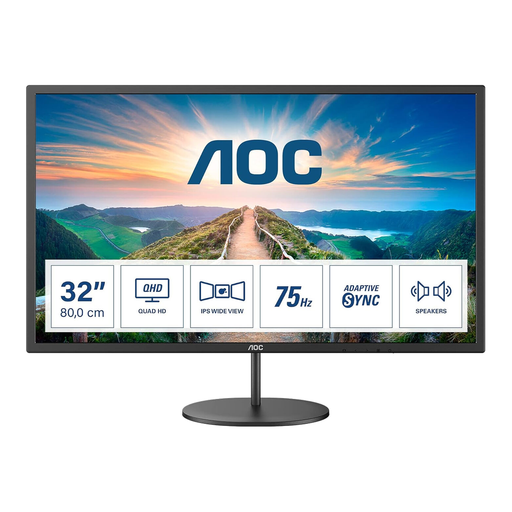 Image unavailable
Consider this larger QHD screen if physical screen size matters more to you than keeping the setup compact.
The product title specifies an IPS panel, Adaptive Sync and built-in speakers. Check the stand footprint and adjustment range; also consider whether its listed 75Hz refresh rate suits the other games you play.
No particular high refresh rate is essential to this choice. If you mainly read maps and management panels, check resolution, readable interface size and desk fit first; a higher refresh rate becomes more relevant if you also play faster games and your computer can output it.
No. LG UK specifies 180Hz as this model’s native rate and says its optional 200Hz overclock requires a DisplayPort 1.4-capable graphics card and DisplayPort 1.4 cable.
Contact the trader and keep your order details and evidence of the fault. The UK Consumer Rights Act 2015 explanatory notes describe a consumer’s right to insist on repair or replacement of faulty goods, with the trader bearing the relevant costs; do not assume the manufacturer is your only point of contact.
Take it to an appropriate electrical-waste collection point rather than putting it in household rubbish, as advised by GOV.UK. Check local collection arrangements before transporting it.