Wide-workspace spacecraft builders
If you want a spacecraft view, design tools and reference material visible together, compare native resolution and usable screen area before focusing on the highest refresh rate.


For a virtual-spacecraft design view with tools and references alongside it, prioritise native workspace resolution and layout before refresh rate. Among the compared examples, LG's 45-inch 5120 × 2160 ultrawide offers the most native pixel workspace; BenQ's 48-inch 4K screen prioritises physical image size, while Samsung's 34-inch ultrawide is a smaller option. Check desk fit, your computer's output and the monitor's supported resolution-and-refresh combinations before choosing.
If you want a spacecraft view, design tools and reference material visible together, compare native resolution and usable screen area before focusing on the highest refresh rate.
You need room for detailed design work as well as a gaming mode your computer can use. Check the resolution-and-refresh combination you intend to run, not just the largest refresh number on the product page.
You want a substantial view without letting the screen, stand or curve overwhelm your desk. Measure the available space and check the proposed mount before settling on a diagonal size.
Decide whether visible design workspace, physical screen size or gaming motion matters most; then check whether the display fits your desk and your computer can drive the mode you want.
Choose it when: You want a wide spacecraft layout with more vertical pixels than a 3440 × 1440 ultrawide; LG lists the 45GX950A-B at 5120 × 2160.
Trade-off: Its large, curved panel needs room on the desk, and the intended resolution and refresh rate need a suitable computer connection.
Choose it when: Physical image size matters more to you than a 21:9 layout; BenQ lists the EX480UZ as a 48-inch, 3840 × 2160 display.
Trade-off: Its 16:9 shape changes how side-by-side panels fit, and BenQ lists a weight of 19.3 kg with the stand.
Choose it when: You want a wide design-and-gaming view but have less space for a 45- or 48-inch display; Samsung lists the Odyssey OLED G8 G85SD at 3440 × 1440.
Trade-off: Its smaller native pixel workspace may mean rearranging panels or switching windows more often.
| Concern | What to check | Who this matters to |
|---|---|---|
| Workspace and detail | Compare native resolution, aspect ratio and pixel density; check how your design software uses a wide layout. | I want the spacecraft view and reference panels open together without constantly switching windows. Around 33% of consumers put usable workspace and detail first. |
| Desk fit and mounting | Measure desk width and depth; compare the screen's stand or VESA pattern and weight with your support. | A larger view is appealing only if I can place and support it comfortably. For around 27% of consumers, physical fit is the primary concern. |
| Gaming motion | Confirm supported resolution-and-refresh combinations and whether your computer, port and cable can supply them. | When I fly or explore the spacecraft in real time, responsive movement matters more to me than extra room for panels. Around 20% of consumers make gaming motion their main priority. |
| Static interfaces on OLED | Read the exact model's panel-care guidance and check its screen-protection and sleep settings. | My toolbars and reference panes may stay in place for long sessions, so I need a panel-care routine I can follow. This is the primary concern for around 20% of consumers. |
Screen size and pixel density answer different questions. BenQ lists 92 pixels per inch for its 48-inch EX480UZ, while LG lists 125 for its 45-inch 45GX950A-B.
Compare native resolution, aspect ratio and pixel density alongside inches. Choose physical scale if that is your priority; check the wide layout if keeping several design panels visible matters more.
A monitor's stated maximum refresh rate does not establish what your computer or console can output at your chosen resolution.
Check the graphics output, cable and monitor's supported signal combinations before ordering, then consider the frame rates your games can deliver.
Design tools can leave interface elements in the same position for extended sessions. ASUS advises using its OLED Care features, a shorter screen-sleep interval and avoiding an unchanged image at maximum brightness for long periods.
Read the guidance for the exact OLED model you choose and keep its recommended safeguards enabled during desktop work.
BenQ specifies a 200 × 200 mm VESA pattern for the EX480UZ and a weight of 19.3 kg with its stand. Screen size alone cannot tell you whether your arm can support it.
Check the proposed mounting configuration, VESA pattern and arm load rating, and measure the desk before purchase.
If your current support is unsuitable, you may need a compatible monitor arm or a different desk arrangement.
LG's 45GX950A-B is a reference point for a very large, high-resolution ultrawide workspace.
BenQ's EX480UZ represents the large physical 16:9 screen route rather than an ultrawide layout.
Samsung's Odyssey OLED G8 G85SD offers a 34-inch ultrawide route for buyers who cannot accommodate the larger examples.
ASUS's PG32UCDM is a 32-inch 4K option when an ultrawide screen is not essential.
These monitors offer different ways to combine a spacecraft-design view with gaming: 49-inch wide-format screens, a 32-inch 4K screen and 34-inch ultrawides. Compare their native layouts and check each one against your desk and computer before choosing.
 No image available
Consider this 32:9 screen if horizontal room for a spacecraft view and adjacent panels is your priority.
 No image available
Its 32:9 layout is worth considering when a wide spacecraft view matters more than the extra vertical pixels of a 5120 × 2160 screen.
 No image available
Choose this route if a 3840 × 2160 design view suits you better than an ultrawide arrangement.
 No image available
This smaller ultrawide is a choice when you want a wide design view but have less room than a 49-inch screen would require.
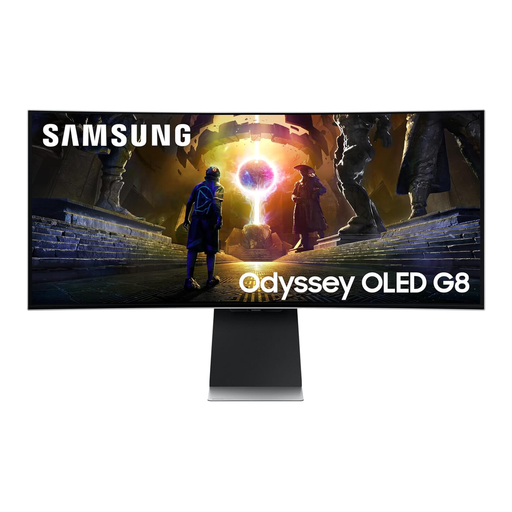 No image available
Consider this 34-inch ultrawide if you want a wide design-and-gaming view without moving to a 49-inch panel.
Choose by workspace layout and desk fit, not diagonal size alone. Among the compared examples, LG's 45-inch 5120 × 2160 ultrawide provides the most native pixel workspace, BenQ's 48-inch 4K EX480UZ provides the largest physical image, and Samsung's 34-inch 3440 × 1440 G85SD is the smaller ultrawide option.
Yes, if you are prepared to follow the exact model's panel-care guidance during prolonged desktop use. ASUS advises using its OLED Care features, setting a shorter screen-sleep interval and avoiding an unchanged image at maximum brightness for long periods; check the guidance and warranty terms for the monitor you choose.
A faulty monitor may give you a remedy under the Consumer Rights Act 2015, separately from a retailer's voluntary returns policy. Section 9 requires supplied goods to be of satisfactory quality; contact the seller with details of the fault and check which statutory remedy applies to your circumstances.
For most UK online purchases, cancellation is available up to 14 days after delivery, according to GOV.UK guidance on distance selling. Check the seller's cancellation process and any applicable exceptions; a retailer may also offer a separate, longer voluntary return period.
Use a suitable electrical-equipment collection or recycling route rather than putting an old monitor in ordinary household waste. GOV.UK identifies the Waste Electrical and Electronic Equipment Regulations as the UK framework for handling this type of equipment; check local collection options or a retailer take-back service.