Detail-focused designers with limited space
If you build spacecraft, cockpits or technical scenes at a shallow desk, you need room for detailed views and tool panels without overlooking stand depth or mounting space.


A 27-inch 4K monitor is a starting point if detailed spacecraft models and crowded design panels matter, provided its stand fits your desk. Consider 4K QD-OLED if contrast and fast gaming justify checking panel-care and warranty terms; consider 4K IPS for long sessions with static interfaces and practical work features. A QHD OLED shifts the choice towards fast play, with fewer pixels for design detail.
If you build spacecraft, cockpits or technical scenes at a shallow desk, you need room for detailed views and tool panels without overlooking stand depth or mounting space.
If contrast and fast motion matter alongside design work, compare the panel types without overlooking the care instructions and warranty terms of a particular OLED model.
If one screen must serve a design laptop and gaming PC, check the required USB-C display connection, laptop charging power and KVM switching before choosing a monitor for its refresh rate alone.
Consider it when: You want 4K design detail alongside the contrast and fast-refresh specifications of the cited ASUS and Dell models.
Accept the trade-off: Persistent design panels make model-specific OLED care and warranty terms important; stand depth still needs measuring.
Consider it when: Static design interfaces and work features such as the matte surface, USB-C connection and KVM on BenQ’s EX271U take priority.
Accept the trade-off: The EX271U is specified at 165Hz, below the cited 240Hz OLED models, and its stand is 276.8 mm deep.
Consider it when: Fast games matter more than fitting the finest design detail into the workspace; LG specifies its 27GS95QE-B at QHD and 240Hz.
Accept the trade-off: QHD has fewer pixels than 4K, and OLED care and warranty terms remain model-specific.
| Concern | What to check | Who this matters to |
|---|---|---|
| Design detail | Compare 4K and QHD resolution at the screen size you can accommodate; check whether your computer can run the software and games at your chosen resolution. | If fine geometry and several design panels must remain visible on a compact screen, I would put resolution first. Around 36% of consumers would make design detail their primary concern. |
| Static-interface use | For OLED, read the exact panel-care instructions and warranty terms; for an IPS alternative, check the screen surface and required work features. | Long sessions with toolbars and scene views in fixed positions make day-to-day panel care a more pressing decision for me. Around 29% of consumers would put static-work practicality first. |
| Gaming motion | Check the refresh mode at your intended resolution, the relevant input and whether your graphics hardware can deliver the frame rate you want. | When quick camera movement in space games takes priority, I would weigh the available refresh mode against the detail I give up. For around 21% of consumers, fast gaming would be the primary need. |
| Desk and device setup | Measure stand depth and cable clearance; confirm mounting, USB-C display and charging, or KVM requirements where relevant. | If my shallow desk must hold both a laptop setup and gaming controls, placement and connections may decide what fits. Around 14% of consumers would put workspace setup first. |
RTINGS notes the trade-off between the detail of 4K displays and the higher refresh rates often available at 1440p. A monitor’s refresh specification alone does not tell you what your computer and preferred games can deliver at that resolution.
Decide how much design detail you need, then check your computer’s output and the monitor input required for your chosen refresh mode.
ASUS lists a 21.88 cm stand depth for the PG27UCDM, while BenQ lists 276.8 mm for the EX271U. Screen size alone does not settle whether either fits a shallow desk.
Measure usable depth with the keyboard and cables in place. If considering an arm, check the monitor’s mounting pattern, the arm’s load capacity and clamp clearance.
A compatible arm or a different desk layout may be needed if the supplied stand takes up too much space.
ASUS states that its PG27UCDM has OLED Care and a three-year warranty including panel burn-in. Dell’s cited Pixel Refresh guidance concerns named Alienware OLED models, not every OLED monitor.
Read the chosen model’s maintenance instructions and applicable warranty wording, including exclusions, before using it for persistent design interfaces.
Monitor specifications do not determine whether the screen, lighting and available desk space work together for a long session. The Health and Safety Executive includes workstation arrangement and breaks in its display-screen guidance.
Plan screen position, lighting and space for controls alongside the monitor; use stand adjustment or a suitable mount where needed.
The PG27UCDM is a 4K QD-OLED option for combining detailed design views with high-refresh gaming.
Dell offers distinct 27-inch-class routes: the 4K QD-OLED AW2725Q and the dual-resolution IPS AW2725QF.
The EX271U is a 27-inch 4K IPS option with a matte surface and connections relevant to a shared work-and-gaming desk.
LG’s 27GS95QE-B is a QHD OLED option for a choice led more by fast gaming than by 4K workspace detail.
These monitors cover 27-inch-class 4K IPS choices for design detail and QHD OLED choices for gaming-led setups. Compare each model’s desk fit and display mode against your own workspace and computer.
 No image available
Consider this for detailed design work on a 27-inch screen. The title specifies 4K IPS and a dual mode with a maximum stated refresh rate of 360Hz; check the resolution available in your intended mode and whether your computer can drive it. Measure the stand and allow for cable clearance.
 No image available
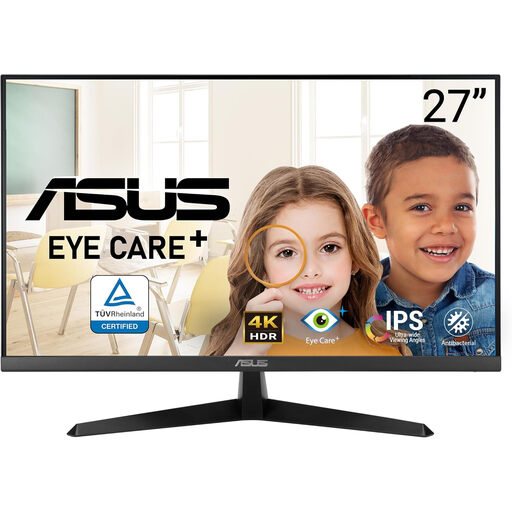
Consider this when 4K design detail matters more to you than high-refresh gaming. Its stated refresh rate is 60Hz; check your computer’s 4K output and measure the space available for the stand.
 No image available
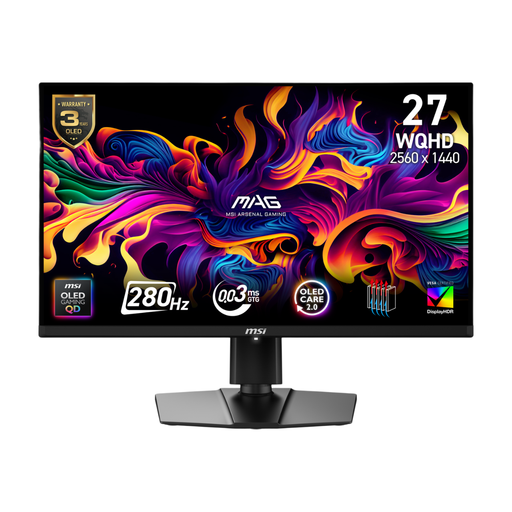
Consider this if fast gaming takes priority over 4K design detail. Its title specifies QHD QD-OLED and 280Hz; confirm the actual desk footprint and read the model’s OLED-care and warranty terms.
 No image available
This is a gaming-led choice if you can accept QHD rather than 4K for spacecraft design. Its title specifies a 27-inch OLED panel and 240Hz; check stand depth, cable space and the exact OLED-care and warranty terms.
 No image available
Consider this for a near-27-inch, gaming-led setup rather than maximum 4K design detail. Its title specifies 2560 × 1440 QD-OLED and 240Hz; measure stand depth and check the model’s panel-care and warranty conditions.
Yes, if its stand and your viewing position fit the usable depth. ASUS lists the PG27UCDM at 21.88 cm deep with its stand, while BenQ lists 276.8 mm for the EX271U, so measure the particular model rather than judging by screen size.
OLED may suit that mix of work and gaming if its display characteristics matter to you and you are willing to follow the chosen model’s panel-care guidance. Check its warranty wording too: ASUS states that the PG27UCDM’s three-year warranty includes panel burn-in, but that statement does not establish the terms for other models.
Arrange the screen, desk space and lighting as part of the workstation, rather than choosing by monitor specification alone. For workers covered by display-screen equipment requirements, the Health and Safety Executive says employers must assess workstations and reduce risks; the applicable work arrangements should be checked separately from a monitor purchase.
Use an appropriate electrical-equipment recycling or take-back route rather than ordinary household waste. GOV.UK identifies the Waste Electrical and Electronic Equipment Regulations 2013, as amended, as the framework for recovery, reuse and recycling; check which local-authority or retailer route accepts your monitor.