For survival games, choose a monitor around the scenes and device you play on: consider OLED or QD-OLED for dark-world presentation, or a high-refresh IPS model if fast PC movement takes priority. Before buying, match the resolution and refresh rate to the port you will actually use; a headline refresh rate or HDMI label does not establish what your PC or console can display.
Who is this for?
Dark-world survival explorers
If caves, night zones and shadow-heavy interiors dominate your games, dark-scene presentation, HDR handling and room reflections may matter more to you than the highest refresh-rate figure. LG and Samsung list relevant features on their cited OLED models, although the results depend on the particular display and its settings.
High-frame-rate PC survival players
If your PC delivers high frame rates during combat and quick camera movement, compare native refresh rates, response-time definitions and variable refresh rate (VRR) support. The connection and selected display mode also need to carry the signal you intend to use.
Console-first QHD gamers
If you mainly play on a console, check the monitor’s HDMI signal table against your chosen resolution and refresh setting. Xbox Support says 1440p requires a compatible display, while its 4K-at-120Hz guidance has additional display and cable requirements.
What matters when choosing?
Start with your main playing device and the experience you want to prioritise, then check whether the exact monitor input can deliver it.
| Concern | What to check | Who this matters to |
|---|
| Dark scenes |
Compare the exact panel, HDR features and reflection treatment; account for room lighting and display settings. |
When I spend most of a game exploring caves or night zones, I want the picture to serve those scenes rather than choosing solely by refresh rate. Around 29% of consumers put dark-scene presentation first. |
| PC motion |
Check native versus overclocked refresh rate and VRR support for your graphics setup. |
Fast turns and combat make smooth movement my main priority, provided my PC can deliver the frames. Roughly 29% of consumers prioritise high-frame-rate PC play. |
| Console output |
Match the HDMI port’s stated resolution and refresh limits to your console target and cable. |
I do not want to select a monitor by its maximum refresh figure only to find that my console uses a different HDMI mode. For around 21% of consumers, console-output compatibility comes first. |
| Practical QHD setup |
Check screen dimensions, stand or mounting options, and which specifications you will use. |
A monitor has to fit my desk and everyday setup, even if I will not use its highest-rated mode. Practical QHD usability is the leading concern for roughly 21% of consumers. |
Mistakes to avoid
-
Assuming an HDMI 2.1 label confirms 4K at 120Hz
Input limits are model-specific: Dell lists the G2725D’s HDMI inputs at up to QHD 144Hz. Xbox Support’s guidance for Xbox Series X 4K at 120Hz calls for an HDMI 2.1-capable display and an Ultra High Speed HDMI cable.
Read the monitor’s signal table for the exact port, resolution and refresh rate you plan to use.
-
Comparing an overclocked maximum with a native refresh rate
ASUS specifies the VG27AQML1A at a native 240Hz and up to 260Hz when overclocked; those figures describe different modes.
Use the native rate for your initial comparison, then check the connection, selected mode and frame rates needed to use the overclock.
-
Expecting an HDR label to look the same in every room
LG gives the 27GS95QE-B’s picture specifications under stated conditions. LG also says Smart Energy Saving is enabled by default, so the operating setting matters when assessing its OLED presentation.
Compare the exact model’s HDR specification, reflection treatment and default settings in the context of your room.
LG says power consumption may increase if Smart Energy Saving is turned off for a brighter OLED experience.
-
Treating a manufacturer listing as a purchase option
Dell’s UK page identifies the G2725D as currently unavailable, despite retaining its specifications.
Check the exact model and current availability with the retailer before making it part of your purchase plan.
Brands and models to consider
LG UltraGear
The UK-listed 27GS95QE-B is a 27-inch QHD OLED option for players considering dark-scene presentation alongside 240Hz PC play.
- LG specifies 2560 × 1440, 240Hz, a 0.03ms GtG response time and QHD at 240Hz through HDMI 2.1 for this model.
- LG says its default Smart Energy Saving setting affects the trade-off between a brighter OLED setting and power consumption.
Samsung Odyssey
Samsung’s UK-listed Odyssey OLED G6 G61SH is a 27-inch QHD QD-OLED model with 240Hz and a manufacturer-described Glare Free treatment.
- Samsung lists HDR10+ Gaming and a 0.03ms response time for the G61SH.
- Samsung’s descriptions of reflection and dark-scene benefits are claims for this model, not comparative results for every Odyssey monitor.
ASUS TUF Gaming
The VG27AQML1A offers a 27-inch QHD Fast IPS route for PC players focused on high refresh rates and VRR.
- ASUS specifies native 240Hz, FreeSync Premium, G-SYNC compatibility and VESA AdaptiveSync.
- Its 260Hz figure requires overclocking, and ASUS says ELMB Sync works best above 85Hz.
Dell Gaming
Dell’s G2725D provides published signal limits for comparing a 27-inch QHD monitor across PC and HDMI-connected setups.
- Dell lists up to QHD 180Hz through DisplayPort and QHD 144Hz through HDMI.
- Dell’s UK page marks the G2725D as currently unavailable; its HDMI signal table does not establish 4K-at-120Hz support.
Joybuy monitor choices
These choices cover conventional QHD OLED monitors, two larger OLED ultrawides and a 27-inch IPS dual-mode monitor. Pick the format that suits your desk and games, then confirm the signal mode needed by your PC or console.
 No image available
Samsung Odyssey G6 S27DG612 27-inch QHD OLED
Consider this conventional-size OLED option if dark scenes and fast PC play are both priorities.
The product name specifies 240Hz and a 0.03ms response time. Check the resolution and refresh rate available through the input you will use. This S27DG612 is not the G61SH discussed in the brand section.
Joybuy
 No image available
LG UltraGear 39GX900A-B 39-inch OLED
Consider its larger ultrawide format if it suits your desk and the survival games you play.
The product name specifies a QHD OLED display and 240Hz. Check that your game, connected device and chosen input support the ultrawide mode you want.
Joybuy
 No image available
LG UltraGear 34GX900A-B 34-inch OLED WQHD
This is another ultrawide OLED choice for a setup where screen fit and game support have been checked.
The product name specifies 240Hz. Confirm that the connected device and input can deliver your intended resolution and refresh-rate combination.
Joybuy
 No image available
LG UltraGear G8 27G850A 27-inch 4K Nano IPS
Consider this IPS option if its 4K resolution and dual refresh-rate modes fit your PC gaming priorities.
The product name specifies 240Hz and 480Hz dual-mode operation, a 1ms GtG response time, DisplayHDR 600, DisplayPort 2.1 and HDMI 2.1. The refresh rates depend on the selected resolution and mode; check the one your device can use.
Joybuy
 No image available
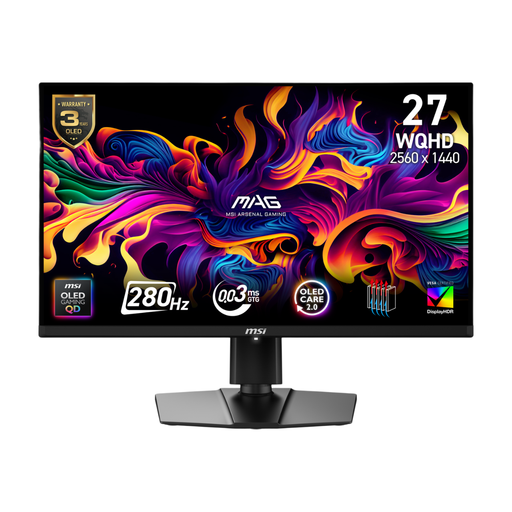
MSI MAG 271QP QD-OLED X28 27-inch QHD
Consider this QD-OLED model if you want a conventional-size QHD display with a high stated refresh rate.
The product name specifies 280Hz and a 0.03ms response time. If VRR matters to you, confirm compatibility, as well as the resolution and refresh rate available through your chosen input.
Joybuy
Questions about survival-game monitors
Do I need HDMI 2.1 for survival games on Xbox Series X?
It depends on the output you want: Xbox Support calls for an HDMI 2.1-capable display and an Ultra High Speed HDMI cable for Xbox Series X gaming at 4K and 120Hz. If you choose 1440p instead, check that the display supports that resolution and, if wanted, 120Hz through HDMI.
How can I tell whether I can use a monitor’s advertised refresh rate?
Check the exact resolution, input and operating mode together. Dell lists the G2725D at up to QHD 180Hz through DisplayPort but QHD 144Hz through HDMI, while ASUS lists the VG27AQML1A at native 240Hz and up to 260Hz when overclocked.
What if a newly bought monitor is faulty in the UK?
The explanatory notes to the UK Consumer Rights Act 2015 describe a right to request repair or replacement of faulty goods at the trader’s expense. The appropriate remedy depends on the circumstances of the fault; a retailer’s change-of-mind policy is a separate matter.
How should I dispose of an old monitor in the UK?
Use an appropriate electrical-equipment collection route rather than putting the monitor in ordinary household waste. GOV.UK describes the UK waste electrical and electronic equipment regime as supporting the recovery, reuse and recycling of electrical products and components; check your local authority or retailer for an available collection option.


