Dark-scene immersion seekers
You care most about contrast and the atmosphere of shadowy scenes, and are willing to follow OLED panel-care guidance for a roughly 27-inch QHD display.


Choose a 27-inch QHD OLED monitor if dark-scene contrast is your main reason for buying; a QHD IPS monitor is worth considering if you would rather avoid OLED care routines. Reserve a 480Hz-or-higher model for games and hardware that can use that mode, rather than buying it solely for survival horror. In a shared bedroom, a dim setting can help with light, but it does not replace stopping screen use before bed.
You care most about contrast and the atmosphere of shadowy scenes, and are willing to follow OLED panel-care guidance for a roughly 27-inch QHD display.
You share a bedroom and want to control screen brightness without treating a monitor setting as a substitute for ending play before bed. Oxford Health CAMHS advises dimming a screen when needed, while recommending that screens be turned off well before bedtime.
You need a monitor that fits your desk and may serve both a PC and a console. The stand, inputs and supported refresh modes matter alongside the panel type.
Decide whether dark-scene contrast, considerate bedroom use, motion or desk-and-device fit is your first priority. Then check the exact model and input mode: a headline refresh rate does not tell you what your own setup can deliver.
| Concern | What to check | Who this matters to |
|---|---|---|
| Dark-scene contrast | Check the panel type and the exact model’s HDR credentials; consider reflections from bedroom lighting. | If shadowy scenes are the point of playing, I want contrast without simply turning up the whole screen. Around 36% of consumers put dark-scene presentation first. |
| Shared-bedroom use | Check how readily you can adjust brightness, and plan when to switch the screen off. | When someone else is trying to sleep, I need to keep screen light manageable and finish play at a sensible time. For around 29% of consumers, considerate late-night use comes first. |
| Motion and response | Confirm the refresh rate at your intended resolution and input, plus the conditions behind any stated response-time rating. | If I also play fast-action games, smoother motion matters beyond the atmosphere of horror. Around 21% of consumers make motion their primary concern. |
| Desk and device fit | Measure the stand footprint and check the inputs and modes needed by your PC or console. | With limited desk space and more than one gaming device, I need a screen that fits and connects as intended. Practical setup and value come first for around 14% of consumers. |
A 480Hz or 500Hz specification does not, by itself, make dark scenes more convincing. LG UK specifies DisplayPort 2.1 for the QHD 480Hz mode on its 27GX790A-B, so the connection matters too.
Start with the resolution, panel and modes your games and hardware can use. Consider the higher refresh tier if fast-action gaming is also a priority, after checking the source device, port and cable.
Oxford Health CAMHS says dimming or filtering a screen can help, but recommends switching screens off well before bedtime; visually stimulating content can still make winding down harder.
Set a brightness level that works for the shared room and agree on a stopping time rather than relying on the display setting alone.
ASUS and MSI describe their panel-care functions as reducing risk, not eliminating it. Regular static desktop use remains relevant when choosing between OLED and IPS.
Read the exact model’s care instructions and consider IPS if you would rather avoid OLED maintenance routines.
LG UK lists the 27GX790A-B as a 27-inch QHD OLED monitor with a 480Hz mode, DisplayHDR True Black 400 and anti-glare, low-reflection treatment.
ASUS ROG UK lists the PG27AQDP as a 26.5-inch viewable QHD WOLED monitor with a 480Hz mode and an optional uniform-brightness setting.
Dell UK lists two QHD choices in this line: the AW2725D QD-OLED at 280Hz and the AW2725DM Fast IPS at up to 180Hz.
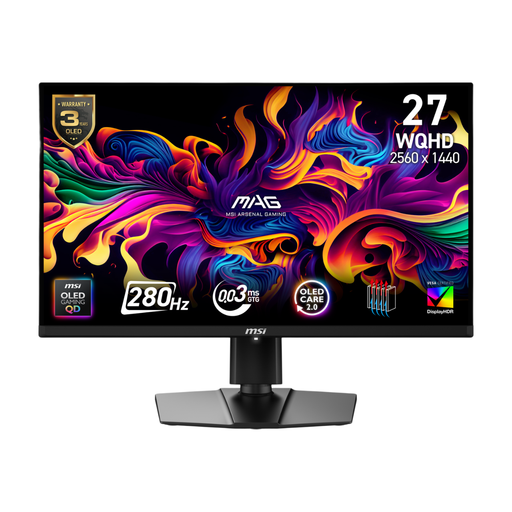
MSI specifies the MAG 271QP QD-OLED X28 as a QHD QD-OLED monitor at 280Hz with DisplayHDR True Black 400 and stated HDMI 2.1 console features.
These Joybuy choices are OLED gaming monitors relevant to dark-scene play. The roughly 27-inch QHD models suit a more compact desk; the larger LG model is a separate 4K option whose refresh mode changes with resolution.
 No image available
Consider this QD-OLED model if dark-scene contrast is your priority and you want to stay with a roughly 27-inch QHD screen.
MSI specifies 280Hz, 0.03ms grey-to-grey response and DisplayHDR True Black 400 for this model. Follow its OLED care guidance, and check whether its brightness controls suit your room.
 No image available
Consider this QD-OLED option if you want a roughly 27-inch screen for dark-scene gaming without choosing the highest refresh tier.
The product name specifies 2560 × 1440, 240Hz, 0.03ms response and Adaptive-Sync. If a particular HDR certification matters to you, confirm it for this exact model; follow its OLED care guidance as well.
 No image available
This 27-inch OLED choice is relevant if dark-scene play and an adjustable desk setup are both important.
The product name specifies QHD, 240Hz and 0.03ms response. Confirm the exact HDR credentials and brightness controls if either will determine your choice.
 No image available
This 26.5-inch QD-OLED model suits shoppers assessing a smaller-format screen for QHD horror gaming.
Its product name specifies 2560 × 1440, 240Hz, 0.03ms response and HDR10. Check its panel-care and brightness settings before deciding whether it suits regular bedroom use.
 No image available
Consider this larger OLED model if you want a 4K option and have measured enough room for its screen and stand.
The product name specifies a dual mode: 240Hz at 4K or 480Hz at Full HD, rather than 480Hz at 4K. Check the brightness controls if you plan to use it while someone else is sleeping.
OLED is worth considering if dark-scene contrast is your leading priority: LG UK and MSI list QHD OLED models with DisplayHDR True Black 400 credentials. A QHD Fast IPS model remains an option if you place more weight on avoiding OLED care routines than on those OLED specifications.
No: dimming can help manage screen light, but it does not make late-night play sleep-neutral. Oxford Health CAMHS recommends switching screens off well before bedtime and notes that visually stimulating content can make winding down harder.
It can if the exact monitor provides the modes your devices need. MSI specifies HDMI 2.1, 120Hz support, variable refresh rate and auto low-latency mode for the MAG 271QP QD-OLED X28; check your console, chosen input and intended resolution rather than assuming those features apply to every monitor here.