Simulation detail and map readers
If you regularly inspect routes, timetables, vehicle controls and dense menus, readable detail and usable screen space may matter more to you than an especially high refresh rate.


For a student-room desk used mainly for transport simulations, start by checking whether a 27-inch QHD monitor fits and whether your PC can run games comfortably at 2560 × 1440. A compact Full HD screen makes more sense when space or graphics capability is the tighter constraint; consider a curved or larger display only after checking desk clearance and viewing distance.
If you regularly inspect routes, timetables, vehicle controls and dense menus, readable detail and usable screen space may matter more to you than an especially high refresh rate.
If your monitor must share a desk with a keyboard, laptop and study materials, check its stand footprint and positioning options as well as its screen size.
If you also play racing, action or competitive games, variable refresh rate (VRR), refresh rate and motion behaviour become more important alongside interface clarity.
Choose a resolution your PC can handle and a screen that fits the desk before comparing headline speed figures. The percentages below describe how consumers with this student-room transport-simulation brief might divide by their single most important concern.
Consider it when: Desk space is tight or your PC is better suited to 1920 × 1080.
Trade-off: A smaller Full HD screen leaves less room for dense maps and controls than a QHD screen.
Consider it when: You want space for simulation interfaces and everyday study work, and your desk and PC can accommodate 2560 × 1440.
Trade-off: QHD asks more of the graphics hardware than Full HD; the available refresh rate also depends on the connection.
Consider it when: You prefer a wider-feeling view and have measured a suitable position for the screen.
Trade-off: The panel and stand may be harder to place on a small desk; check model-specific motion behaviour rather than relying on the panel label.
| Concern | What to check | Who this matters to |
|---|---|---|
| Readable detail | Compare native resolution and screen size, then check how your PC runs the game at that resolution. | If I spend time reading maps and route controls, I want enough detail without making the interface uncomfortable to use. Around 33% of consumers would put readable detail first. |
| Desk fit | Measure the space available for the screen and stand; check adjustment or mounting options on the exact model. | When books and a laptop share my desk, I need the monitor to fit at a comfortable position. Desk fit would come first for roughly 27% of consumers. |
| Smooth motion | Check VRR compatibility and the refresh-rate limit of the input you will use. | If I also play faster games, I care about how moving images behave, not just how a still map looks. Approximately 20% of consumers would prioritise smooth motion. |
| Overall value | Compare the specifications you will use, warranty terms and energy information for products in scope. | With several study and gaming needs to cover, I want to avoid paying for speed I cannot use or overlooking running information. For about 20% of consumers, overall value would be the primary concern. |
A high advertised refresh rate cannot make a monitor fit a cramped desk or ensure your PC runs a transport simulation comfortably at QHD.
Measure usable desk width and depth, then check your graphics output and expected performance at the resolution you want.
Response-time figures can use different measures and operating modes. RTINGS explains that slow response behaviour can cause blur or inverse ghosting in moving images.
Check whether a quoted figure refers to grey-to-grey response, MPRT or another measure; consult independent motion testing if clarity in fast games matters to you.
Dell specifies 165Hz through DisplayPort but 144Hz through HDMI for the G2724D. LG says the 27GS75QN-B’s 200Hz overclock requires a DisplayPort 1.4-capable graphics card and cable.
Match the exact monitor input, your computer’s output and the cable to the mode you intend to use.
For products within the scope of UK energy-information rules, an accurate energy label helps with comparison. The Consumer Rights Act 2015 also sets a satisfactory-quality requirement for goods supplied under a consumer contract.
Review the applicable energy information and keep the model number, advertised specifications and order confirmation in case you need to raise a problem with the seller.
These brands offer specific monitor models relevant to the choices above; check the specifications of the exact model rather than applying them to an entire range.
The AOC Q27G4X is one example of a 27-inch QHD Fast IPS gaming monitor.
The MAG 275QF is a QHD gaming option for comparing 180Hz-class specifications.
The LG 27GS75QN-B is a QHD IPS model to examine if VRR compatibility is important.
Dell’s G2724D provides a model-specific reference for QHD, connection limits and stand adjustment.
These QHD and 4K monitors offer different approaches to simulation detail, desk use and refresh rate. Check your available space and PC connections against the individual model before choosing.
 No image available
Consider this if you want a QHD screen for detailed simulation interfaces and also value a high advertised refresh rate for other games.
The product title specifies a 27-inch OLED panel, QHD resolution, 240Hz and a 0.03ms response-time claim. Check which mode your PC, cable and chosen monitor input can use; the response-time figure is not an independent motion test.
 No image available
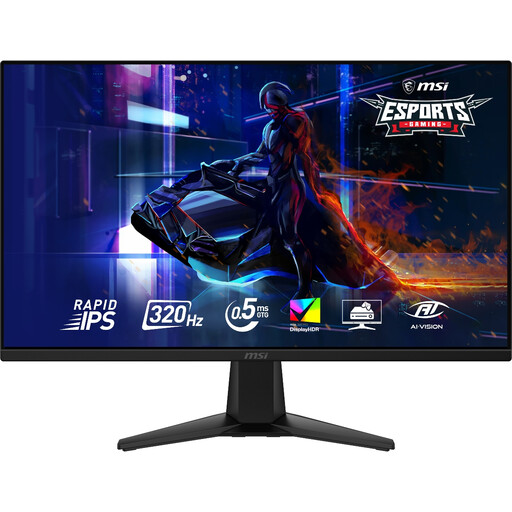
Consider this if you want QHD detail for maps and menus alongside Adaptive-Sync for compatible gaming.
The product title specifies 2560 × 1440, a Rapid IPS panel, 320Hz, Adaptive-Sync and a 0.5ms response-time claim. Check the refresh-rate limit of the input you will use and measure the space needed for the stand or mount.
 No image available
Consider this if QHD screen detail is your starting point and you also want to compare higher-refresh gaming models.
The product title specifies a 27-inch Fast IPS panel, 2560 × 1440 and 220Hz. Check the input-specific refresh limits, PC compatibility and stand clearance before deciding whether those specifications suit your desk.
 No image available
Consider this if you want to assess 4K detail as an alternative to the QHD route and your PC can handle the mode you plan to use.
The product title specifies 4K UHD, a 27-inch Nano IPS panel, dual-mode 240Hz/480Hz, DisplayPort 2.1 and HDMI 2.1. Check which resolution and refresh-rate combination each mode uses, and which input and cable it requires.
 No image available
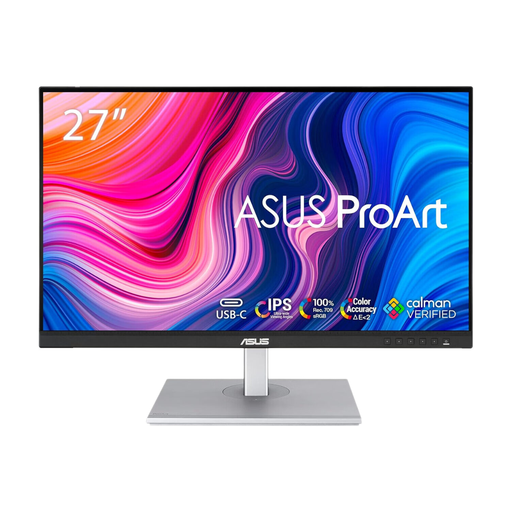
Consider this if readable QHD interfaces and study use matter more to you than the higher refresh-rate claims of the gaming-focused models.
The product title specifies an IPS panel, QHD resolution and 100Hz. If VRR matters for your games, confirm support for this exact variant and check the refresh-rate limit of your intended connection.
Yes, if the screen fits your desk and your PC runs the game comfortably at 2560 × 1440. The extra resolution can be useful when you read maps and dense controls; choose a more compact Full HD setup if space or graphics capability takes priority.
No: decide on readable resolution, physical fit and a suitable PC connection before paying attention to a 240Hz claim. A higher refresh rate may matter more if fast games are also a major use, but your PC must deliver frames at the chosen resolution for you to make use of it.
No. For the LG 27GS75QN-B specifically, LG says its 200Hz overclock requires a DisplayPort 1.4-capable graphics card and cable. Check the conditions for your exact monitor and computer rather than assuming a headline maximum works through every connection.
Check the energy label when comparing monitors within the scope of UK energy-information rules. GOV.UK states that products in scope must be supplied with an accurate printed energy label; compare the information for the exact models you are considering.
Keep your order confirmation, the product listing and any advertised specifications so you can explain the problem to the seller. The Consumer Rights Act 2015 requires goods supplied under a consumer contract to be of satisfactory quality; the appropriate remedy depends on the circumstances of the problem.