Racers with limited cockpit space
If the PC must sit beside, beneath or on a compact rig, leave room not just for the case but also for ventilation, cable bends and access to its ports.


Choose the PC around your kart simulator and intended display, then check that its case and cables fit the cockpit. A compact desktop is a practical choice for a single-screen setup if its exact graphics configuration meets the game’s requirements; a larger tower gives you more room to consider future displays and component changes, but needs space beside the rig. Neither case size nor a graphics-card name alone confirms how the finished setup will work.
If the PC must sit beside, beneath or on a compact rig, leave room not just for the case but also for ventilation, cable bends and access to its ports.
Plan the connections for your controls before choosing a PC. PiBoSo strongly recommends a steering wheel for Kart Racing Pro, while Fanatec notes that additional sim-racing peripherals can make port planning important.
If you may change your display setup later, assess the exact PC’s graphics configuration, video connections and physical upgrade options before committing to the smallest case.
Settle your simulator and display plan before choosing a case size: a compact PC is useful only if it also accommodates the controls, connections and airflow your cockpit needs.
Consider it when: the PC needs to sit close to the rig and your planned display setup suits the exact configuration.
Allow for: model-specific limits on graphics options, cooling clearance and later component changes.
Consider it when: future component changes matter enough to justify a separate position beside the cockpit.
Allow for: a bigger footprint and potentially longer, more carefully routed display and control cables.
| Concern | What to check | Who this matters to |
|---|---|---|
| Graphics and displays | Compare the exact GPU and video connectors with your simulator, monitor and any planned VR or additional displays. | If I want responsive visuals on my chosen display, I need to judge the PC against that setup rather than its case size. Around 36% of consumers put display suitability first. |
| Fit and ventilation | Measure the PC’s intended position, including cable bends, port access and the maker’s required airflow space. | When the rig leaves little room beside the pedals, I need a case I can position without obstructing movement or airflow. Physical fit comes first for around 29% of consumers. |
| Control connections | Count the USB connections for your wheel, pedals and accessories; check display connectors separately. | With several cockpit controls to attach, I want them connected without an awkward run of adapters and cables. Around 21% of consumers chiefly prioritise peripheral connections. |
| Room to upgrade | Check the exact model’s component access, expansion space and support terms before relying on a future upgrade. | If I expect to change graphics hardware or add components later, I can accept a larger case now. Upgrade access is the main concern for around 14% of consumers. |
Configurations within a range can differ. ASUS ROG describes the G22CH with graphics options up to RTX 4070, while its ROG NUC range uses laptop-class RTX 4070 or 4060-series graphics; similarly named options should not be treated as interchangeable.
Check the exact model’s GPU, video outputs, USB connections and your simulator’s current requirements before buying.
A small case still needs unobstructed ventilation, and a position that blocks rear ports can make the cockpit difficult to use.
Measure the location, follow the case maker’s clearance guidance and route power and display cables away from pedal movement.
A wheel, pedals and other accessories can use several connections before the PC is installed. Fanatec suggests a dock as one option where peripheral ports are limited.
List each device and connector, then check the PC’s port layout and any proposed hub or dock for compatibility.
If a hub or dock is needed, it also needs space and another cable route around the cockpit.
A larger chassis may offer more accessible component options, but it can undermine the space-saving reason for a compact cockpit.
Choose its position and cable route before purchase. Give upgrade access priority only if those future changes are realistic for your setup.
ASUS ROG offers two different compact formats to examine: the 10 L G22CH desktop and the smaller ROG NUC line.
HP’s OMEN 16L and 35L ranges offer compact-on-desk and larger-tower formats to compare.
MSI’s MPG Trident AS AI is another compact prebuilt desktop format relevant to cockpit placement.
These options include three mini PCs and two Stormforce desktops. Compare each one with your simulator and display plan, then check its physical fit and connections for your cockpit.
 No image available
Consider this mini PC when keeping the computer close to the rig matters, provided its graphics suit your simulator and display.
The named configuration has Radeon 760M graphics, 24 GB LPDDR5 RAM and a 512 GB PCIe 4.0 SSD. Check its dimensions, ventilation requirements and USB connections for your controls.
 No image available
This is another small-format option to assess if the PC needs to sit near the cockpit.
Its named configuration includes Radeon 680M graphics, dual M.2 slots and triple-display support. Check the actual display and USB connectors, physical clearance and suitability for your chosen game.
 No image available
Consider the A8 if you want a mini-PC format and are prepared to confirm how its connections fit your display and controls.
The named configuration includes Radeon 880M graphics, 24 GB DDR5 RAM, a 1 TB PCIe 4.0 SSD, USB4 and OCuLink. Check the exact ports and any intended external-device compatibility, as well as cockpit clearance.
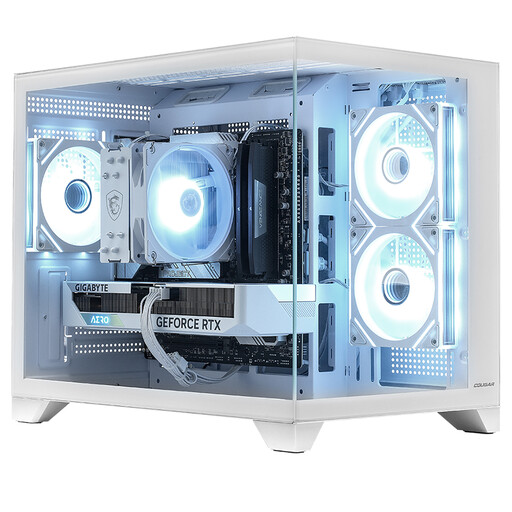 No image available
This desktop is worth assessing if you want the listed dedicated graphics card and have a suitable position beside the cockpit.
Its product name also specifies a 1 TB SSD and Windows 11. Measure the case position and check its video outputs, USB ports and ventilation space against your planned setup.
 No image available
Consider this tower only if you can give a larger PC its own position without compromising access to the rig.
Its product name specifies a 2 TB SSD and Windows 11. Confirm the case dimensions, ventilation clearance, video outputs and USB layout before matching it to your simulator and cockpit controls.
No: a compact desktop can work if its exact configuration meets your simulator’s requirements and has the connections your display and controls need. A larger tower is worth considering if future component changes matter to you and you have room to position it safely.
List your wheelbase, pedals, other controls, display or VR equipment, headset and any network cable first. Match each device to the PC’s actual ports and plan the cable route; if you need a hub or dock, check its compatibility with the connected devices.
Not for every game: PiBoSo strongly recommends a wheel for Kart Racing Pro but also lists keyboard, joystick and gamepad support. Check the current controller support of the simulator you intend to play and the compatibility of your chosen wheel.