For a new PC intended for DCS World at high graphics settings, start with Eagle Dynamics’ recommendation of 32GB RAM, 500GB of SSD space plus room for additional content, and a discrete GPU with at least 8GB of VRAM. In a shared bedroom, choose between a tower, compact desktop and laptop according to the space you can leave set up, then check the exact cooling hardware, connections and room for flight controls; those specifications alone cannot promise a particular frame rate or noise level.
Who needs what from the PC?
DCS formation trainees
If high-settings DCS World and multiplayer practice are the main uses, compare the complete PC with Eagle Dynamics’ recommended memory, SSD-space and discrete-GPU requirements. Meeting a lower settings tier is a different purchase decision.
Shared-bedroom space planners
If the setup must coexist with sleeping or study space, measure where the PC, cables and controls will go before choosing a case size. Microsoft Flight Simulator identifies available physical space as a factor in choosing simulation hardware; a small case label does not tell you how loud its fans will be.
Peripheral-led sim pilots
If you use or plan to add a joystick, HOTAS, pedals, head tracking or VR, work out the desk space and connections the chosen equipment needs. Microsoft Flight Simulator lists flight peripherals among its PC setup options, but the practical layout depends on the controls you select.
What should you check first?
Set the specification around your intended simulator, then measure the shared space and plan the controls. A laptop can be put away between sessions, while a desktop needs a permanent place for its case and display; neither choice removes the need to accommodate flight controls.
| Concern |
What to check |
Who this matters to |
| Simulator capacity |
For high-settings DCS World, compare the full configuration with Eagle Dynamics’ 32GB RAM, 500GB SSD plus additional content space, and discrete GPU with at least 8GB VRAM recommendations. Check the exact GPU rather than its series name alone. |
If I am buying mainly for DCS formation practice, I want capacity for my intended settings rather than a PC that only meets lower settings requirements; around 42% of consumers put simulator capacity first. |
| Bedroom fit and disturbance |
Measure the case or laptop storage space and check the listed cooler, fans and placement clearance. Ask about noise under the use conditions that matter to you rather than treating size as a noise rating. |
When someone else sleeps or studies in the room, I need the setup to fit without assuming a compact case will be quiet; for around 33% of consumers, room fit and disturbance are the primary concern. |
| Controls and connections |
Count the ports needed for your selected controls alongside everyday devices, and measure where controls can be used or stored. Check any planned head-tracking or VR connections separately. |
If my joystick, throttle or pedals cannot fit comfortably on the desk, the PC specification alone will not make the setup usable; around 25% of consumers prioritise controls and connections. |
Buying pitfalls
-
Choosing a PC around lower DCS settings requirements
Eagle Dynamics lists 16GB RAM, 250GB storage and a discrete GPU with 6GB VRAM for lower settings, compared with 32GB RAM, a 500GB SSD plus additional content space, and at least 8GB VRAM for recommended high settings. The lower tier is not the same target for a new high-settings setup.
Check the complete configuration against the settings you intend to use, including any multiplayer or VR plans; published requirements do not guarantee a particular frame rate.
Changing course later may involve a RAM, SSD or GPU upgrade and moving simulator content.
-
Assuming a compact PC will be quiet
A smaller case may help with the room layout, but its label does not establish fan noise or cooling behaviour during a simulation session.
Measure its placement space and check the exact CPU cooler, case fans and graphics-card cooler. Consider how you can assess noise under your intended conditions before committing to the configuration.
-
Planning for the computer but not the flight controls
Microsoft Flight Simulator identifies a gamepad or joystick for aircraft control and lists further flight peripherals as options. Each control you choose changes the space and connection plan.
Decide which controls you will use, count their connections and measure mounting and storage space before finalising the PC.
Additional controls, mounts or USB expansion may also take up space that the bedroom setup needs to accommodate.
-
Treating every UK listing as having the same compliance route
Office for Product Safety & Standards guidance sets out requirements for electrical equipment placed on the Great Britain market. Department for Business and Trade guidance distinguishes conformity-marking frameworks for Great Britain and Northern Ireland.
Confirm the delivery jurisdiction and check the seller’s information for the exact PC, supplied mains lead and plug, applicable compliance documentation and warranty territory.
Relevant brands to consider
AMD
AMD components can appear in either the processor or graphics configuration of a gaming PC. Compare the exact parts rather than treating an AMD-based system as one fixed specification.
- AMD lists the Ryzen 7 7800X3D as an eight-core, 16-thread desktop processor, giving buyers a specific model to compare with the processor named in a PC listing.
- AMD lists 304W typical board power and a 750W minimum PSU recommendation for its Radeon RX 9070 XT example. If considering that GPU, check the assembled PC’s actual graphics-card variant, PSU and case clearance; those figures do not apply to every AMD-based PC.
NVIDIA
GeForce-based PCs are relevant when comparing graphics configurations for a chosen simulator and display.
- NVIDIA identifies its GeForce RTX 5070 family as Blackwell-based and describes DLSS technologies for the family. Check whether the particular simulator and configuration support any feature you intend to use.
- A GeForce family name does not establish the VRAM capacity, cooler or power needs of the exact card installed in a prebuilt PC.
Intel
Intel offers desktop processor options that may appear in prebuilt gaming PCs; the processor model is only one part of the assembled configuration.
- Intel lists the 14th-generation Core i5-14600K with 14 cores, providing a specific model reference when checking a builder’s component list.
- Core count alone does not establish simulator performance or bedroom noise. Check the processor suffix, cooling, motherboard, RAM and power settings of the actual PC.
Joybuy laptop options
These Lenovo gaming laptops are options for a room where the computer needs to be put away between sessions. Their listed memory and storage differ, and both still require space for flight controls; check each exact graphics configuration against your simulator before choosing.
 Image unavailable
Lenovo Legion Pro 7 16IAX10H, 83F5000UUK
This 16-inch laptop is a choice to consider if the PC must be stored between formation-flying sessions, although external controls will still need desk space.
The named configuration includes an Intel Core Ultra 9 processor, 64GB RAM, a 2TB SSD and NVIDIA GeForce RTX 5090 graphics. Confirm the graphics card’s VRAM, the connections needed for your controls, the laptop’s dimensions and its noise under your intended use.
View on Joybuy
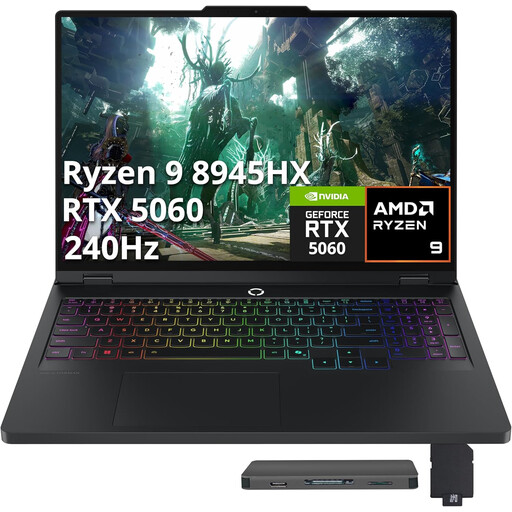 Image unavailable
Lenovo Legion Pro 5 LEG P5 R9, 32GB/2TB, 5060
This laptop suits consideration when packing the PC away matters more than keeping a tower permanently set up; allow separate space for the controls you intend to use.
Its name specifies 32GB RAM, 2TB storage and 5060 graphics. Before selecting it for high-settings DCS World, confirm the exact processor model and GPU VRAM, as well as its dimensions, control connections and noise under your intended use.
View on Joybuy
Frequently asked questions
What specification should I start with for high-settings DCS World?
Start with Eagle Dynamics’ recommended 32GB RAM, 500GB SSD space plus room for additional paid content, and a discrete GPU with at least 8GB VRAM. Check the exact CPU and GPU against the current simulator requirements too; this baseline does not promise a particular result in multiplayer, at a chosen display resolution or in VR.
Is a compact PC a good choice for a shared bedroom?
A compact PC is worth considering if its measured dimensions fit your available space and its complete component list meets your simulator needs. Check cooling hardware, placement clearance and connections separately: a small case is not, by itself, evidence of quiet operation.
Do I need flight controls as well as the PC?
Plan for a suitable controller and somewhere to use it. Microsoft Flight Simulator identifies a gamepad or joystick for aircraft control, while equipment such as HOTAS, pedals and head tracking is optional; check the requirements of your chosen simulator and the desk space and connections for your chosen controls.
What should I check about UK product information?
Check which jurisdiction the PC is being supplied to and review the seller’s information for the exact configuration, mains lead, plug and applicable compliance documentation. Office for Product Safety & Standards guidance covers electrical equipment requirements in Great Britain, while Department for Business and Trade guidance distinguishes Great Britain and Northern Ireland marking frameworks; do not assume one marking answers every product or jurisdiction question.


