Large-screen desk players
If you are pairing a PC with a large monitor or TV, check the display’s inputs, resolution and refresh rate alongside the PC’s video outputs. Screen size alone cannot establish the connection or performance target.


Choose a PC around the games you will actually play and the resolution and refresh rate of your large display, rather than the deck-building label or screen size alone. If your library centres on 2D deck-builders such as Slay the Spire and Balatro, check whether an existing or value-focused PC meets their requirements before buying a gaming tower. If you also plan to play a 3D tactical game such as Marvel’s Midnight Suns, compare the exact configuration with 2K’s game-specific requirements and check its connection to your display.
If you are pairing a PC with a large monitor or TV, check the display’s inputs, resolution and refresh rate alongside the PC’s video outputs. Screen size alone cannot establish the connection or performance target.
If Slay the Spire and Balatro represent most of what you play, start with those games’ requirements and your display connection before deciding whether you need a new gaming tower.
If your library also includes a title such as Marvel’s Midnight Suns, compare the complete PC configuration with that game’s official requirements rather than assuming all card-based games need similar hardware.
Start with your game list and display details. That determines whether checking an existing PC makes more sense than selecting a new tower, and which specifications matter if you do buy one.
Consider it when: Your library is mainly 2D deck-builders such as Slay the Spire and Balatro.
Trade-off: Check each game and the display connection; suitability for more demanding 3D games does not follow from the genre name.
Consider it when: You also want to play card-based tactical games such as Marvel’s Midnight Suns; 2K suggests 16 GB RAM and AMD RX 5700 or GeForce GTX 1070 graphics for that game.
Trade-off: Meeting those game-specific specifications does not establish performance at your chosen display settings.
Consider it when: You also need the PC for other demanding games or workloads, or have a specific upgrade plan.
Trade-off: Extra components or expansion options may go unused in a deck-builder-only setup; verify what the individual configuration offers.
| Concern | What to check | Who this matters to |
|---|---|---|
| Display connection and target | Match the PC’s video outputs to the display’s inputs; check the intended resolution, refresh rate and cable. | If I already have a large TV or monitor, I need to know that the chosen PC can connect to it and suit the settings I intend to use. Around 31% of consumers put display compatibility first. |
| Performance for 2D deck-builders | Check the official requirements and operating-system compatibility of the games you will play. | When my library centres on Slay the Spire or Balatro, I want to establish what those games need before choosing a larger gaming configuration. Value for those games comes first for around 31% of consumers. |
| Demands of 3D tactical games | Compare the exact CPU, GPU and RAM with the game publisher’s requirements; 2K suggests 16 GB RAM and RX 5700 or GeForce GTX 1070 graphics for Marvel’s Midnight Suns. | If I also play Marvel’s Midnight Suns, I need to choose for that game rather than assume my 2D deck-builders set the hardware requirement. Around 23% of consumers primarily need to account for more demanding tactical games. |
| Capacity and later upgrades | Check installed storage and memory, available expansion options and the selected model’s access and warranty terms. | As my game library or other uses grow, I want room to plan storage or memory changes without assuming every tower has the same internal layout. Later capacity and servicing are the main concern for around 15% of consumers. |
Deck-builders and card-based tactical games can call for different PC configurations, while a display’s diagonal size does not specify its resolution, refresh rate or inputs.
List the games you expect to play, then check their requirements against your display target and the selected PC’s video outputs.
2K publishes separate minimum and suggested requirements for Marvel’s Midnight Suns. Neither category, on its own, promises a particular result at your display settings.
Use the publisher’s suggested requirements as a starting point for that game, then check guidance for the resolution, settings and refresh rate you intend to use.
Manufacturer ranges include different component options. A family name does not identify the graphics card, storage, ports or upgrade options in the particular PC you are buying.
Check the individual configuration’s processor, graphics card, memory, storage, video outputs, included accessories and warranty terms.
A gaming PC is electrical equipment. GOV.UK describes the UK waste electrical and electronic equipment framework and retailer take-back responsibilities for equipment of the same type.
When replacing a PC, ask the seller which take-back arrangement applies or check an appropriate local electrical-waste recycling option.
These manufacturer ranges illustrate configuration choices; compare the individual model and variant with your games and display rather than treating a brand name as a specification.
Dell’s Alienware Aurora is a configurable ready-built desktop range.
Lenovo’s Legion desktop range is relevant if you want to examine tower configurations and later memory or storage options.
HP OMEN includes desktop configurations in different case sizes for buyers comparing desk-space and component needs.
ASUS ROG G700 is a full-tower option to examine if component access and a broader configuration plan matter to you.
These are desktop options to compare if your game list, display target or other uses lead you towards a discrete-GPU tower. They include a bundled setup and configurations with differing memory, storage and graphics cards; check each one against your actual games and display before choosing.
 No image available
Consider this configuration if your PC will also serve other demanding games or workloads, rather than assuming its components are needed for deck-builders alone.
The product name specifies 32 GB RAM, a 1 TB SSD and Windows 11 Home. Before buying, check its video-output version and whether you have a suitable cable for your display.
 No image available
This bundle is worth checking if you need a desktop and accompanying setup items together; confirm that its monitor suits the large-screen use you have in mind.
The product name specifies 16 GB DDR5, a 1 TB NVMe SSD, Windows 11 Home, and a monitor, keyboard, mouse, headset and mousepad. Check the monitor’s model, resolution, refresh rate and inputs, as well as the PC’s output versions and included cables.
 No image available
Consider this configuration if you have uses beyond a small deck-building library and can identify a need for its listed memory, storage and graphics card.
The product name specifies 32 GB DDR5, a 2 TB NVMe SSD and Windows 11 Home. A monitor and peripherals are not included; check the video-output versions and cable requirements for your display.
 No image available
This is an option to assess if you want a discrete-GPU desktop for a wider game library, while checking whether its particular configuration fits your display target.
The product name specifies 32 GB DDR5, a 1 TB NVMe SSD and Windows 11 Home. A monitor and peripherals are not included; confirm the video-output versions and suitable cables before connecting your display.
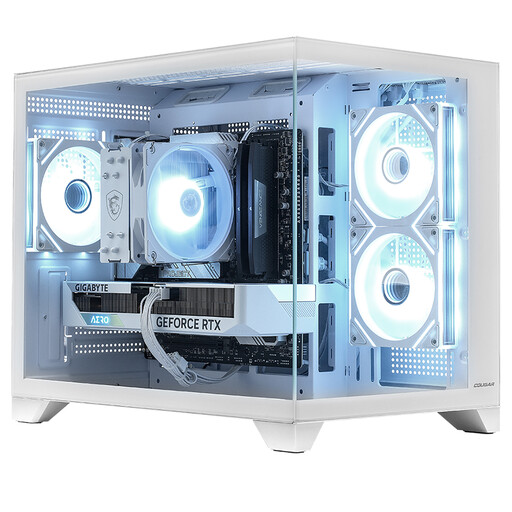 No image available
Consider this desktop if you want to compare a 16 GB discrete-GPU configuration with the requirements of your intended games.
The product name specifies 16 GB RAM, a 1 TB SSD and Windows 11. Check the HDMI output version and cable against your display’s inputs and intended settings.
No: screen size alone does not set a PC-performance requirement. Check the display’s resolution, refresh rate and inputs, then assess your games and the exact PC against the settings you intend to use.
Compare the complete PC configuration with 2K’s requirements for Marvel’s Midnight Suns, not just the tower’s gaming label. 2K’s suggested specifications include 16 GB RAM and AMD RX 5700 or GeForce GTX 1070 graphics; they do not promise a particular result at every large-display setting.
A faulty PC purchase may engage consumer remedies under the Consumer Rights Act 2015, which GOV.UK identifies as covering faulty goods. Keep the order confirmation, the exact configuration details and your communications with the seller so the issue can be assessed against what you bought.
Use an appropriate electrical-waste route rather than putting the PC in general household waste. GOV.UK describes UK electrical-equipment take-back responsibilities; ask the retailer about its applicable arrangement for replacing equipment of the same type, or check a local recycling option.