Small-desk endurance racer
You need space for a wheel, pedals and display as well as the PC. Check the tower’s placement, airflow and cable routes alongside the game requirements.


Start with the simulator and display setup you intend to use, then compare PCs with its recommended requirements rather than its minimum tier. For iRacing, the published recommended guidance includes a six-core CPU and 8GB of dedicated graphics memory; at a small desk, the tower must also fit without obstructing your controls or ventilation. A compact case may help with placement, while a larger one needs more room, so check the dimensions, connections and exact configuration before choosing.
You need space for a wheel, pedals and display as well as the PC. Check the tower’s placement, airflow and cable routes alongside the game requirements.
You want to compare complete PC configurations with iRacing’s published recommended requirements, rather than choosing from its minimum tier alone.
Your display or headset plans may change what you need from the PC. Check the requirements of each intended simulator and headset before committing to a configuration.
Set your simulator and display plans first, then check the PC’s configuration, its place around the desk and the connections for your controls.
Consider it when: the tower must sit in a restricted space and its measured dimensions leave room for your racing controls.
Trade-off: a smaller case does not establish how quiet it will be or how much room it has for later upgrades.
Consider it when: iRacing is your intended simulator and the selected configuration meets its recommended CPU and dedicated graphics-memory guidance.
Trade-off: the tower still needs a suitable location, and meeting recommended specifications does not establish performance for every display or VR setup.
Consider it when: you are checking iRacing’s high-end guidance or planning a more demanding display or VR setup.
Trade-off: greater chassis capacity can take more of the space needed for the desk, controls and cables.
| Concern | What to check | Who it matters to |
|---|---|---|
| Simulator requirements | Compare the exact CPU, dedicated graphics memory and RAM with your simulator’s recommended tier. iRacing lists a recommended six-core CPU and 8GB of dedicated graphics memory. | If I want to practise full iRacing sessions, I would not choose a PC solely because it meets the minimum tier. Around 42% of consumers put recommended-specification suitability first. |
| Desk fit and airflow | Measure the intended location against the exact case dimensions and the manufacturer’s ventilation-clearance guidance; allow access to the controls and cables. | With a wheel and display sharing a small desk, I need a place for the tower that does not crowd the setup. Desk fit is the primary concern for around 33% of consumers. |
| Connections and expansion | Count the connections required by your own wheel, pedals, displays and headset; check memory and storage expansion on the exact configuration. | If I expect to add controls or change my display setup, I want to know what the PC can connect now and what I can change later. Around 25% of consumers place this need first. |
iRacing describes its minimum tier as suitable for minimum graphics in test mode, while its recommended tier targets all session types at medium settings.
Compare every component of the chosen PC with the guidance for the simulator and settings you plan to use.
Graphics, memory and storage can differ between configurations sold under the same range name. The range alone cannot identify the PC you will receive.
Check the exact model and SKU for its CPU, dedicated graphics memory, RAM, storage, operating system, connections and case dimensions.
A case still needs space for its vents, cables and accessible ports. HP describes its OMEN 16L as compact, whereas ASUS lists a 58L chassis for the cited ROG G700; neither description replaces measuring your intended location.
Map out the PC, wheel, pedals and displays, then check the exact case measurements and manufacturer’s airflow-clearance guidance.
A seller’s change-of-mind terms are separate from rights concerning goods that are faulty or not as described. Citizens Advice notes that an in-store purchase does not carry an automatic refund right simply because you change your mind.
Read the seller’s terms, retain the advertised specification and order record, and contact the seller if the PC is faulty or misdescribed.
The Legion Tower line gives you tower configurations to compare when you have room beside or under the desk.
HP’s OMEN 16L is a compact-desktop option to examine when PC placement is a constraint.
The cited ROG G700 illustrates a full-tower option for a setup with a suitable location away from the working area.
MSI describes MAG Infinite S3 14th as a gaming-desktop range with Intel 14th-generation processors and RTX 40-series graphics.
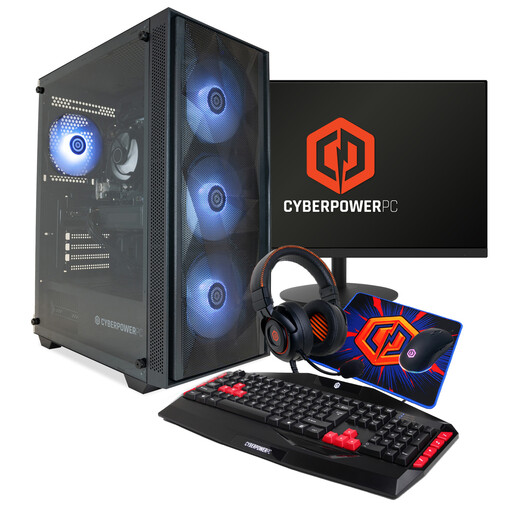
These gaming desktops include a PC-and-peripherals bundle and several tower configurations for comparing simulator requirements with available desk space. Check each model’s fit and connections for your own racing controls; a more capable listed component does not, by itself, establish how a complete setup will perform.
 No image available
Consider this bundle if you need a desktop together with a monitor and basic peripherals, and iRacing is among your planned simulators.
The named configuration includes 16GB DDR5, a 1TB NVMe SSD and Windows 11 Home, plus a monitor, keyboard, mouse, headset and mousepad. Check the included monitor’s display specifications, the tower’s fit and the connections required by your racing controls.
 No image available
Consider this tower when comparing higher-capacity configurations for your planned simulator and display setup, provided you have a suitable place for it.
The named configuration has 32GB DDR5, a 2TB NVMe SSD and Windows 11 Home in a white case. Check the space and ventilation it needs, along with your specific controls and any headset requirements.
 No image available
This is another higher-capacity tower to compare with your intended simulator and display requirements, subject to fitting the available space.
The named configuration includes 32GB DDR5, a 1TB NVMe SSD and Windows 11 Home in a black case. Confirm ventilation space and the connections needed for each planned peripheral.
 No image available
Consider this tower if its configuration matches your simulator plans and you can accommodate a larger PC near the desk.
The named configuration includes a 2TB SSD and Windows 11. Check the chassis measurements and ventilation space before deciding where it will go, and confirm the connections for your controls and displays.
 No image available
Consider this configuration if memory and storage are priorities, while checking the graphics and physical setup against your simulator plans.
The named configuration includes a 2TB SSD and Windows 11. Confirm the RTX 5070’s dedicated graphics-memory capacity, case dimensions and connections before judging its fit for iRacing, your desk and your peripherals.
Start with iRacing’s recommended tier rather than its minimum if that is the experience you intend to target: iRacing lists a recommended six-core CPU and 8GB of dedicated graphics memory. iRacing Support also lists at least 16GB of system RAM and 25GB of free storage, or 50GB for all cars and tracks; check those figures against the exact PC configuration.
Not under iRacing’s current published requirements: its requirements page lists Windows 11 64-bit as supported and Mac OS, Linux and virtual machines as unsupported. Check other simulators separately if you intend to use them too.
A compact desktop may solve a placement problem, but its size alone cannot establish suitability for your simulator or long sessions. Check the exact CPU, dedicated graphics memory, RAM, case dimensions, ventilation guidance and connections for your controls and display.
Contact the seller and keep your order record, the advertised specification and details of the problem. Rights concerning faulty or misdescribed goods are distinct from a retailer’s voluntary change-of-mind policy; the remedy depends on the circumstances of the purchase and the fault.
GOV.UK says householders can take waste electrical products to a local household waste recycling centre. Before handing over a PC, deal with any personal data stored on it.