2D inventory-icon designers
You mainly edit flat icons, work with layers and export interface assets. Adobe’s Photoshop requirements offer a more useful starting point for this work than a gaming label.


For flat 2D inventory icons, choose a desktop around the requirements of your design software rather than paying for gaming performance you will not use. A stronger gaming configuration makes more sense if you also model or render 3D assets; in a shared office, check the exact tower’s noise, placement and complete workstation setup separately from its processing specifications.
You mainly edit flat icons, work with layers and export interface assets. Adobe’s Photoshop requirements offer a more useful starting point for this work than a gaming label.
You also model props, preview game assets or render in Blender. The Blender Foundation’s recommended hardware and the compatibility of your chosen rendering setup become relevant alongside your 2D editor.
You need a tower that fits a communal workstation as well as your creative workload. Consider where it will sit, how its fans behave during your work and whether there is room to maintain or upgrade it.
Decide whether inventory-icon production will remain mostly 2D or regularly involve 3D work, then assess how the selected tower will fit the shared workstation.
Choose when: Your regular work is editing and exporting flat icons rather than modelling or rendering.
Trade-off: A configuration chosen around current 2D needs may leave less capacity for later 3D projects.
Choose when: You expect to make 3D props, render occasional scenes or preview assets in a game engine.
Trade-off: Blender GPU rendering depends on a supported graphics setup, and the GPU’s memory can limit a scene.
Choose when: Large scenes or frequent rendering are routine rather than a possible future task.
Trade-off: The extra hardware is difficult to justify for flat icons alone, while the exact tower still needs a shared-office placement and noise check.
| Concern | What to check | Who this matters to |
|---|---|---|
| 2D app performance | Check your editor’s current requirements. Adobe recommends at least 16 GB RAM for Photoshop; confirm storage and GPU compatibility for the features you use. | If I mostly edit flat icons, I want a responsive design app without choosing hardware chiefly for rendering I rarely do. Roughly 50% of consumers put this 2D need first. |
| 3D headroom | For Blender, compare the CPU, RAM and graphics memory with its recommended 8 cores, 32 GB RAM and 8 GB VRAM; check the GPU driver and render backend separately. | When icon work extends to props or rendered assets, I need the machine to handle that workflow as well as 2D editing. Around 30% of consumers prioritise this mixed-workflow need. |
| Shared-office fit | Confirm case dimensions, ventilation space and the monitor arrangement. Seek measured noise information for the exact configuration where available. | If the tower will sit near colleagues, I need to know it fits my workstation without becoming distracting during heavier tasks. Approximately 20% of consumers place office fit first. |
Flat icon editing and Blender rendering call for different hardware decisions. Graphics capability bought for rendering will not, by itself, tell you whether your 2D workflow needs it.
List the applications and tasks you will actually use, including how often you render, then compare each application’s recommended requirements with the exact PC configuration.
CPU, graphics card, memory and storage can differ between configurations sold under one family name. A family-level description cannot establish what a particular model contains.
Keep the full model and configuration details to hand, and confirm the components, ports, dimensions and included peripherals before ordering.
A cooling description does not establish how loud a selected tower will be during your creative workload in a shared room.
Look for measured acoustics for the exact configuration where possible, and check its proposed position and ventilation space with the people who manage the workspace.
The display, input devices, desk and working conditions affect whether the complete setup is usable. The Health and Safety Executive says employers must assess workstations for workers who use display screen equipment daily as part of normal work, continuously for an hour or more.
Confirm the monitor you need, available desk space, cable routing, power access and backup arrangements alongside the PC.
The OMEN 35L line is relevant if you want to compare a specified gaming-desktop configuration with your icon and possible 3D workload.
Legion towers are relevant when comparing desktop configurations for creative work and possible future changes to the setup.
Alienware Aurora is relevant to buyers whose regular work calls for a more demanding gaming or 3D configuration, rather than flat-icon editing alone.
These desktops cover mixed 2D and occasional 3D work, plus one bundle suited to a primarily 2D setup. Compare each configuration with your software before deciding how much graphics capacity you need.
 No image available
Consider this configuration if occasional 3D work is part of your inventory-asset workflow.
Its listed components include an AMD Ryzen 7 9800X3D, NVIDIA GeForce RTX 5080 with 16 GB graphics memory, 32 GB DDR5 RAM, a 2 TB NVMe SSD and Windows 11 Home.
Plan separately for a monitor and peripherals. Check the exact GPU and driver against your software, as well as noise and tower placement in the shared office.
 No image available
This is another configuration to assess if icon editing will be joined by occasional 3D work.
The title specifies an Intel Core Ultra 7 265KF, NVIDIA GeForce RTX 5070 with 12 GB graphics memory, 32 GB DDR5 RAM, a 1 TB NVMe SSD and Windows 11 Home.
A monitor, keyboard and mouse are not included. Confirm software compatibility, workstation space and noise for the exact configuration.
 No image available
Consider this tower for mixed icon and 3D work if access for later component changes also matters.
Its title lists an Intel Core Ultra 7 265K, RTX 5070 Ti, 32 GB RAM, a 1 TB SSD and Windows 11 Home. The product information describes a tool-less chassis; check compatibility before planning any upgrade.
Check its dimensions against the assigned workspace, and confirm software compatibility and noise for this configuration.
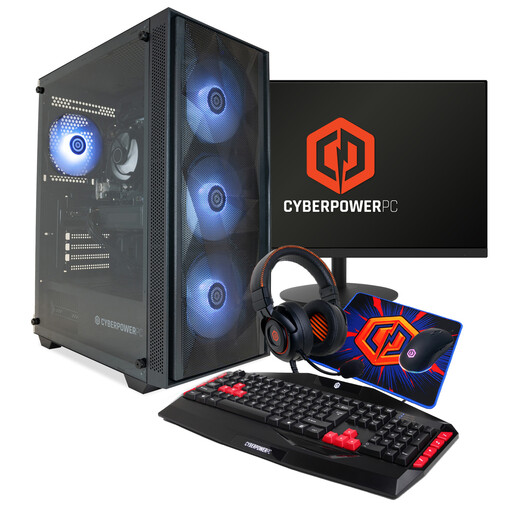 No image available
This bundle is worth considering if your icon work is mainly 2D and you also need a monitor and input devices.
It lists an AMD Ryzen 5 7500F, NVIDIA GeForce RTX 5060 with 8 GB graphics memory, 16 GB DDR5 RAM, a 1 TB NVMe SSD and Windows 11 Home. The bundle names a monitor, keyboard, mouse, headset and mousepad.
Its listed RAM is below the Blender Foundation’s 32 GB recommendation for Blender. Confirm the supplied monitor’s details, software compatibility and shared-office noise before choosing it.
 No image available
Consider this desktop if occasional Blender work and room for project files are important alongside 2D icon editing.
The title lists an AMD Ryzen 7 5700X, RTX 5070, 32 GB RAM, a 2 TB SSD and Windows 11.
Confirm the case dimensions and ventilation clearance for your desk, plus the exact GPU and driver compatibility and noise under your intended workload.
Not necessarily: for mainly 2D icon work, start with the recommended requirements of the editor you use. Adobe recommends at least 16 GB RAM for Photoshop, alongside suitable storage and graphics compatibility; assess a stronger gaming GPU against specific 3D or rendering tasks rather than the gaming label.
Use Blender’s recommended specification as a starting point for that additional work: the Blender Foundation lists an 8-core CPU, 32 GB RAM and 8 GB graphics memory. If you intend to render on the GPU, also confirm that the exact graphics card, driver and selected rendering backend work together.
The complete workstation matters, not just the tower. The Health and Safety Executive says employers must carry out a workstation assessment when workers use display screen equipment daily as part of normal work, continuously for an hour or more; the assessment considers the equipment, furniture, working conditions and job.