What to prioritise
Start with the requirements of your actual editor and project, then decide whether memory, graphics, sustained-use configuration or storage is most likely to shape your choice. The checks below help distinguish an editing-and-gaming PC from one selected chiefly for playing games.
| Concern |
What to check |
Who this matters to |
| Editor memory |
For Unreal Engine 5, compare installed RAM with Epic Games’ 32GB recommendation. Check occupied memory slots and the available upgrade path if projects may grow. |
I want larger scenes and several development tools open without choosing memory solely around the games I play. Around 31% of consumers put project-memory headroom first. |
| Viewport and test graphics |
Check the exact GPU model, its graphics-memory capacity and your editor’s API and driver requirements. Epic Games recommends a DirectX 12-capable card with at least 8GB of graphics memory for Unreal Engine 5. |
When I edit a map and test it on the same machine, the graphics specification needs to suit both tasks. For around 31% of consumers, editor and test graphics are the primary concern. |
| Long-session cooling and support |
Check the named cooler, its fit in the case and the final warranty’s parts, labour and collection terms. Overclockers UK advises matching more powerful processors with more efficient cooling. |
I expect long build-and-test sessions, so I want to assess the complete cooling setup and what happens if the PC needs attention. Sustained-use arrangements come first for around 23% of consumers. |
| Project storage |
Check SSD capacity, the drive specification and room for additional project storage. Unity Technologies recommends a high-IOPS drive because its editor reads and writes many small files when creating a build. |
With engine versions, assets and test builds to keep, I need space for active projects as well as games. Around 15% of consumers place the storage and build workflow first. |
Joybuy product choices
These PCs include editor-and-gaming desktops, a gaming laptop for buyers who need that form factor, and a desktop bundle. Compare each one with your map editor’s requirements: in particular, the bundle’s 16GB RAM sits below Epic Games’ 32GB Unreal Engine 5 recommendation.
 No image available
Stormforce Cyclone Intel Core i7, 32GB RAM, RTX 5080, 2TB SSD
Consider this desktop if you want the 32GB system-memory capacity in Epic Games’ Unreal Engine 5 recommendation alongside a 2TB SSD for games and projects.
The listed configuration includes an Intel Core i7 processor, RTX 5080 graphics card and Windows 11. Confirm the GPU’s graphics memory and compatibility with your editor, plus the exact cooler and final component list, before deciding whether it suits long sessions.
View on Joybuy
 No image available
CyberPowerPC JOYB1013, Ryzen 7 9800X3D, RTX 5080 16GB, 32GB DDR5, 2TB NVMe SSD
This desktop is worth comparing if you create and locally test maps and want the system RAM and graphics-memory capacities in Epic Games’ Unreal Engine 5 guidance.
Its listed configuration has a Ryzen 7 9800X3D, 32GB DDR5 RAM, an RTX 5080 with 16GB graphics memory, a 2TB NVMe SSD and Windows 11 Home. Check the editor’s GPU requirements, the cooling arrangement and the applicable warranty terms for extended sessions.
View on Joybuy
 No image available
CyberPowerPC JOYB1010, Core Ultra 7 265KF, RTX 5070 12GB, 32GB DDR5, 1TB NVMe SSD
Consider this desktop for editing and local game testing if its 1TB SSD has enough room for your engine versions, assets and active projects.
The listed configuration includes 32GB DDR5 RAM, an RTX 5070 with 12GB graphics memory and Windows 11 Home. Check the exact cooling setup and your editor’s graphics requirements before selecting it for long build-and-test sessions.
View on Joybuy
 No image available
Lenovo Legion Pro 7 16IAX10H, 16-inch, 64GB RAM, RTX 5090, 2TB SSD, 83F5000UUK
This laptop is an alternative if you need a movable map-editing setup and expect to keep larger projects or several applications open; its 64GB RAM is a workload-led choice rather than a universal engine requirement.
The listed variant has an Intel Core Ultra 9 processor, RTX 5090 graphics card, 2TB SSD and Windows 11 Home. Consider whether the laptop form factor and display suit your workspace, and check your editor’s GPU requirements, sustained-use behaviour and warranty terms.
View on Joybuy
 No image available
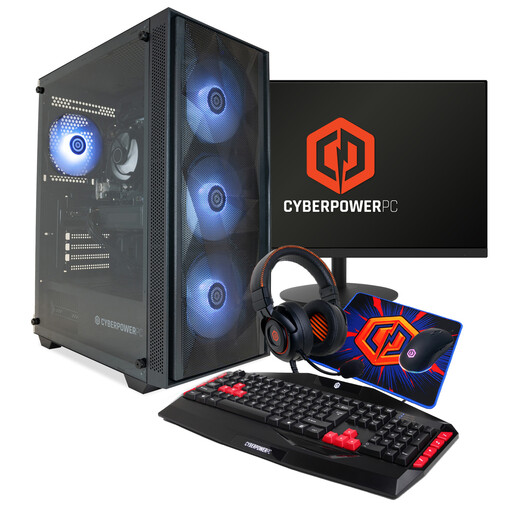
CyberPowerPC JOYB1004 bundle, Ryzen 5 7500F, RTX 5060 8GB, 16GB DDR5, 1TB NVMe SSD
Consider this bundle if you also need a monitor and peripherals, but assess its memory before choosing it for Unreal Engine 5 map work: its listed 16GB RAM is below Epic Games’ 32GB recommendation.
The bundle lists Windows 11 Home, a monitor, keyboard, mouse, headset and mousepad alongside the desktop. Its RTX 5060 has 8GB graphics memory; check RAM upgrade options, the monitor specification, cooling and your editor’s graphics requirements before ordering.
View on Joybuy
Common questions
Is 32GB RAM enough for creating custom game maps?
32GB is a sensible starting point for an Unreal Engine 5-focused PC because Epic Games lists it in its recommended hardware. It is not a ceiling: Unity Technologies says larger and more complex projects need additional RAM, so consider 64GB if large scenes and persistent multitasking are normal for you.
Should I prioritise the GPU or CPU for map editing?
Check both against your actual editor and workload rather than choosing by a gaming benchmark alone. For Unreal Engine 5-oriented work, Epic Games recommends a DirectX 12-capable GPU with at least 8GB graphics memory and 32GB system RAM; if compiling or other processor-heavy tasks dominate your sessions, examine CPU choices and their cooling together.
What storage should a map-editing PC have?
Choose SSD storage with enough capacity for active projects, engine versions, assets and test builds. Unity Technologies recommends a high-IOPS drive because its editor reads and writes many small files while creating a build; check the exact drive and any expansion options rather than judging capacity by installed games alone.
How should I compare PC-builder warranties?
Compare parts, labour, collection and return cover separately, alongside exclusions and the terms for the exact PC. PCSpecialist describes packages with differing parts cover, while Chillblast states three years of parts and labour followed by two further years of labour cover. A voluntary warranty is separate from consumer rights concerning faulty goods, as described in GOV.UK consumer-rights guidance.


