Panoramic-view cargo simmers
You want several monitors to extend the outside flight view. The combined rendered resolution, graphics memory and usable display connections matter when choosing your PC.


Choose the PC around what each monitor will show: several outside flight views make graphics capacity especially important, while one main simulator view with charts and other applications calls for a balanced CPU, memory and storage configuration. Microsoft Flight Simulator Support lists 64 GB RAM and a GeForce RTX 4080 or Radeon RX 7900 XT with 12 GB VRAM in its Microsoft Flight Simulator 2024 ideal tier, but that tier does not guarantee results for a particular monitor layout. Before ordering, confirm the chosen graphics card’s active-display support and connections for your screens.
You want several monitors to extend the outside flight view. The combined rendered resolution, graphics memory and usable display connections matter when choosing your PC.
You keep the main flight view on one screen and use others for charts, route planning, dispatch or instrument applications. Memory, storage and independent Windows displays matter alongside the simulator’s graphics requirements.
You would rather order an assembled PC than build one, but still need to settle its memory, storage and exact graphics-card connections before committing to a monitor arrangement.
Decide whether the extra screens will render more of the flight view or hold separate applications. That choice changes which specifications deserve the closest attention.
Choose when: Two or more monitors will show outside scenery or cockpit views.
Trade-off: Rendering more views raises the combined graphics workload, so settings may need adjusting even with a high-end GPU.
Choose when: One monitor shows the simulator while the others hold charts, dispatch or instrument applications.
Trade-off: The extra screens are not additional scenery views, but each still needs a compatible independent display connection.
| Concern | What to check | Who this matters to |
|---|---|---|
| Rendered flight views | Record each scenery screen’s resolution and refresh rate; compare the exact GPU and its VRAM with the intended combined workload. | If I want the outside view spread across several screens, graphics headroom is my primary concern. Roughly 50% of consumers put panoramic rendering first. |
| Simulator and applications | Check the installed CPU, RAM and SSD capacity. Microsoft Flight Simulator Support lists 32 GB RAM in the MSFS 2024 recommended tier and 64 GB in its ideal tier. | For long cargo routes with supporting applications open, I want the PC’s memory and storage to suit everything I plan to run. Around 30% of consumers prioritise this combined workload. |
| Independent displays | Confirm the exact graphics-card outputs and supported active displays at your monitors’ resolutions and refresh rates; match the required cables. | Before choosing graphics settings, I need to know that my separate cockpit screens can all connect and work independently. Approximately 20% of consumers make connection certainty their first concern. |
Microsoft Flight Simulator Support lists 32 GB RAM and a GeForce RTX 2080 in the MSFS 2024 recommended tier, versus 64 GB RAM and a GeForce RTX 4080 in its ideal tier. Meeting the recommended tier does not establish headroom for your particular several-monitor setup.
Use the ideal tier as a planning reference, then decide how many screens will render flight views before choosing a GPU.
Physical sockets alone do not establish how many monitors the exact graphics card can drive independently at your intended resolutions and refresh rates. Windows display arrangement cannot resolve a hardware mismatch.
Ask for the card model and confirmation of the intended active-display arrangement before ordering the PC and cables.
Systems bearing the same GPU name can differ in installed memory, storage, connections and warranty terms. Those differences affect whether the delivered configuration meets your cockpit plan.
Compare the final specification line by line, including CPU, GPU, RAM, SSD, disclosed outputs and support terms.
These brands have relevant prebuilt lines to compare; choose by the final configuration and its suitability for your monitors, not by the brand name alone.
Scan lists a 3XS Flux RTX configuration with a Ryzen 7 9800X3D, RTX 5080, 32 GB DDR5 and a 2 TB SSD.
Chillblast offers a Sim Flight Ultra prebuilt line listing a Ryzen 7 9800X3D and RTX 5080.
Overclockers UK lists RTX 5080 prebuilts, including a Gaming Hydrogen configuration with a Ryzen 7 9800X3D, 32 GB RAM and a 2 TB SSD.
The CyberPowerPC JOYB1013 configuration lists a Ryzen 7 9800X3D, RTX 5080 16 GB, 32 GB DDR5 and a 2 TB NVMe SSD.
These gaming desktops and the laptop offer different starting configurations for a cargo-flight setup. Decide which screens need rendered flight views, then check each machine’s connections and memory against that plan.
 No image available
Consider this desktop if you want an RTX 5080 configuration for a stationary cargo-flight cockpit.
It lists 32 GB DDR5, a 2 TB NVMe SSD and Windows 11 Home. The installed RAM is below Microsoft Flight Simulator Support’s 64 GB MSFS 2024 ideal tier; confirm the exact card’s active-display support for your monitors.
 No image available
This desktop is an option if you want an RTX 5080 system for the simulator and separate cockpit applications.
Its listed 32 GB RAM is below Microsoft Flight Simulator Support’s 64 GB MSFS 2024 ideal tier. Confirm the exact graphics-card outputs and active-display support for your screens.
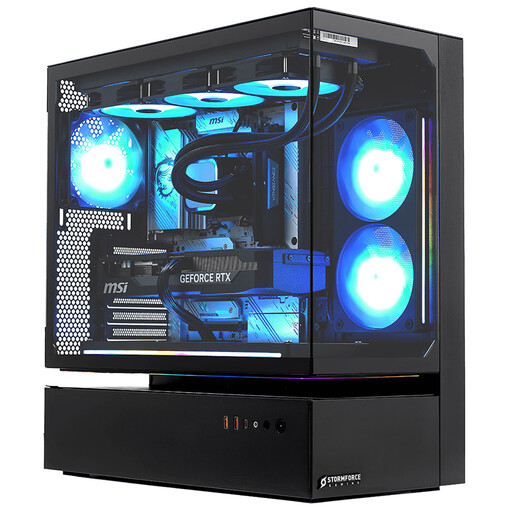 No image available
Consider this desktop if you are comparing Ryzen 7 and RTX 5080 configurations for a fixed cockpit setup.
Check its exact graphics-card outputs and active-display limit before planning several independent screens. Its listed 32 GB RAM is below Microsoft Flight Simulator Support’s 64 GB MSFS 2024 ideal tier.
 No image available
This desktop is worth assessing if one monitor will show the main flight view and others will hold supporting applications.
It lists a 2 TB SSD and Windows 11. Do not treat graphics-memory capacity alone as proof that its RTX 5070 matches the GPU in Microsoft Flight Simulator Support’s ideal tier; check suitability for your intended rendered views and verify independent-display support.
 No image available
Consider this laptop if you need a PC you can move as well as use with a fixed cockpit arrangement.
It lists a 16-inch display, Intel Core Ultra 9, 64 GB RAM, a 2 TB SSD and Windows 11 Home. Its 64 GB RAM matches Microsoft Flight Simulator Support’s MSFS 2024 ideal RAM tier, but confirm how many external displays it supports at your intended resolutions.
32 GB meets Microsoft Flight Simulator Support’s recommended RAM tier for MSFS 2024, but its ideal tier specifies 64 GB. If you are planning around the ideal tier or substantial add-ons and concurrent applications, compare 64 GB configurations; neither figure guarantees a particular frame rate.
No. If charts, dispatch or instrument applications are more useful to you, those screens need not render additional scenery views. Decide what each screen will display before choosing the GPU and monitor resolutions.
For compatible connected displays, use Windows Settings, then System and Display, to identify, detect and arrange the screens, as described by Microsoft Support. Confirm the PC’s outputs and any required cables or adaptors before purchase.
Compare the specific system’s warranty, support route and return conditions, including how planned component changes affect its terms. Scan states a three-year premium warranty for its 3XS Gaming PCs, while the Joybuy CyberPowerPC JOYB1013 listing states a two-year manufacturer warranty; neither term applies to every PC from those brands.