For platform games on a large 1080p or 1440p screen, start by comparing Windows 11 desktops with discrete graphics, 16 GB RAM and SSD storage, then check each game’s requirements and the PC’s connection to your screen. Consider a configuration with 16 GB graphics memory if higher-resolution play or more demanding games matter to you; screen size alone does not establish what performance you need. If you use a DualSense controller, its connection method and the game’s support for its features also affect the choice.
Who is this for?
Living-room platform-game players
If you want to play with a controller on a large TV or monitor, check the desktop’s display connections and the connection method your controller needs. PlayStation says DualSense connects to a Windows PC by USB Type-C or Bluetooth, although some features have further conditions.
Higher-resolution large-display players
If you also play more demanding games or want additional graphics-memory capacity, compare exact GPU configurations rather than relying on screen size. The Scan Gamer RTX configuration cited by Scan UK has an RTX 5060 Ti with 16 GB graphics memory; each game and display mode still needs checking.
Growing PC-game library owners
If you expect to keep several games installed or add storage later, compare the installed SSD and the exact model’s expansion options. Game requirements vary by title, according to Xbox Support, while Lenovo describes storage expansion for its Legion Tower 5i range.
What matters when choosing?
Start with your screen’s resolution and refresh rate and the games you intend to play. Then decide whether controller features or room for a growing library changes which desktop configuration suits you.
| Concern |
What to check |
Who this matters to |
| Large-screen platform play |
Compare the GPU, 16 GB system RAM and SSD capacity with your games’ requirements; confirm a display output your screen accepts. |
If platform games are my main use on a large 1080p or 1440p screen, I want a straightforward setup without choosing graphics capacity solely because the screen is physically large. Around 40% of consumers put this primary need first. |
| Resolution and graphics memory |
Check your intended resolution and refresh rate, the exact GPU and graphics-memory capacity, and the documented output mode. |
When I also play more demanding games, I want to assess whether a higher-spec configuration suits my screen and settings. For around 30% of consumers, resolution or graphics-memory headroom is the primary concern. |
| Controller-led play |
Check accessible USB connections or Bluetooth and whether your games support the controller features you want. |
Playing from the sofa, I care about connecting my controller conveniently without assuming wireless play provides every feature. Controller use comes first for around 20% of consumers. |
| Library growth and support |
Compare installed SSD capacity, documented storage expansion and the warranty terms for the exact desktop. |
If I plan to keep adding games, I need enough storage or a practical way to expand it, with support terms I understand. Around 10% of consumers make library growth or upgrade access their primary concern. |
Buying pitfalls
-
Assuming a large TV requires a 4K/120 gaming PC
Physical size does not tell you the screen’s resolution or refresh rate, and Xbox Support notes that PC-game requirements vary by title. A GPU upgrade may be unnecessary for one setup without meeting the target mode of another.
Note your display’s resolution, refresh rate and available inputs, then compare them with the PC’s documented outputs and your games’ recommended requirements.
-
Assuming Bluetooth enables every DualSense feature on PC
PlayStation says DualSense haptic feedback on PC requires USB and game support; the controller headset jack also requires a wired PC connection.
Check support in the games you intend to play, and plan a USB connection if the wired-only features matter to you.
A wired setup may also mean arranging a suitable cable between your seat and the PC.
-
Comparing desktops by GPU name alone
Storage, graphics-memory capacity, ports and warranty can differ between configurations. The cited Lenovo LOQ Tower has a 512 GB SSD, while the HP OMEN and Scan Gamer RTX examples list 1 TB SSDs; Scan UK also states a two-year parts-and-labour warranty for its cited system.
Compare the complete specification and warranty for the exact model, including its display outputs and any documented expansion options.
Brands to consider
These brands offer different preconfigured desktop routes; the points below apply to the cited configurations, not every model in each range.
HP OMEN
The HP OMEN 16L configuration offers a prebuilt desktop with an Intel Core i5-14400F, RTX 5060 8 GB, 16 GB DDR5, a 1 TB SSD, HDMI and DisplayPort connections.
- This particular configuration is positioned for 1440p gaming, with several display outputs listed.
- That positioning does not confirm results for every game or a particular 4K or high-refresh-rate TV mode.
Scan
Scan UK specifies a Gamer RTX desktop with an RTX 5060 Ti 16 GB, 16 GB DDR5 and a 1 TB NVMe SSD.
- Scan UK also states a two-year parts-and-labour warranty for the cited configuration, making its terms worth comparing alongside the components.
- Scan’s description of high frame rates in its RTX 5060 Ti range concerns 1080p use; it does not establish a result for every game on a higher-resolution display.
Lenovo Legion / LOQ
Lenovo lists a LOQ Tower configuration with RTX 5060 8 GB graphics, 16 GB DDR5 and a 512 GB SSD. Separately, Lenovo describes tool-less access and expandable SSD storage for its Legion Tower 5i range.
- The documented Legion Tower access may interest buyers considering later storage expansion.
- Do not assume the LOQ configuration has the Legion model’s upgrade features or a 1 TB SSD; check the exact tower before buying.
Joybuy product choices
These choices include a desktop with 16 GB graphics memory, a desktop-and-monitor bundle and a standalone Stormforce tower. Match any choice to your intended games and screen rather than treating its GPU name as a display-mode guarantee.
 No image available
CyberPowerPC JOYB1013 White — RTX 5080 16 GB
Consider this desktop if you want a configuration with 16 GB graphics memory and more installed storage; check its suitability against your games and display before choosing it for a particular resolution or refresh rate.
AMD Ryzen 7 9800X3D, NVIDIA GeForce RTX 5080 16 GB, 32 GB DDR5, 2 TB NVMe SSD and Windows 11 Home.
View on Joybuy
 No image available
CyberPowerPC JOYB1004 bundle — RTX 5060 8 GB
This bundle suits consumers who also need a monitor and basic peripherals; confirm the included monitor’s resolution, refresh rate and connections suit the planned setup.
AMD Ryzen 5 7500F, NVIDIA GeForce RTX 5060 8 GB, 16 GB DDR5, 1 TB NVMe SSD and Windows 11 Home. The bundle includes a monitor, keyboard, mouse, headset and mousepad.
View on Joybuy
 No image available
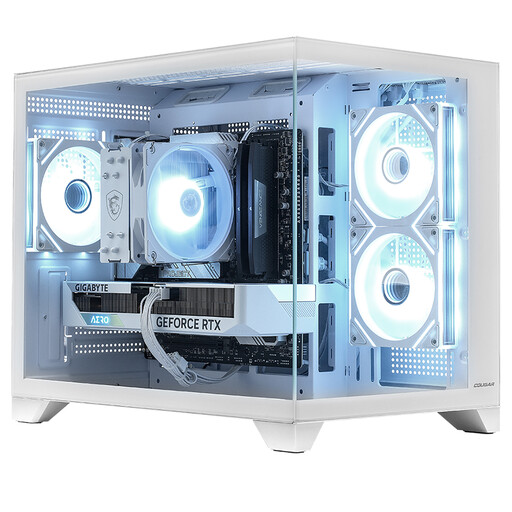
Stormforce White Ryzen 5 — RTX 5060 Ti
Consider this standalone desktop if its stated graphics card and storage meet your game needs; confirm its display outputs and controller connections for your screen and seating arrangement.
AMD Ryzen 5, 16 GB RAM, 1 TB SSD, RTX 5060 Ti and Windows 11.
View on Joybuy
Common questions
Do I need a 4K gaming PC just because my TV is large?
No: physical screen size alone does not determine the PC specification. Check your TV’s resolution, refresh rate and supported inputs alongside each game’s requirements and the desktop’s documented output capability. Xbox Support notes that PC-game requirements vary by title.
Can I use a PS5 DualSense controller with a Windows gaming PC?
Yes. PlayStation says DualSense connects to Windows PCs by USB Type-C or Bluetooth. PC haptic feedback requires USB and game support, while adaptive triggers also depend on game support.
What should I check before connecting a gaming PC to a large screen?
Check the screen’s supported inputs, resolution and refresh rate against the exact PC’s documented HDMI or DisplayPort output and the connection you plan to use. Then compare your intended games’ requirements with the desktop configuration; the presence of an HDMI socket alone does not establish a particular 4K or high-refresh-rate mode.
Is a 512 GB SSD enough for a gaming PC?
It may suit a small or carefully managed game library, but capacity needs depend on the games you install. Xbox Support says requirements vary by title; compare the space you expect to use and the exact desktop’s expansion options before choosing between the cited Lenovo LOQ Tower’s 512 GB SSD and the 1 TB configurations listed for the HP OMEN and Scan Gamer RTX.


