Choose a gaming PC for competitive replay review around the most demanding task you will regularly do: watch in-game replays, record matches or edit video breakdowns. Check the requirements of your particular game and replay client before comparing configurations, then give capture compatibility, memory and storage more attention if recording or editing is part of your workflow. Adobe recommends 32 GB RAM or more for Premiere on Windows, but that is an editing recommendation, not a requirement for viewing replays.
Who is this PC for?
Replay-first competitive players
If you mainly watch native in-game replays to examine positioning, timings and decisions, begin with the requirements of the game and replay client you use. Video-editing recommendations need not set your PC specification if you do not edit video.
Players who record review footage
If you also capture matches, save clips or share footage with a team, check both your recording software and the game’s supported capture methods. OBS Project explains that hardware encoding can move recording work from the CPU to specialised GPU hardware, but the capture method may still be game-specific.
Analysts who edit match breakdowns
If you turn recordings into annotated videos or exports, memory and space for projects and footage become more important to your choice. Adobe’s processor and memory recommendations are useful if Premiere is your editing application; they are not universal requirements for replay viewing.
What matters when choosing?
For competitive replay review, establish what your game and replay client require, then decide whether simultaneous recording, a local clip library or video editing will place additional demands on the PC.
| Concern |
What to check |
Who this matters to |
| Replay and game compatibility |
Compare the exact CPU, GPU, RAM and operating system with your game’s and replay client’s current requirements. Check the display connections if you are keeping an existing monitor. |
If I mainly inspect in-game demos, I need the PC to run my particular game and replay client before adding features for video production. Roughly 27% of consumers put dependable replay and game playback first. |
| Recording while playing |
Check the exact GPU’s encoder support and the game’s permitted capture modes. OBS Project says hardware encoding can reduce CPU workload; Bungie says OBS Game Capture is not supported for Destiny 2. |
When I capture a match for later review, I need a recording method that works with the game without overlooking tasks running at the same time. Around 33% of consumers make recording and concurrent use their primary concern. |
| Footage storage and editing |
Check SSD capacity and whether storage can be added. If you use Premiere on Windows, compare the configuration with Adobe’s recommendation of 32 GB RAM or more. |
Keeping recordings and editing breakdowns means I need room for footage and a configuration suited to my editing application. Roughly 20% of consumers place their clip library and editing needs first. |
| Demanding games and displays |
Compare the exact GPU and its video memory with your game, intended display resolution and editing application; inspect the selected PC’s cooling and power configuration. |
If I also play a demanding title or use a higher-resolution display, I need to judge graphics capability against that particular workload rather than the gaming label alone. Around 20% of consumers prioritise their graphics and display needs. |
Mistakes to avoid
-
Treating a desktop family name as a fixed specification
RAM, storage, graphics and cooling can differ between configurations in the same range. HP Store UK lists different OMEN 35L configurations, while Dell UK presents selectable options for Alienware Aurora.
Check the individual PC’s CPU, GPU, RAM, SSD, cooling, connections, warranty and included peripherals rather than relying on the range name.
-
Choosing the GPU before checking the capture workflow
A graphics card specification cannot establish whether your replay client, overlay or preferred capture mode works with a particular game. Bungie, for example, says OBS and XSplit Game Capture is not supported for Destiny 2.
Check the game publisher’s current replay and capture guidance, then assess the GPU and encoder against the recording method you can use.
-
Assuming hardware encoding removes every recording compromise
OBS Project says hardware encoders can reduce CPU workload, but notes that earlier encoder generations may produce lower image quality than software encoding at the same bitrate.
Confirm support for the encoder you intend to use and try a short recording at your chosen game settings, resolution and bitrate.
-
Overlooking online-order and configuration terms
For a standard UK distance sale of physical goods, the Consumer Contracts Regulations 2013 generally set a cancellation period ending 14 days after the day the consumer takes physical possession, subject to applicable exceptions. Cancellation of an eligible order is distinct from remedies for faulty or misdescribed goods.
Keep the selected specification, order and delivery records. Read the seller’s cancellation instructions and check any terms relevant to the configuration you select before ordering.
Gaming desktop brands to consider
HP OMEN
The OMEN 35L is a desktop range with configuration choices relevant to gaming and replay review.
- HP describes the OMEN 35L design as tool-less and intended to allow component upgrades within an industry-standard form factor.
- Check the individual OMEN 35L configuration: memory, storage and graphics specifications vary across the range.
Lenovo Legion
Lenovo’s Legion tower lines offer configurations for gaming and creation workflows.
- Lenovo describes tool-free side-panel access on its Legion T Series towers for reaching internal components.
- Choose by the selected tower’s components and your workload, not by the Legion name alone.
Alienware
Dell’s Alienware Aurora is a configurable gaming desktop with component choices that can suit different workloads.
- A Dell UK Aurora configuration lists 32 GB DDR5 RAM, a 1 TB NVMe SSD, an RTX 5070 Ti and a 240 mm liquid cooler.
- Those specifications describe that configuration, not every Aurora. Check the selected components and included peripherals.
ASUS ROG
ASUS ROG offers desktop formats including full towers and more compact systems; the G700 is a larger prebuilt option.
- ASUS describes the G700’s cooling arrangement and configuration-dependent support for up to 64 GB DDR5 RAM and 2 TB PCIe Gen4 storage.
- Those maximum figures do not describe every G700 configuration or establish that a full tower is needed for replay viewing.
Joybuy desktops for replay review
These gaming desktops are options to assess for in-game replay review, with RAM and SSD configurations that may also matter if you keep clips or edit footage. Check the exact game, replay client and recording method you plan to use before choosing among them.
 Image unavailable
CyberPowerPC JOYB1013 — Ryzen 7 9800X3D, RTX 5080
Consider this configuration if replay review is accompanied by a local collection of recordings; confirm that its graphics and capture setup suit your game.
- AMD Ryzen 7 9800X3D; NVIDIA GeForce RTX 5080 16GB.
- 32GB DDR5 RAM, 2TB NVMe SSD and Windows 11 Home.
The listing says a monitor and peripherals are not included.
View on Joybuy
 Image unavailable
Stormforce Cyclone Intel Core i7 — RTX5080, 32GB RAM, 2TB SSD
The stated SSD capacity may be relevant if you retain recordings locally; check the particular game’s requirements and your intended capture method separately.
- Intel Core i7 and RTX5080.
- 32GB RAM, 2TB SSD and Win 11.
The listing says a monitor, keyboard and mouse are not included.
View on Joybuy
 Image unavailable
CyberPowerPC JOYB1010 — Core Ultra 7 265KF, RTX 5070
This configuration offers an SSD for replays and clips; consider how much footage you intend to retain before settling on its stated capacity.
- Intel Core Ultra 7 265KF; NVIDIA GeForce RTX 5070 12GB.
- 32GB DDR5 RAM, 1TB NVMe SSD and Windows 11 Home.
The listing says a monitor, keyboard, mouse, headset and mousepad are not included.
View on Joybuy
 Image unavailable
Lenovo Legion T7 34IAS10 — Core Ultra 7 265K, RTX 5070 Ti
If you also edit match footage, compare this PC’s memory and storage with your editing application’s guidance and the size of your planned clip library.
- Intel Core Ultra 7 265K and RTX 5070 Ti.
- 32GB RAM, 1TB SSD and Windows 11 Home.
Check the listing for the included monitor and peripherals before planning your setup.
View on Joybuy
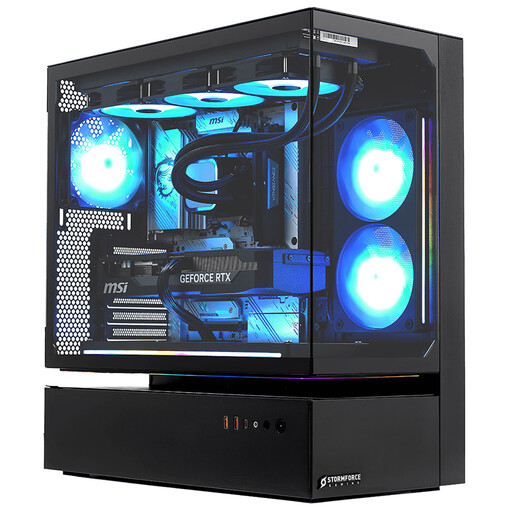 Image unavailable
Stormforce Cyclone AMD Ryzen 7 — RTX5080, 32GB RAM, 2TB SSD
The stated SSD capacity gives you a configuration to consider if you keep replay footage locally; confirm game compatibility and encoder support for any recording you plan to do.
- AMD Ryzen 7 and RTX5080.
- 32GB RAM and 2TB SSD.
Check which monitor and peripherals come with the selected listing.
View on Joybuy
Common questions
Do I need 32 GB RAM to review competitive replays?
No single RAM figure applies to every game and replay client; check their current requirements for native replay viewing. If you also edit with Premiere on Windows, Adobe recommends 32 GB RAM or more for that editing workflow.
Why check for a hardware video encoder?
A hardware encoder matters if you plan to record matches or replay sessions, because OBS Project says it can move encoding work from the CPU to specialised GPU hardware. Confirm that the exact GPU supports the encoder you intend to use and that your game permits your chosen capture method.
Will OBS Game Capture work with every competitive game?
No; capture compatibility depends on the game and method. Bungie says OBS and XSplit Game Capture is not supported for Destiny 2, so consult the publisher’s current guidance for the title you play before relying on a particular recording setup.
What should I check before ordering a gaming PC online?
Confirm the exact configuration, included peripherals, delivery terms and the seller’s cancellation instructions. For a standard UK distance sale of physical goods, the Consumer Contracts Regulations 2013 generally set a cancellation period ending 14 days after the day you take physical possession, subject to applicable exceptions; cancellation is separate from remedies for faulty or misdescribed goods.


