Current maritime-simulation players
If you plan to play a current cargo, navigation or vessel-management simulator, use that game’s requirements and your intended settings to judge the CPU, GPU, memory and storage in a specific PC configuration.


Choose a PC around the exact ship simulator and the display settings you intend to use, rather than the label “gaming PC”. Reported recommended requirements for current maritime simulators differ, so compare the selected desktop’s CPU, GPU, installed memory and storage with your game’s requirements; for long sessions, also check its cooling design, controller connections and warranty.
If you plan to play a current cargo, navigation or vessel-management simulator, use that game’s requirements and your intended settings to judge the CPU, GPU, memory and storage in a specific PC configuration.
If you expect to play for hours with a controller and background tools, pay attention to the desktop’s cooling arrangement, installed storage, available connections and warranty as well as its core components.
If you mainly play older or lighter ship simulators, establish what those games require before paying for a higher-tier configuration intended for more demanding titles.
Start with the named game and your display target. That determines whether a modest desktop is worth considering or whether a current simulator’s reported recommended specification calls for more memory and graphics hardware.
Consider this route: Your chosen game has requirements a lower-spec desktop can meet, and you do not need the settings target of a demanding current title.
Trade-off: A configuration chosen for an older game may need reassessing if you move to a newer simulator.
Consider this route: You have a specific current game and settings target to compare with a desktop’s installed components.
Trade-off: A mid-range configuration may fall short of that game’s reported recommended target, particularly if you also keep background applications open.
Consider this route: Your chosen game and display settings justify comparing desktops with its higher reported GPU and memory recommendations.
Trade-off: Higher specifications alone do not establish performance in your game or measured noise during a long session.
| Concern | What to check | Who this matters to |
|---|---|---|
| Game performance | Match the exact CPU, GPU, graphics memory and installed RAM to your game’s current requirements and intended display settings. PC Game Check reports different recommended memory targets for Seafarer: The Ship Sim and Professional Ship Simulator. | If I want detailed settings in a current ship simulator, I need to judge the PC against that particular game rather than its gaming label; around 45% of consumers put game performance first. |
| Long-session setup | Check installed RAM and SSD capacity, plus the connections needed for your controller and background tools. Confirm controller support for the particular game. | When I play for hours with a controller and other applications open, I want a setup that accommodates them; roughly 27% of consumers prioritise that practical arrangement. |
| Proportionate specification | Identify the game before selecting a component tier, and compare the exact configuration with its requirements. | If I mainly play an older or lighter ship game, I would rather choose for its actual needs than pay for unused headroom; around 18% of consumers make that their primary concern. |
| Cooling and support | Inspect the selected case and cooler, warranty and return terms. Seek configuration-specific acoustic testing if low noise matters to you. | For extended play, I care about where the tower will sit, how it is cooled and what support applies after purchase; approximately 10% of consumers put those ownership questions first. |
A game launching does not establish that it will meet your preferred graphics settings or accommodate the other applications you use during a long session. PC Game Check reports substantially different minimum and recommended requirements for current maritime simulators.
Choose the simulator first, then compare the selected PC’s installed components with the game’s current requirements for your intended settings.
Desktops within a named range can have different CPUs, graphics cards, memory and storage. A family name cannot tell you which configuration is in your basket.
Keep a copy of the exact component list and check its connections, operating system and warranty before ordering.
Change-of-mind cancellation, retailer policies and remedies for faulty goods are different questions; the treatment of a customised order needs particular attention.
Read the seller’s terms for the specific build before ordering, and ask how cancellation and fault resolution would be handled.
Lenovo describes added vents and air cooling for long sessions in its Legion Tower 5 Gen 8 material. That description does not establish how loud a particular configuration will be in your room.
Check the cooler and case in the selected build, and look for configuration-specific acoustic testing if quiet operation is important.
The Legion Tower 5 Gen 8 (AMD) is a prebuilt-tower family worth examining if case ventilation is a priority for your setup.
The OMEN desktop range offers configurations to compare against the requirements of your chosen simulator.
Scan’s itemised desktop configurations give shoppers component lists to compare with game requirements.
The configurable Aurora desktop is a route to examine when a demanding game and display target justify higher listed specifications.
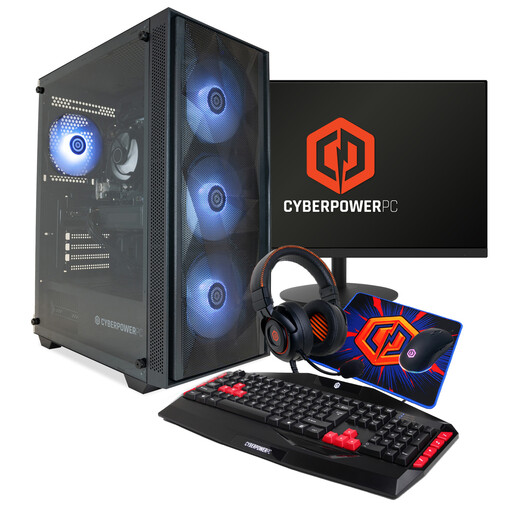
These desktops provide different listed component combinations to compare with your chosen ship simulator. The CyberPowerPC JOYB1004 is a bundle with a monitor and peripherals; the other choices should each be assessed by their exact configuration, not treated as a promise of particular game settings.
 No image available
Consider this bundle if you want a desktop and peripherals together, after checking its components against your chosen simulator.
AMD Ryzen 5 7500F, NVIDIA GeForce RTX 5060 8GB, 16GB DDR5, 1TB NVMe SSD and Windows 11 Home. The bundle lists a monitor, keyboard, mouse, headset and mousepad; confirm the supplied peripheral specifications before ordering.
 No image available
Consider this configuration when comparing a desktop with 32GB installed memory against a demanding simulator’s requirements; check the game and settings before deciding.
Intel Core i7, RTX 5080, 32GB RAM, 2TB SSD and Windows 11. Check the exact cooling arrangement if long-session noise matters to you.
 No image available
This is another configuration to compare with a demanding current simulator, particularly if its stated memory and storage match your intended setup.
AMD Ryzen 7 9800X3D, NVIDIA GeForce RTX 5080 16GB, 32GB DDR5, 2TB NVMe SSD and Windows 11 Home. Confirm the cooling design and the peripherals you need for your desk.
 No image available
Compare this desktop’s installed memory and graphics card with the requirements of the current simulator you plan to play.
Intel Core Ultra 7 265KF, NVIDIA GeForce RTX 5070 12GB, 32GB DDR5, 1TB NVMe SSD and Windows 11 Home. Check the selected build’s cooling and the connections needed for your controller.
 No image available
Consider this desktop if its listed processor, graphics card and installed memory fit the requirements you have checked for your game.
AMD Ryzen 7 5700X, RTX 5070, 32GB RAM, 2TB SSD and Windows 11. Confirm the graphics-memory amount and cooling configuration when comparing it with another PC.
No: choose for the particular game and settings you intend to use. PC Game Check reports recommended targets of 32 GB RAM for Professional Ship Simulator and 64 GB for Seafarer: The Ship Sim; those game-specific figures are not universal requirements for older or lighter ship games. Check the game’s current store-page requirements before ordering.
Seafarer: The Ship Sim lists full controller support, but support varies by game and controller. Confirm your chosen game’s compatibility and that the PC has an available connection for the controller you intend to use.
For applicable UK distance sales, GOV.UK says customers must tell the seller within 14 days of receiving an item if they want to cancel. Check how the rules apply to the specific order, particularly a customised build; change-of-mind cancellation is separate from remedies for faulty, damaged or misdescribed goods.
Use an appropriate electrical-waste or reuse route rather than treating the PC as ordinary rubbish. GOV.UK describes the UK waste electrical and electronic equipment framework as aimed at recovery, reuse and recycling; check your local authority’s arrangements or an available retailer or manufacturer take-back service.