Players keeping the PC on the desk
If the computer must sit beside your monitor, keyboard and mouse, its actual footprint, connections and ventilation space matter as much as the description “compact”.


Choose a compact desktop if the PC must share a small desk with your monitor and controls, but compare the exact case dimensions and ventilation needs before settling on a model. A configurable small-form-factor PC gives you more scope to choose components around your game and display target; a larger tower makes more sense if you can place it elsewhere and value room for future changes. For VALORANT, Riot Games publishes separate 30 FPS, 60 FPS and 144 FPS hardware tiers, so its minimum tier alone is not a suitable target for every player.
If the computer must sit beside your monitor, keyboard and mouse, its actual footprint, connections and ventilation space matter as much as the description “compact”.
If you have a particular game and frame-rate target in mind, choose components against that game’s requirements. Riot Games, for example, publishes distinct 60 FPS and 144 FPS hardware tiers for VALORANT.
If you can accommodate a larger chassis or put it away from the desk, access to components, storage options and the chosen configuration’s support terms may matter more to you than the smallest footprint.
Consider it: When the PC must stay on the desk and you want a ready-configured small-form-factor system, such as one from CORSAIR’s CORSAIR ONE line.
Allow for: A compact product-line name does not tell you the dimensions or components of the particular configuration.
Consider it: When you want to choose a compact build around your intended game, resolution and display target.
Allow for: A seller’s performance description for one configuration does not establish what a different build will achieve.
Consider it: When the PC can sit off the desk and you place greater value on access for future changes.
Allow for: Its larger chassis still needs a suitable placement area; advertised platform options are not necessarily fitted to the model you buy.
| Concern | What to check | Who this matters to |
|---|---|---|
| Desk fit and airflow | Compare the exact case width, depth and height with the space available. Check vent positions and access to cables. | If my PC has to sit beside my monitor and mouse, I need room to use the desk without crowding the case or its vents; around 40% of consumers put desk fit and airflow first. |
| Game and display target | Check the intended game’s current requirements against the configured CPU and GPU, your resolution and your monitor’s refresh rate. | I want the PC chosen for the matches and display I will actually use, rather than just for a game’s minimum tier. For around 40% of consumers, meeting that game-and-display target is the primary concern. |
| Storage, upgrades and support | Confirm installed storage, provisions for planned upgrades and the warranty terms for the exact configuration. | If I expect to change components later, I need to know what the chosen case and configuration will accommodate; roughly 20% of consumers prioritise that longer-term flexibility and support. |
A minimum tier is not the same as a higher frame-rate target. Riot Games separates VALORANT requirements into 30 FPS, 60 FPS and 144 FPS tiers; those tiers do not establish requirements for other games.
Decide which game, resolution and display refresh rate matter to you, then compare its current publisher requirements with the final PC configuration.
Systems within a compact line can differ by model, and a tight placement can make vents and connections harder to access.
Measure the intended space and check the exact case dimensions, vent locations, power lead and display and USB connections before ordering.
HP describes storage, cooling and other options for the OMEN 35L AMD platform, but the components fitted depend on the retail configuration.
Check the exact model’s installed memory and storage, available expansion provisions, cooling, power supply and warranty terms.
CORSAIR positions its CORSAIR ONE line as compact prebuilt desktops for gamers with limited desk space.
Scan’s 3XS range includes configurable small-form-factor desktops, including its Nano Ridge mini-ITX system.
HP presents the OMEN 35L AMD as an upgrade-oriented gaming-desktop platform for buyers who can accommodate a larger case.
These choices include three compact mini PCs and a Stormforce gaming desktop. For any of them, compare the exact case with your available desk space and check the configured hardware against your intended game and display target; the Stormforce case name alone does not establish its footprint.
 No image available
A compact desktop to consider when desk space is the starting constraint; compare its size and your game’s requirements before choosing it for online matches.
The listed configuration includes Radeon 680M graphics, dual M.2 slots, triple-display support and Wi-Fi 6. Check the exact dimensions and ventilation arrangement for its intended position.
 No image available
This compact option is worth comparing if its listed connections suit your setup, provided you also check desk fit and game-specific requirements.
Its listed features include Radeon 760M graphics, a 512GB PCIe 4.0 SSD, USB 4.0, HDMI 2.1, 2.5G Ethernet and Wi-Fi 6E. Confirm its dimensions and ventilation needs before placing it on a small desk.
 No image available
Consider this compact PC if its storage and connections meet your needs, while checking the intended game and monitor target separately.
The listed configuration has Radeon 880M graphics, a 1TB PCIe 4.0 SSD, USB4 and OCuLink. Compare its exact dimensions and vent positions with the space available.
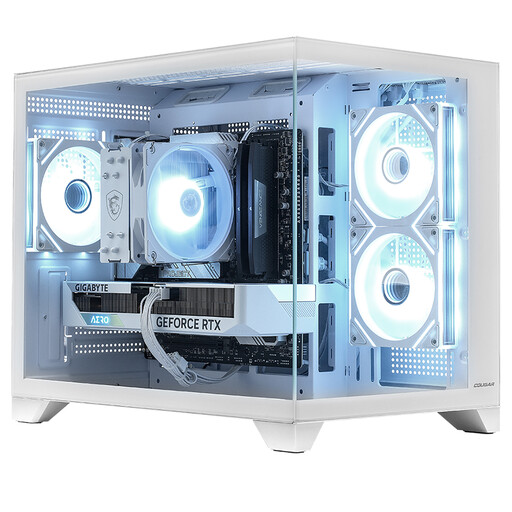 No image available
This gaming desktop offers a different configuration to compare with the mini PCs, but the FV150 Mini case name is not a desk measurement.
The listed configuration includes a Ryzen 5 processor, RTX5060Ti graphics, 16GB RAM, a 1TB SSD and Windows 11. Check the exact case dimensions, vent positions and requirements for your intended game.
Not necessarily: choose for the particular game, resolution and frame-rate target rather than the category label alone. Riot Games publishes separate 30 FPS, 60 FPS and 144 FPS hardware tiers for VALORANT, but those requirements do not apply to every online arena game.
Measure the width, depth and height available at the intended position, then compare them with the exact PC’s dimensions. Allow for access to vents, the power lead and the connections you will use; a compact product-line name does not establish the fit of every configuration.
No performance target follows from case size alone. Check the configured CPU and GPU against your game’s requirements and your display target. Scan describes one 3XS Nano Ridge configuration as intended for 1080p high-refresh gaming, but that description does not establish performance for every game or compact PC.
Check the exact model’s installed parts and its provisions for the changes you have in mind, including storage space, component access, power supply and cooling. Options described for a product platform, such as HP’s OMEN 35L AMD, are not necessarily fitted to every retail configuration.