Single-screen circuit learner
If you practise on one monitor, start with the requirements of your chosen simulator and settings. You need not select a PC for VR simply because it is marketed for sim racing.


Choose a gaming PC around the racing simulator and display setup you will use, rather than buying for VR or multiple monitors by default. For single-screen practice, the simulator’s mid-range guidance is a starting point; if VR or higher visual settings are planned, compare its higher-end requirements instead. For long sessions, also check the exact PC’s cooling, connections, storage and support terms: a component list alone cannot establish how quiet or comfortable a system will be in your room.
If you practise on one monitor, start with the requirements of your chosen simulator and settings. You need not select a PC for VR simply because it is marketed for sim racing.
If a force-feedback wheel or VR headset is part of your plan, check the simulator’s support for that equipment, the PC’s connections and the hardware guidance for your intended display setup. iRacing publishes separate system-requirement tiers and states that it supports VR headsets.
If practice sessions run for hours, compare the stated cooler, case layout, placement space, storage and support terms as well as the CPU and graphics card. A manufacturer’s cooling description does not tell you how loud a particular configuration will be in your room.
Settle the simulator, monitor arrangement and VR plans before comparing PC configurations. Then check the practical details that matter when the same setup will be used for extended practice.
| Concern | What to check | Who this matters to |
|---|---|---|
| Simulator and display demands | Compare the exact CPU, graphics memory and system RAM with your simulator’s guidance for the intended settings and display arrangement. As a game-specific reference, iRacing lists a 6-core CPU and at least 6 GB of dedicated graphics memory for its mid-range tier, and an 8-core CPU, 32 GB RAM and at least 8 GB of dedicated graphics memory for its high-end tier. | If I am learning on one screen, I want hardware suited to that setup; if I plan VR, I need to check a different set of demands. Around 29% of consumers put simulator and display demands first. |
| Long-session practicality | Inspect the exact cooler, case dimensions, airflow provisions and access for cleaning, then consider model-specific noise information where available. A listed cooler is not a measured noise or temperature result. | During extended practice, I need a tower I can place sensibly and live with for a whole session, not just an appealing graphics-card name. Around 29% of consumers prioritise long-session practicality. |
| Wheel and VR connections | Confirm support for the intended controls and headset in the simulator, then check the fitted PC’s USB and graphics outputs against your equipment. | If I am connecting a wheel, pedals or headset, the setup needs to work with the equipment I intend to use. For around 21% of consumers, connection readiness is the primary concern. |
| Configuration and support | Compare the final RAM, SSD, operating system, upgrade access, warranty and seller terms for the exact configuration. Ask how cancellation terms apply if ordering a custom-built PC. | I would rather settle the final parts list and support arrangements than pay for graphics headroom I may never use. Around 21% of consumers put the configuration and support route first. |
iRacing describes its minimum tier as providing minimum graphics in test mode. That is a different basis from choosing a PC for your preferred settings and regular circuit practice.
Check the chosen simulator’s requirements against your resolution, display count and VR plans before choosing a hardware tier.
Lenovo, Dell and HP list configurations that differ in memory, storage, graphics and cooling. A family name cannot establish what is in the PC you order.
Check the final configuration’s graphics memory, RAM, SSD, cooler, operating system and ports before paying.
Manufacturer descriptions identify cooling hardware or design features, but do not establish sustained temperatures or sound levels for your room and placement.
Compare the exact cooling configuration, allow appropriate space around the tower and consult model-specific independent testing if noise is a deciding factor.
GOV.UK lists personalised and custom-made goods among exceptions to ordinary distance-selling cancellation rules. Whether that applies to a particular configured PC depends on the order; it does not remove remedies for faulty or misdescribed goods.
Read the seller’s cancellation and warranty terms, and ask how the final build is classified before confirming the order.
These product lines offer different ways to select a gaming desktop; compare individual configurations rather than treating a brand name as a performance result.
Lenovo’s Legion Tower 7i is a ready-configured tower route. Its UK listings include RTX 5080 configurations with DDR5 memory and PCIe Gen4 SSD storage.
Dell’s Alienware Aurora offers a manufacturer-configured desktop route. One listed UK configuration specifies a Core Ultra 9 285K, RTX 5080 16 GB, 64 GB DDR5, 2 TB NVMe storage and a 240 mm liquid-cooled CPU.
HP’s OMEN desktops span several chassis and configuration tiers, with graphics options differing by model.
Scan 3XS offers configurable gaming PCs and identifies an Apex Racing Simulators range. This route may suit someone who has already settled their simulator, displays and peripherals.
These desktops include single-screen starting points and configurations to consider when planning more graphics headroom. Match any candidate to your simulator and displays, then check its cooling and connections for longer sessions.
 No image available
Consider this desktop if your simulator and display plans call for more hardware headroom. Its named configuration includes an AMD Ryzen 7 9800X3D, NVIDIA GeForce RTX 5080 16GB, 32GB DDR5 RAM and a 2TB NVMe SSD.
Check the cooling configuration and the connections required by your displays and controls before ordering; those specifications alone cannot predict long-session noise or game performance.
 No image available
This is another desktop to compare with the requirements of a more demanding display plan. The product name specifies an Intel Core i7, RTX5080 graphics, 32GB RAM and a 2TB SSD.
Confirm the exact processor, graphics memory, cooler and peripheral connections for the configuration you order. Plan a suitable position for the tower as well as space for your sim-racing equipment.
 No image available
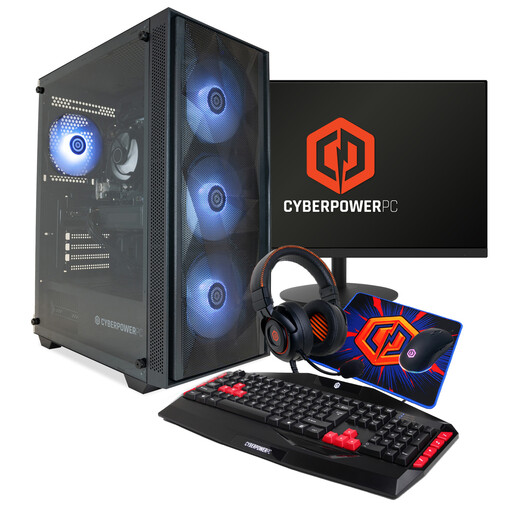
If you are assembling a single-screen setup, this bundle includes a monitor, keyboard, mouse, headset and mousepad alongside the PC. The named PC configuration has an AMD Ryzen 5 7500F, NVIDIA GeForce RTX 5060 8GB, 16GB DDR5 RAM, a 1TB NVMe SSD and Windows 11 Home.
Check the supplied monitor’s exact specifications and the PC’s cooling and connections before relying on the bundle for your intended simulator.
 No image available
For a desktop-only purchase, compare this configuration with your chosen simulator’s higher-setting requirements and your existing display. Its named components include an Intel Core Ultra 7 265KF, NVIDIA GeForce RTX 5070 12GB, 32GB DDR5 RAM and a 1TB NVMe SSD.
Confirm the cooling hardware and the outputs needed for your monitor and sim-rig equipment; the component names do not establish sustained temperatures or frame rates.
 No image available
This desktop offers a named AMD Ryzen 7 5700X, RTX5070 graphics, 32GB RAM and a 2TB SSD for comparison with your simulator’s requirements.
Confirm the fitted graphics card’s memory capacity before comparing it with VRAM guidance. Also check the cooling hardware, tower dimensions and connections needed at your rig.
No. iRacing lists several supported control methods, including steering wheels and gamepads. It suggests a force-feedback wheel and pedals for a more involved racing experience, so decide whether that equipment is part of your practice plan rather than treating it as a requirement to run the software.
Not for iRacing under its published system requirements: iRacing says macOS is unsupported and lists Windows 11 64-bit as supported. Check other racing simulators separately, as their requirements may differ.
In the UK, statutory remedies for faulty or misdescribed goods are distinct from a seller’s change-of-mind policy. GOV.UK says a seller must offer a full refund when goods are faulty, not as described or do not do what they are supposed to; the appropriate remedy can depend on the circumstances and when the problem is raised.
Ordinary UK distance-sales cancellation rules may not apply if the PC qualifies as personalised or custom-made. GOV.UK lists those goods as exceptions, so ask the seller how your specific order is classified before confirming it. That change-of-mind exception is separate from remedies if the PC is faulty or misdescribed.