Choose the PC around how you make your tiles, rather than the word gaming: a pixel-art workflow does not, by itself, call for a 3D-rendering specification. For layered work in Photoshop, Adobe recommends at least 16 GB of RAM and space for the application; for 3D work in Blender, the Blender Foundation recommends 32 GB of RAM and 8 GB of graphics memory on Windows, subject to checking the exact GPU and driver for your rendering method. At a standing desk, display position and cable reach also affect whether the setup works at both desk heights.
Who needs which setup?
Pixel-art tile-set makers
If you mainly draw sprites, animated tiles and sprite sheets, establish what your 2D editor and other open applications need before paying for 3D-rendering hardware. Igara Studio describes Aseprite as a tool for pixel art, animation and sprite-sheet export.
Layered raster tile artists
If your tile sheets involve layered documents, reference material and several open applications, plan memory and working storage around your actual editor. Adobe’s Photoshop desktop recommendations offer a relevant checkpoint when Photoshop is part of that workflow.
3D-to-2D environment artists
If you model, light or render assets in Blender before turning them into tiles, check the PC’s memory and the exact GPU-rendering path. The Blender Foundation’s requirements and GPU-rendering guidance make both the specification and driver choice relevant.
What to check before buying
Decide whether your primary creation work is pixel art, layered raster editing or 3D rendering; then check the standing-desk arrangement alongside the PC.
Pixel-art-first PC
Choose when: your tile sets are mainly sprites, animation frames and exported sprite sheets, without substantial 3D scenes.
Bear in mind: a PC chosen for this work may need reassessment if you later add Blender rendering or larger layered projects.
Layered-raster PC
Choose when: Photoshop-style tile sheets and several open applications are central to your work.
Bear in mind: Adobe’s recommendations apply to Photoshop, not every tile-set editor; check the version you will use and leave room for working files.
Blender-rendering PC
Choose when: you will build and render 3D models, materials or lighting for your tiles.
Bear in mind: the Blender Foundation specifies different GPU-rendering paths with model and driver conditions, so a graphics-card brand alone does not establish compatibility.
| Concern |
What to check |
Who this matters to |
| 3D rendering |
Compare RAM and graphics memory with the Blender Foundation’s Windows recommendation of 32 GB and 8 GB respectively; confirm the exact GPU, driver and rendering path. |
If I am rendering 3D assets before making tiles, I need to know that my planned Blender workflow will run on the chosen hardware. Around 40% of consumers put 3D-creation headroom first. |
| Layered files and storage |
For Photoshop on Windows, check Adobe’s recommendation of at least 16 GB RAM, 100 GB available disk space and a fast internal SSD; consider the space your other files need. |
With layered tile sheets and other applications open, I want enough working space without making 3D rendering my priority. Layered-raster work comes first for around 30% of consumers. |
| Standing-desk fit |
Check display adjustment and cable slack at the desk’s raised height, including the connection to a tower on a fixed surface. |
I switch between making tiles and gaming, and need the screen and controls to remain usable when the desk rises. Around 30% of consumers prioritise that workstation flexibility. |
Buying pitfalls
-
Choosing a GPU by brand alone
The Blender Foundation documents separate CUDA or OptiX, HIP and oneAPI rendering paths, each with hardware and driver conditions. A brand name does not establish support for the path you intend to use.
Check the exact graphics-card model and planned driver against Blender’s current guidance before choosing a PC for GPU rendering.
-
Applying Photoshop specifications to every pixel-art editor
Adobe’s memory and storage recommendations describe Photoshop. Igara Studio documents Aseprite for 2D sprites and pixel art, so the applications should not be treated as having identical purchasing requirements.
List the tools and file types you will actually use, then check their requirements before deciding how much memory and storage to buy.
-
Checking the tower but not the raised desk
A PC can have suitable components yet leave the display poorly positioned or cables under tension when the desk rises. The Health and Safety Executive’s display-screen guidance considers the screen, input devices and desk together.
Measure the full desk travel and check the monitor, keyboard, mouse, tower position and cable routes at standing height.
An adjustable monitor mount or different cable arrangement may be needed if the existing setup cannot accommodate the raised position.
Relevant brands for reference
NVIDIA
Relevant to Blender users considering CUDA or OptiX GPU rendering on Windows or Linux.
- The Blender Foundation documents CUDA support for qualifying NVIDIA GPUs and OptiX support subject to GPU and driver conditions.
- Check the exact model, graphics memory and driver; the NVIDIA name alone does not establish suitability for your scene or software version.
AMD
Relevant to Blender users considering its HIP GPU-rendering path on Windows or Linux.
- The Blender Foundation documents HIP support for qualifying AMD GPUs with RDNA1 architecture or newer.
- Support depends on the model, driver and feature; Blender notes that HIP does not support shadow caustics.
Intel
Relevant to Blender users considering oneAPI rendering with qualifying Arc graphics on Windows or Linux.
- The Blender Foundation documents oneAPI support for Arc GPUs using Xe HPG architecture, including qualifying A-Series and B-Series products.
- Confirm the exact Arc model and driver; the guidance does not extend to all Intel graphics.
Logitech G
A keyboard reference for readers planning the controls at a height-adjustable desk, separate from the PC specification.
- Logitech describes its G515 as a 22 mm-high, low-profile gaming keyboard.
- Keyboard height does not establish that the screen, desk and input devices are suitably positioned together.
Joybuy desktops for tile-set creation
These desktops have listed memory and graphics-memory capacities relevant to the Blender Foundation’s Windows recommendations of 32 GB RAM and 8 GB graphics memory. They are most pertinent if your tile-set workflow includes 3D work; check the exact GPU-rendering compatibility and your standing-desk arrangement before choosing one.
 No image available
CyberPowerPC JOYB1013, Ryzen 7 9800X3D, GeForce RTX 5080, white
Consider this configuration if your tile-set work includes Blender rendering, after confirming support for your intended GPU-rendering path and driver.
- 32 GB DDR5 RAM; NVIDIA GeForce RTX 5080 with 16 GB graphics memory.
- 2 TB NVMe SSD; Windows 11 Home.
- Check display placement and cable reach at the desk’s standing height.
Joybuy
 No image available
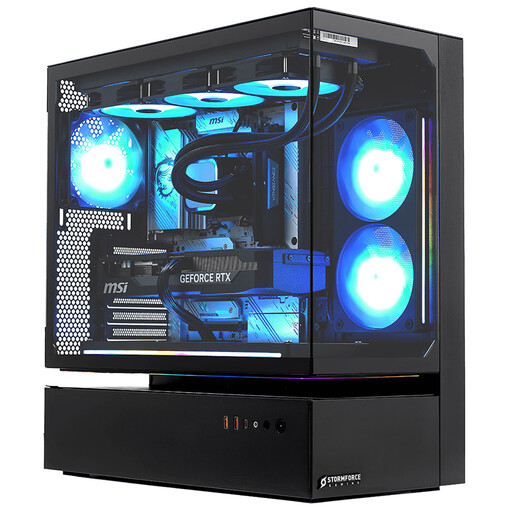
Stormforce Cyclone, Intel Core i7, RTX 5080, 32 GB RAM
The listed memory makes this a configuration to assess for 3D tile creation; verify the RTX 5080 and planned driver against the Blender rendering path you will use.
- 32 GB RAM; RTX 5080 graphics.
- 2 TB SSD; Windows 11.
- Check where the tower will sit and whether cables reach at standing height.
Joybuy
 No image available
Stormforce Defiance, Ryzen 7 5700X, RTX 5070, 32 GB RAM
For a Blender-based tile workflow, compare its listed memory with your project needs and confirm GPU and driver support before relying on GPU rendering.
- 32 GB RAM; RTX 5070 graphics.
- 2 TB SSD; Windows 11.
- Plan tower placement and cable reach for the raised desk.
Joybuy
 No image available
Stormforce Cyclone, AMD Ryzen 7, RTX 5080, 32 GB RAM
This is another configuration to consider when tiles involve 3D assets; confirm that its exact graphics setup supports your chosen Blender rendering method.
- 32 GB RAM; RTX 5080 graphics.
- 2 TB SSD.
- Check tower clearance and cable slack through the desk’s height range.
Joybuy
 No image available
CyberPowerPC JOYB1010, Core Ultra 7 265KF, GeForce RTX 5070, black
If you create 3D tiles in Blender, check this configuration against your rendering path and driver requirements as well as your storage needs.
- 32 GB DDR5 RAM; NVIDIA GeForce RTX 5070 with 12 GB graphics memory.
- 1 TB NVMe SSD; Windows 11 Home.
- Allow space for games and project files, and check the standing-desk cable route.
Joybuy
Questions about tile-set PCs
Do pixel-art tile sets require a powerful gaming GPU?
Not solely because they are pixel art. Igara Studio documents Aseprite for 2D sprites, animation and sprite-sheet export; the Blender Foundation’s higher graphics-memory recommendation relates to Blender’s 3D workflow. Check the applications you actually use before choosing graphics hardware.
What should I check for 3D tiles made in Blender?
Use the Blender Foundation’s Windows recommendation of an 8-core CPU, 32 GB RAM and 8 GB graphics memory as a software-specific checkpoint. For GPU rendering, also check the exact graphics card and driver against the CUDA, OptiX, HIP or oneAPI path you intend to use.
How should I check a PC setup at standing height?
Check the screen and input-device positions with the desk fully raised, as well as the route and slack of cables to the tower. The Health and Safety Executive advises approximately horizontal forearms and eyes at the same height as the top of the screen; measure your own setup before deciding whether its stands or cable arrangement need changing.
What should I do with an old PC when upgrading?
Look for an appropriate reuse or electrical-equipment recycling route rather than putting the PC in general waste. UK government guidance describes the waste electrical and electronic equipment framework as encouraging recovery, reuse and recycling; check current local collection and retailer take-back arrangements.


