UI designers who also game
If you use Figma, browser-based collaboration tools and PC games on one Windows desktop, distinguish what your design work needs from what your games demand of the graphics card.


Choose the desktop around the games and other demanding applications you actually use, rather than buying a high-end graphics card solely for Figma: Figma says its WebGL-based rendering has very low graphical requirements. At a standing desk, the tower must also fit without compromising the screen, keyboard or cable arrangement; the Health and Safety Executive recommends a screen with its top at eye level and a keyboard just below elbow height.
If you use Figma, browser-based collaboration tools and PC games on one Windows desktop, distinguish what your design work needs from what your games demand of the graphics card.
If desk space is tight or the work surface moves between sitting and standing heights, plan the screen, keyboard, tower and cables together. The Health and Safety Executive’s workstation guidance makes display and input-device positioning part of that decision.
If you also run GPU-intensive applications beyond browser-based UI design, a higher-specification tower may be worth considering—but only alongside the space it needs at your workstation.
Start with the space available at the moving desk and your actual software and gaming workload. Then compare complete desktop configurations rather than relying on a product-family name.
Consider when: The tower needs to share a restricted work area with displays and input devices; HP positions its OMEN 16L as a compact option.
Check: Compact branding alone does not establish the dimensions, ports or upgrade options of the configuration you choose.
Consider when: You regularly combine design files, browser tabs, collaboration tools and games; HP lists an OMEN 35L configuration with 32 GB of memory and an RTX 5070 12 GB graphics card.
Allow for: A tower still needs its own position, and similarly named configurations can differ in memory, graphics and storage.
Consider when: Your games or additional local GPU-intensive work justify the components, rather than Figma use alone.
Allow for: Clearance can become decisive: ASUS lists the ROG G700 in a 58 L chassis, which needs measuring against the intended desk position.
| Concern | What to check | Who this matters to |
|---|---|---|
| Design work and multitasking | Compare the exact memory and storage configuration with the design files, browser tabs and other applications you keep open together. | If I work across design files, browser tabs and collaboration tools, I want a configuration chosen for that combined workload. Around 31% of consumers put multitasking first. |
| Standing-desk fit | Measure tower clearance and the cable travel needed across the desk’s full height range; check that the screen and keyboard can be positioned comfortably. | When my desk moves, I need room for the tower and a cable route that does not interfere with the screen or keyboard. For around 25% of consumers, workstation fit is the primary concern. |
| Gaming performance | Identify your games, resolution and refresh-rate target before comparing graphics-card configurations and display connections. | If my games are the demanding part of the setup, I want to choose graphics hardware around those games, not around Figma alone. Gaming is the first priority for around 25% of consumers. |
| Capacity and connections | Check storage, display outputs, USB ports and supported upgrade options for the exact configuration. | With games and local design assets on one PC, I need enough storage and connections for the devices I plan to use. Around 19% of consumers make capacity and connectivity their leading concern. |
Figma says its WebGL rendering has very low graphical requirements and does not restrict use to particular graphics cards. A demanding graphics configuration is therefore not a requirement of basic Figma use.
Choose the graphics tier against your games and any other local GPU-intensive applications.
A tower can take up space needed for displays and input devices, while an alternative position still needs a workable cable route as the desk rises and falls.
Measure the desk, tower position and cable run at both ends of its height range before ordering.
Depending on the arrangement, completing the setup may also call for longer cables, cable management or a different monitor position.
HP lists OMEN desktops with different memory and graphics configurations, so the family name alone cannot tell you what a particular PC contains.
Compare the complete configuration, including processor, memory, storage, graphics, ports and dimensions, before choosing a model.
HP’s UK OMEN desktop range offers compact OMEN 16L, OMEN 35L and higher-specification OMEN MAX 45L configurations.
Lenovo describes the Legion Tower 5 Gen 8 (AMD) as a 26 L gaming tower with Ryzen 7000-series processors and RTX 40-series graphics options.
Dell’s cited Alienware Aurora ACT1250 configuration is a gaming-desktop option with 32 GB DDR5 memory, 1 TB NVMe storage and RTX 5070 Ti 16 GB graphics.
ASUS lists a ROG G700 (2025) configuration with high-end components in a 58 L chassis.
These desktops cover different ways to combine UI-design work and gaming: several have higher-tier graphics configurations, one offers a 32 GB RTX 5070 configuration, and one is a tower-and-peripherals bundle. Check each tower and display arrangement against your standing desk before choosing.
 No image available
Consider this configuration if demanding games or other local GPU-intensive work justify its graphics card; Figma alone does not require that tier.
AMD Ryzen 7 9800X3D, NVIDIA GeForce RTX 5080 16 GB, 32 GB DDR5, 2 TB NVMe SSD and Windows 11 Home.
Plan a separate screen and input-device arrangement, and check the tower’s position and cable route at the standing desk.
 No image available
Consider this configuration if you want one desktop for concurrent design applications and games, with the graphics choice driven by what you play.
Intel Core Ultra 7 265KF, NVIDIA GeForce RTX 5070 12 GB, 32 GB DDR5, 1 TB NVMe SSD and Windows 11 Home.
Check the display connections for your planned monitors, and leave room for the tower and cables as the desk moves.
 No image available
Consider this tower if your games or other local GPU-heavy applications warrant its graphics configuration alongside UI-design work.
Intel Core i7, 32 GB RAM, 2 TB SSD, RTX 5080 and Windows 11.
Check for stable placement and adequate clearance, and confirm the display connections for your intended monitor arrangement before ordering.
 No image available
Consider this configuration when games or additional GPU-intensive work justify the graphics card as well as your concurrent design applications.
Intel Core Ultra 7 265K, 32 GB RAM, 1 TB SSD, RTX 5070 Ti and Windows 11 Home.
Confirm the connections for your monitors and check that the tower can be placed securely without obstructing the desk’s movement.
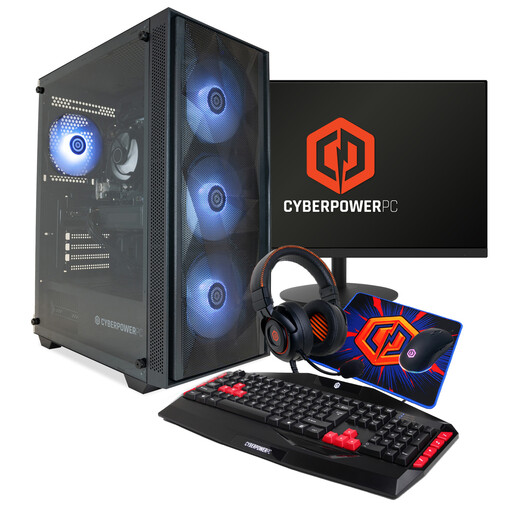 No image available
Consider this bundle if you are arranging the tower, display and input devices together for a standing desk.
AMD Ryzen 5 7500F, NVIDIA GeForce RTX 5060 8 GB, 16 GB DDR5, 1 TB NVMe SSD and Windows 11 Home; the bundle names a monitor, keyboard, mouse, headset and mousepad.
Confirm the supplied monitor’s model and adjustability so you can position its screen appropriately. Compare the 16 GB memory configuration with the applications you plan to run together.
No particular dedicated graphics card is required for Figma-based UI design: Figma says its WebGL rendering has very low graphical requirements. Choose a stronger graphics configuration if your games or other local applications call for it.
The Health and Safety Executive advises placing the top of the screen at eye level, about an arm’s length away, with the keyboard just below elbow height. Check that these positions work at the desk heights you use and that the tower does not crowd the input devices.
Choose its position after checking the tower’s dimensions against usable desk space, desk load limits, ventilation clearance and cable travel through the full height range. A larger tower may need a different position from a compact desktop; neither placement suits every setup.
The Health and Safety Executive says employers must assess workstations when workers use display screen equipment daily as a normal part of work for continuous periods of an hour or more. Its guidance also calls for reassessment when the workstation or its use changes, which matters if an employer-provided setup is rearranged around a standing desk.