Game-and-music learners
If you want one PC for games and learning virtual instruments, compare its CPU, RAM and storage with your music software's requirements, then assess its graphics against the games and monitor you will use.


For a Windows PC used to learn virtual instruments and play games, start with the processor, memory, SSD and a supported audio setup, then choose graphics for your games and single monitor. Ableton recommends at least 16 GB of RAM for its Live-oriented computer specification; larger instrument projects may call for more memory and storage, while responsive playing also depends on the audio driver and buffer settings.
If you want one PC for games and learning virtual instruments, compare its CPU, RAM and storage with your music software's requirements, then assess its graphics against the games and monitor you will use.
If you play a MIDI keyboard or record an instrument in real time, the audio interface, its Windows driver and the buffer setting deserve attention alongside the PC. Ableton explains that smaller buffers reduce latency but increase CPU load.
If you expect to add instruments, samples and plug-ins as you learn, check memory and SSD headroom against those plans. Ableton's computer guidance treats project size and plug-in use as relevant to hardware choice.
Decide whether responsive playing, a balance between games and music, or room for larger projects matters most when those needs compete. Then check the exact games, software, audio equipment and monitor against the configuration you intend to buy.
| Concern | What to check | Who this matters to |
|---|---|---|
| Responsive playing | Check that your intended audio interface has a supported Windows driver with native ASIO support and a suitable connection on the PC. Ableton notes that lowering the audio buffer reduces latency but raises CPU load. | If I play or record in real time, I need the sound to respond without disruptive delay or dropouts; roughly 36% of consumers would put responsive playing first. |
| Games and music on one PC | Compare CPU, installed RAM and SSD capacity with your DAW's requirements, and choose graphics for your games at the monitor's native resolution. | When I use the same computer for games and lessons, I need neither activity to dictate the whole configuration; around 36% of consumers would prioritise that balance. |
| Room for larger projects | Check installed RAM, SSD capacity and available upgrade options against the libraries and projects you plan to use. Ableton recommends 16 GB or more RAM; 32 GB is a choice to assess against your own workload, not a universal requirement. | If I expect to add substantial sample content and plug-ins, I need space for that growth without choosing by GPU name alone; roughly 28% of consumers would make expansion their primary concern. |
A gaming GPU should be judged against your games and monitor. Ableton's recommended computer guidance also gives CPU, RAM and storage a direct role in choosing a system for Live; it does not make a high-tier gaming GPU a baseline audio requirement.
Set a graphics target from the games you intend to play, then compare the remaining CPU, memory, SSD and audio setup rather than assuming the GPU settles both uses.
Ableton lists 8 GB RAM in Live's minimum requirements but recommends 16 GB or more in its computer specification guidance. A minimum for running software does not describe the headroom your planned games and instrument projects need.
Use 16 GB as an Ableton-oriented starting point for a new dual-purpose PC, and assess additional memory against the instruments and project sizes you expect to use.
On Windows, Ableton recommends ASIO audio drivers for lower buffer settings. Lower buffers can make playing feel more immediate, but they also increase CPU load.
Identify your intended interface and check its current Windows and native ASIO-driver support before ordering. Adjust buffer settings once the complete setup is in place.
Allow time to set up the interface driver and find a buffer setting that works with your projects.
Microsoft states that Windows 10 support ended on 14 October 2025. Ableton's recommended specification points to a current, updated Windows 11 installation.
Check the PC's supplied Windows version and the compatibility of your DAW, plug-ins and audio-interface driver before committing to a configuration.
These custom-system builders offer routes worth comparing if a fixed gaming configuration does not suit your intended music setup. Check the components and compatibility of an individual build rather than relying on the builder's wider range.
PCSpecialist offers gaming-PC and pro-audio configuration routes for shoppers who want to specify the component mix.
Scan 3XS offers gaming systems and a separate pro-audio workstation route, relevant if recording responsiveness or quiet operation is a priority.
Chillblast offers configurable gaming PCs and workstations for shoppers who want to adjust a build around both activities.
These gaming desktops and one gaming laptop are options to compare for games and virtual-instrument learning with one monitor. Match their listed memory, storage and graphics to your plans, and check the audio interface and display connections your setup needs.
 No image available
Consider this laptop if you want a gaming computer with its own display while planning a single-monitor learning setup.
The listed configuration has 16 GB RAM, a 1 TB SSD and a 15.6-inch 144 Hz FHD display. Check its connections against your intended monitor and audio interface, and whether its memory capacity suits your planned instruments.
 No image available
Consider this desktop if your game requirements and planned music projects warrant assessing a configuration with substantial listed memory and storage.
It is listed with 32 GB DDR5 RAM, a 2 TB NVMe SSD, a GeForce RTX 5080 16 GB and Windows 11 Home. Check the graphics against your games and monitor; the monitor is not included, and your intended audio-interface connection and driver need checking separately.
 No image available
Consider this tower if you want to compare a gaming desktop with 32 GB of memory against the demands of your planned instrument projects.
Its listed configuration includes 32 GB RAM, a 2 TB SSD, RTX 5080 graphics and Windows 11. The monitor is not included; check display connections, game requirements and your intended audio interface before choosing it.
 No image available
Consider this desktop if its memory and storage suit your project plans and its graphics suit the games you intend to play.
It is listed with 32 GB RAM, a 2 TB SSD and Windows 11. Confirm what is supplied for your single-monitor setup, along with the display connection and the Windows driver for your intended audio interface.
 No image available
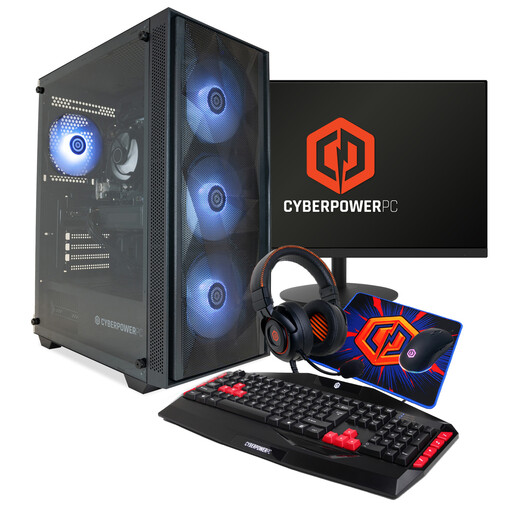
Consider this bundle if you also need a monitor and basic peripherals for a single-display desk setup.
The listed PC has a Ryzen 5 7500F, 16 GB DDR5 RAM, a 1 TB NVMe SSD, GeForce RTX 5060 8 GB graphics and Windows 11 Home; the bundle also names a keyboard, mouse, headset and mousepad. Confirm the included monitor's exact model, resolution, refresh rate and connectors, and check your intended audio interface's driver support.
For Ableton Live-oriented use, start by comparing PCs with Ableton's recommended 6- to 12-core Intel Core i7/i9 or AMD Ryzen 7/9 class processor, at least 16 GB RAM and a 500 GB–2 TB NVMe or high-speed SSD. Check your actual DAW, instruments, games and project sizes before settling on capacities or a graphics card.
Do not choose a high-tier GPU solely for virtual instruments: Ableton lists a dedicated GPU as optional for video work in its computer guidance. Select graphics against the games, native resolution and refresh rate of your monitor, and check any separate graphics requirements of your chosen software.
An audio interface matters particularly when you need to connect and record instruments or want to play and monitor with lower latency. For Windows use, check that the intended interface has a supported native ASIO driver; Ableton notes that reducing its buffer setting lowers latency while increasing CPU load.
Match your monitor's input and native resolution to the exact PC's graphics outputs, and assess its refresh rate against the games you intend to play. Ableton recommends a display of at least 1920 × 1080 for Live and advises Windows scaling at 100% or whole 50% increments where plug-in interface scaling causes problems.
Check the retailer's electrical-equipment take-back arrangements and your local recycling options rather than putting the desktop in general waste. GOV.UK describes waste electrical and electronic equipment rules intended to support recovery, reuse and recycling.