What to check before choosing
Start with the software and headphone-monitoring setup you intend to use, then match the PC to your project size and gaming targets. The concerns below describe different primary needs among consumers choosing a gaming PC for this purpose.
| Concern |
What to check |
Who this matters to |
| Responsive headphone practice |
Check Windows support for your DAW and the availability of a current ASIO driver for your planned audio interface. Confirm its headphone connection. |
When I press a MIDI key, I want to hear the instrument promptly without crackles. Around 33% of consumers put responsive practice and monitoring first. |
| Room for larger projects |
Compare your instruments’ requirements with the PC’s processor, installed RAM and SSD capacity; check upgrade options if your library is likely to grow. |
Adding sampled instruments and plug-ins means I need capacity beyond a small starting project. For around 27% of consumers, project growth is the primary concern. |
| Gaming and music balance |
Set a target for the games, resolution and graphics settings you want, then check the same configuration’s processor, RAM and SSD for music work. |
I want my games to run at my chosen settings without overlooking what my music software needs. Around 20% of consumers place that balance first. |
| Connections and software support |
Confirm support for your Windows version, DAW, plug-ins, audio-interface driver and MIDI controller, as well as the USB connections they need. |
Before setting everything up, I want to know that my controller and audio equipment can connect and use supported drivers. That is the leading need for around 20% of consumers. |
Relevant brands to consider
These gaming-desktop ranges offer starting points for comparing exact configurations; a brand name alone does not establish suitability for your instruments or audio equipment.
Lenovo Legion
Legion Tower is Lenovo’s gaming-desktop range for consumers considering a conventional tower.
- Lenovo describes upgradeable memory and storage across the Legion Tower range.
- Check the upgrade options, processor, installed memory, storage and connections of the exact configuration; range-level descriptions do not establish them for every tower.
ASUS ROG
ASUS ROG includes gaming desktops in different form factors, making the exact model important when space and expansion matter.
- ASUS describes cooling designs and upgradeability within its desktop range.
- Check the selected model’s physical size and expansion options rather than assuming a compact system has the same options as a larger tower.
Alienware
Dell’s Alienware desktop range includes configurations aimed at demanding gaming workloads.
- Dell lists configurations with high-end processor and graphics options.
- Choose those components against your games and music software separately; a higher graphics tier does not, by itself, address headphone latency.
Joybuy gaming desktops
These Windows gaming desktops include configurations with different memory and storage capacities for learning virtual instruments alongside gaming. Compare their stated specifications with your chosen software, and check your intended audio interface, driver and headphone connections separately.
 No image available
CyberPowerPC JOYB1013 Ryzen 7 9800X3D, RTX 5080, 32GB, 2TB
Consider this configuration if you need space for a growing instrument library as well as a gaming desktop.
- AMD Ryzen 7 9800X3D; 32GB DDR5; 2TB NVMe SSD.
- NVIDIA GeForce RTX 5080 16GB; Windows 11 Home.
- The desktop is supplied without a monitor or peripherals. Check the connections and driver support for your intended headphone setup.
View on Joybuy
 No image available
Stormforce Cyclone Core i7, RTX 5080, 32GB, 2TB
The stated memory and SSD capacity make this a configuration to compare if you expect to build larger instrument libraries.
- Intel Core i7; 32GB RAM; 2TB SSD; RTX 5080; Windows 11.
- The tower is listed at 22kg, so plan a stable, ventilated position.
- It has a headphone jack; check support for any separate audio interface and ASIO driver you intend to use.
View on Joybuy
 No image available
CyberPowerPC JOYB1010 Core Ultra 7 265KF, RTX 5070, 32GB, 1TB
Compare this tower if gaming and virtual-instrument projects will share the same PC.
- Intel Core Ultra 7 265KF; 32GB DDR5; 1TB NVMe SSD.
- NVIDIA GeForce RTX 5070 12GB; Windows 11 Home.
- A monitor, keyboard, mouse and headset are not included. Check the connections needed for your planned audio interface and headphones.
View on Joybuy
 No image available
Lenovo Legion T7 34IAS10 Core Ultra 7 265K, RTX 5070 Ti, 32GB, 1TB
Consider this gaming tower alongside your intended DAW’s requirements if you also plan to add instruments and plug-ins.
- Intel Core Ultra 7 265K; 32GB RAM; 1TB SSD.
- RTX 5070 Ti; Windows 11 Home.
- A headphone/microphone combo port is listed. Check compatibility with any separate audio interface and ASIO driver you intend to use.
View on Joybuy
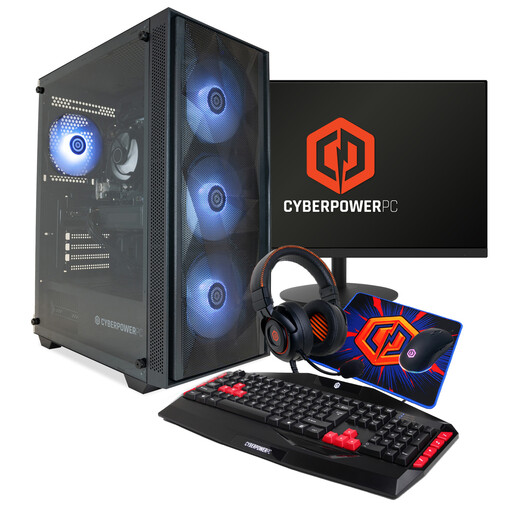 No image available
CyberPowerPC JOYB1004 Ryzen 5 7500F, RTX 5060 monitor and headset bundle
This bundle is worth checking if you want a gaming desktop supplied with a monitor and headset for a new setup.
- AMD Ryzen 5 7500F; NVIDIA GeForce RTX 5060 8GB; 16GB DDR5; 1TB NVMe SSD; Windows 11 Home.
- The bundle includes a monitor, keyboard, mouse, headset and mousepad.
- The headset specification may vary. Check its connector against your monitoring plans and confirm support for any separate audio interface and ASIO driver.
View on Joybuy
Frequently asked questions
Do virtual instruments need a high-end gaming graphics card?
Not for audio processing alone. Ableton’s computer guidance focuses on processor, memory and storage requirements and lists dedicated graphics as optional for video work. Choose graphics capability for the games, resolution and settings you intend to use.
Can I begin practising through the PC’s headphone jack?
You can try built-in audio, but check whether it gives you stable, responsive playing in your chosen DAW. If you use a compatible Focusrite interface, Focusrite recommends connecting headphones to the interface outputs rather than the PC’s internal output; check the guidance for the particular equipment you choose.
What buffer setting should I use when playing virtual instruments?
Use the lowest setting that remains stable in your actual project. Ableton advises increasing the buffer until crackles and dropouts stop, noting that a larger buffer also increases latency.
Which Windows and software requirements should I check?
Check the requirements of your exact DAW, virtual instruments and audio-interface driver against the PC’s processor, memory and Windows version. For example, Ableton specifies an AVX2-capable processor in its Live requirements; if you plan to use Windows 11, check Microsoft’s requirements for that operating system separately.
How can I manage headphone volume during long practice sessions?
Keep the volume comfortable and take listening breaks. The World Health Organization states that hearing-loss risk rises with louder sound and longer exposure; use a device’s exposure-monitoring features where available.


