Couch-battle hosts
If several people follow separate areas of one screen, you need a size that works from the seats they actually use. Which? advises measuring from the sofa to the proposed TV position before choosing a screen size.


For local console arena battles, measure the sofa-to-screen distance before choosing a screen size, then check that the intended HDMI connection supports 4K/120Hz, variable refresh rate (VRR) and Auto Low Latency Mode (ALLM) with your equipment. A 165Hz specification matters chiefly if you also use a compatible gaming PC and game; if you have a soundbar or AV receiver, plan its audio connection alongside the gaming devices.
If several people follow separate areas of one screen, you need a size that works from the seats they actually use. Which? advises measuring from the sofa to the proposed TV position before choosing a screen size.
If you switch between a console and a gaming PC, check which refresh-rate modes each source can use. LG and Samsung describe 165Hz capabilities for specific TVs, while Samsung says 4K/165Hz requires a compatible PC game and graphics hardware.
If a soundbar or AV receiver shares the TV with consoles and other devices, count the available connections as well as the gaming features. Which? explains the role of ARC and eARC in connecting cinema audio equipment.
For shared arena play, settle the screen’s fit in the room, the gaming signal path and the audio-device connections before comparing headline refresh rates.
| Concern | What to check | Who this matters to |
|---|---|---|
| Shared viewing and room fit | Measure the sofa-to-screen distance and check the TV’s overall dimensions, stand footprint or mounting requirements. Which? recommends starting with the actual viewing distance. | If several players must follow different parts of the screen, I need a size everyone can watch comfortably from our seats. Around 42% of consumers put shared viewing and room fit first. |
| Responsive gaming | Check 4K/120Hz, VRR and ALLM on the intended HDMI input, then check the source and cable. Sony’s setup guidance notes that 4K/120Hz can require the appropriate HDMI setting. | When quick local matches are the priority, I want to know that my console or PC can use the TV’s gaming connection as intended. For around 33% of consumers, responsive play is the primary concern. |
| Cinema audio and devices | Count your HDMI devices and identify the ARC or eARC audio connection. Port capabilities can differ: Sony specifies VRR on HDMI 3 and 4 of the K-65XR8M2. | With a soundbar or receiver already in the room, I need a connection plan that leaves a suitable input for gaming. Cinema-system integration comes first for around 25% of consumers. |
A 165Hz label does not mean every console or PC game can use that mode. Samsung says 4K/165Hz requires a compatible PC game and graphics hardware.
For console play, check the intended port’s 4K/120Hz, VRR and ALLM capabilities first. Assess 165Hz against the PC and games you will actually connect.
A soundbar or receiver needs a place in the connection plan, and gaming features need not be available on every socket. Sony, for example, specifies VRR on HDMI 3 and 4 of the K-65XR8M2.
List the console, audio equipment and other sources, then check the exact TV’s port map and ARC or eARC connection before ordering.
Shared-game readability depends on where people sit, while the TV’s full dimensions determine whether it fits the intended furniture or wall.
Measure the viewing distance and installation space. Which? recommends measuring from the sofa to the TV position before selecting a size.
Gaming specifications alone do not describe a television’s electricity use or how an old set will be removed.
Compare the exact models’ energy information and ask the seller how its old-TV take-back arrangement works. GOV.UK identifies televisions as covered electronic displays and sets out retailer responsibilities for taking back waste equipment of the same type.
These model-specific examples illustrate different checks for a cinema room; a brand name alone does not establish which TV suits your connections or seating position.
LG’s 65-inch OLED evo AI G6, model OLED65G66LS, is an OLED option for a room used for both films and PC gaming.
Samsung describes its 65-inch OLED S95F, model QE65S95FATXXU, as a Glare Free option for rooms where reflections matter.
Sony’s 65-inch BRAVIA 8 II K-65XR8M2 is an OLED option to assess for a console and separate cinema-audio setup.
These TVs offer different screen sizes and display types for a shared gaming and home-cinema room. Choose a size for your measured space, then confirm the exact gaming modes and audio connections needed by your equipment.
 No image available
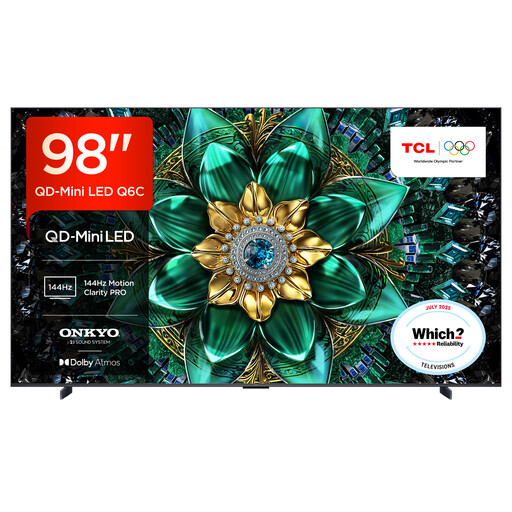
Consider this for shared viewing only if a 98-inch screen fits your seating distance and installation space.
The product title specifies a 144Hz native refresh rate, up to 512 dimming zones and an ONKYO 2.1 sound system. Confirm the supported 4K/120Hz HDMI mode and intended console port before buying.
 No image available
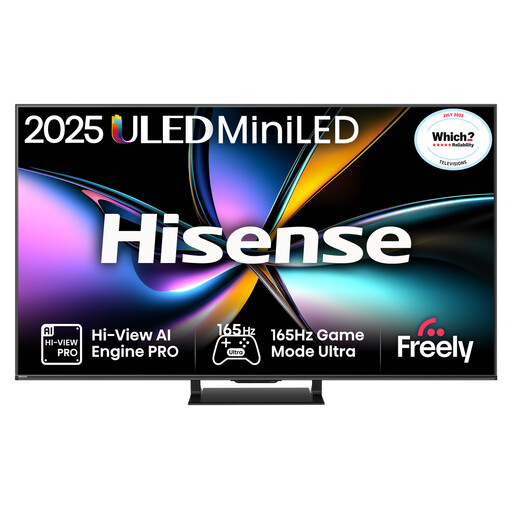
This is a 65-inch option to assess if that size works for the players’ seats and the room.
The title names a 165Hz Game Mode Ultra and a built-in subwoofer; that mode name alone does not establish which signal your equipment can deliver. Check the exact HDMI gaming modes, installation dimensions and sound-system connection.
 No image available
Consider the 55-inch variant when that screen size suits your seating arrangement better than the larger U7Q Pro.
Its title names a 165Hz Game Mode Ultra and a built-in subwoofer. Check which gaming signals your source and chosen HDMI port can use, along with the TV’s physical dimensions and audio connections.
 No image available
This 55-inch OLED is an option if that size suits both shared play and film viewing in your room.
Check the exact 4K/120Hz input path for your gaming source and the set’s physical dimensions before ordering. The S90F is a different model from the S95F discussed above.
 No image available
Assess this model against your seating distance and the connections needed for local play.
Its title specifies an ONKYO 2.1 sound system, Miracast and Google Cast. The named 288Hz Game Accelerator does not, by itself, establish the TV’s native refresh rate or a supported 4K/120Hz input path; check the gaming signal modes and audio connection you intend to use.
No: start by checking whether your console and intended TV input can use 4K/120Hz, VRR and ALLM. Samsung says 4K/165Hz modes require a compatible PC-connected game and graphics hardware, so the higher figure is chiefly relevant if you also play on a suitable PC.
Choose the console input after identifying the ARC or eARC connection for your audio equipment and counting your other HDMI devices. Check the exact model’s port map: Sony specifies VRR on HDMI 3 and 4 of the K-65XR8M2, so its sockets should not be treated as interchangeable for that feature.
Check the TV input format, console or PC output, suitable cable and VRR settings against the modes both devices support. Sony’s UK gaming guidance says 4K/120Hz may require the appropriate Enhanced Format HDMI setting.
Compare the energy information for the exact model and screen size, including the stated on-mode consumption in kWh per 1,000 hours. GOV.UK identifies televisions as electronic displays covered by energy-information rules and lists SDR consumption, with HDR information where applicable, among television label data.
Ask the seller about its take-back or collection arrangements before the new set arrives. GOV.UK states that retailers must offer take-back of waste electrical equipment of the same type as the item bought; check the practical handover arrangements for your order.