Households playing in daylight
If windows or strong room lighting are present during play, assess reflections and how the picture looks in that light before prioritising a maximum refresh-rate figure.


Choose around the room and the players before chasing the highest refresh-rate figure: daylight reflections and the view from each sofa seat can change which TV works for local co-op. Mini LED and QD-Mini LED models are worth considering when bright-room viewing is the main concern; a reflection-controlled OLED is another option if evening contrast matters too. For either route, check the chosen size in your room and map the HDMI features to your console and sound system.
If windows or strong room lighting are present during play, assess reflections and how the picture looks in that light before prioritising a maximum refresh-rate figure.
When players sit across a sofa rather than in one central seat, screen size, off-centre viewing and the position of reflected windows or lamps all affect the shared view.
If you want to use 4K at 120Hz, variable refresh rate (VRR) or auto low latency mode (ALLM) where supported, check the features assigned to the HDMI input you will actually use. PlayStation UK, Xbox Support and Sony UK provide model- or console-specific guidance.
Consider it: When daylight and strong room lighting are the main obstacles to enjoying a shared screen.
Check: Brand-stated brightness and HDR figures do not establish how a particular size handles reflections or looks from every seat.
Consider it: When evening contrast matters alongside daytime play, and the exact model has documented reflection control.
Check: Reflection treatment is model-specific; assess the chosen size and placement rather than assuming every OLED behaves like LG’s G6 or Samsung’s S90H.
For local co-op in a bright lounge, decide which of these needs would drive your purchase, then check the corresponding details on the exact TV size.
| Concern | What to check | Who this matters to |
|---|---|---|
| Daylight visibility | Look for model-specific reflection-control information and assess whether a window or lamp will face the screen. | With daylight falling across the lounge, I need every player to see past distracting reflections. Around 36% of consumers would put daylight visibility first. |
| Shared-seat comfort | Check the view from each seat, the screen size against seating distance, and the stand or mounting dimensions. | If players spread across the sofa, I want a screen and position that work beyond the centre seat. Shared viewing would be the main priority for around 29% of consumers. |
| Console connections | Check 4K120, VRR and ALLM on the intended HDMI input, including any port needed for eARC audio. | When connecting a PS5 or Xbox and a soundbar, I need a workable port plan rather than a high panel-refresh figure alone. Roughly 21% of consumers would prioritise console compatibility. |
| Size and installation fit | Compare the same screen size and measure the TV unit or wall position; check installation and collection terms if needed. | If the TV must fit existing furniture, I would rather settle the size and setup before choosing extra features. Around 14% of consumers would make practical fit their primary concern. |
A maximum panel or gaming-mode figure does not tell you what your console, game and selected HDMI input can use. PlayStation UK specifies 4K 120Hz output for PS5, while Xbox Support describes 4K gaming at 120Hz on Series X with a suitable HDMI 2.1 TV.
For a console setup, check 4K120, VRR and ALLM on the intended input. Treat refresh rates above 120Hz as a separate consideration if you also plan to connect a compatible PC.
Sony UK lists four HDMI inputs on the 65-inch BRAVIA 7, but specifies VRR on HDMI 3 and 4. Counting sockets alone would miss that distinction.
Map your console, any second device and a soundbar’s eARC connection against the exact model’s port table before ordering.
Players at opposite ends of a sofa may face different viewing angles and reflected light sources.
Check the planned seats, windows and lamps together, then measure the furniture or wall space before deciding on screen size.
Replacing a large TV also means deciding how the old one will be moved and collected; a retailer’s available services can depend on the order and address.
Check collection and recycling options for your postcode, including access arrangements and whether wall unmounting is covered.
The 65-inch OLED G6 is an OLED example to examine when you want documented reflection control alongside gaming features.
Its researched models illustrate both a Neo QLED Mini LED route and an OLED with stated glare control.
The 65-inch BRAVIA 7 is a useful model-specific example for planning console and soundbar connections.
The 65Q7C-UK provides a model-specific QD-Mini LED option to consider for a bright lounge.
These Mini LED and QD-Mini LED TVs offer different screen sizes to assess for a bright lounge and shared sofa play. Their display technology alone does not establish glare control, so check the exact model’s reflection behaviour and connections before choosing.
 No image available
Consider this 55-inch model if a Mini LED screen fits your shared seating space.
The product name specifies 4K and a 165Hz Game Mode Ultra. Check how this model handles reflections and which gaming features your console can use on the chosen input.
 No image available
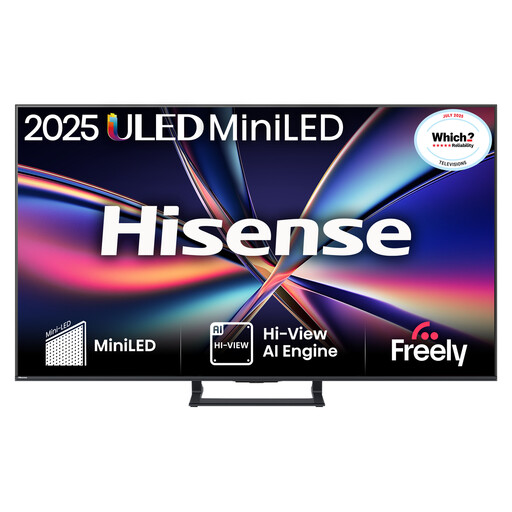
This is another 55-inch Mini LED option if that size suits the sofa and TV position.
The product name specifies 4K and a 144Hz Game Mode Pro. Check reflection handling and the HDMI features available to your console and sound system.
 No image available
Consider the 50-inch size where a larger set would be difficult to position for the group.
Its product name specifies 4K, a 144Hz native refresh rate and up to 512 dimming zones. Assess reflections and off-centre viewing in the intended layout, and confirm the HDMI port allocation.
 No image available
The 75-inch screen is worth assessing if several players need a shared view and the intended location can accommodate it.
The product name specifies 4K, a 144Hz native refresh rate and up to 2,048 local dimming zones. Measure the installation space and check reflections, off-centre viewing and the exact console-port features.
 No image available
Consider this 65-inch screen if it fits the seating layout and installation position.
The product name specifies 4K, a 144Hz native refresh rate and up to 2,048 local dimming zones. Check reflection control, the view from side seats and the model-specific HDMI port table.
Not just for that headline figure. PlayStation UK specifies 4K 120Hz output for PS5, and Xbox Support describes 4K gaming at 120Hz on Series X with a suitable HDMI 2.1 TV. Check 4K120, VRR and ALLM on the TV input you plan to use; a higher maximum refresh rate may matter separately for a compatible PC.
No—use the exact TV model’s port table. Sony UK lists four HDMI inputs on the 65-inch BRAVIA 7 but specifies VRR on HDMI 3 and 4. If a soundbar also needs eARC, plan both connections before buying.
A docked original Nintendo Switch can use TV mode, but Nintendo UK states that Switch Lite does not support TV mode. Check that your game supports the intended player count and that the console is connected to the selected HDMI input; 4K120 need not drive a purchase made solely for an original Switch setup.
Check the retailer’s old-TV collection or recycling options and your local authority’s arrangements before delivery. Confirm any collection charge, access requirements and whether the service includes removing a wall-mounted set rather than assuming collection comes with the new TV.